The upside of untidiness: why a little mess can be good for your home
If we’re to follow the philosophy of organiser extraordinaire Marie Kondo, a tidy home is a better home.
Albert Einstein, however, might have contested that point. “If a cluttered desk is a sign of a cluttered mind,” goes a quote widely attributed to the famed physicist, “of what, then, is an empty desk a sign?”
My newly published research, which studied 22 New Zealand households, also challenges the conventional wisdom that mess is a problem which must be fixed.
Far from being a symptom of poor organisation, mess can help families function and make life run more smoothly.
When mess makes life easier
Consider the spaces in our homes that serve more than one purpose, and where things tend to pile up. A living room that doubles as a play area, or a bedroom that also serves as a study.
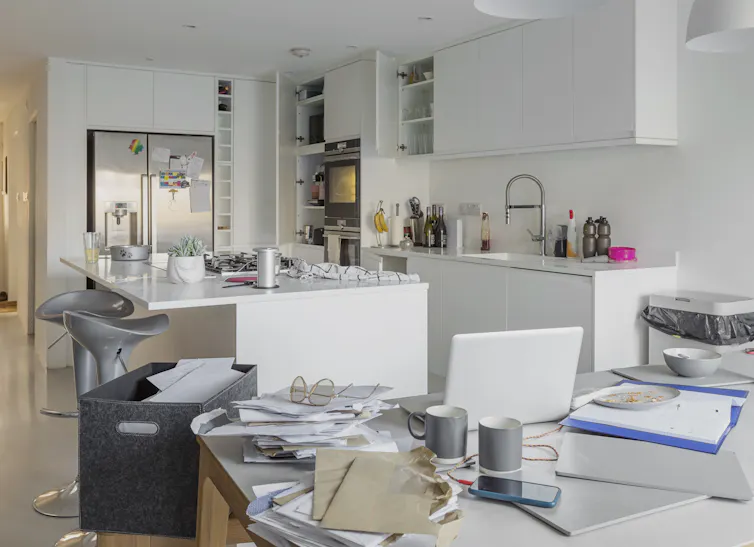
One couple told me how their dining table becomes a “drop zone” for belongings such as bags and drink bottles, before it’s cleared each evening. Another person described how leaving something on his kitchen island made him less likely to forget it when leaving the house.
Disorderly as each of those spaces might have appeared, they served daily routines which might have been disrupted for the sake of a tidier-looking home. We might think of clutter as stuff that simply gets in our way. But often, a messy space is just one that is being useful to us.
For one mum, her kitchen counter served as a dining table and a workspace for her and her daughter. Pens, toys and other items might accumulate, but “as long as there’s still space to eat, then I kind of just let it be”.
Mess can also tell us much about family relationships. One dad would leave his daughter’s jumper hanging on the back of a chair rather than pack it away. She had previously left it on the floor, and he wanted to acknowledge her progress. “So I regard that as a win,” he said.
Another person told me she put up with some of her partner’s mess because “he also lives here”. For her, a shared home should not be organised only around one person’s idea of tidiness. Leaving some things alone was a way of recognising that the space belonged to both of them.
These might be modest examples, but they show us that the seemingly simple act of tidying can run up against the encouragement we offer our children or the respect we show our partners.
When we’re making room for other people’s ways of living, putting everything in its “proper” place sometimes isn’t the most considerate thing to do.
Knowing when to tidy up
So, should we just stop tidying and embrace chaos? Not quite.
Previous research has linked household clutter to stress, embarrassment and conflict between family members. Mess can make things harder to find, prevent us from using a space or create more work for someone else.
Our study doesn’t dispute these problems. Rather, it suggests we need to look beyond how messy a space appears to understand whether that mess is actually causing difficulties.
We found households used three main approaches to managing disorder: clearing things away, tolerating them or simply hiding them from view.
One woman described pushing her partner’s golf balls and other belongings beneath a cabinet, where they were less visible. Another kept her daily supplements on the kitchen counter rather than in the pantry, because putting them away might mean she forgot to take them.
These decisions reflect something earlier research has tended to overlook: keeping a home tidy involves balancing different needs, routines and expectations. What one person regards as clutter might be important to someone else’s daily life.
Our findings also suggest tidiness is rarely a permanent state. Spaces become messy as people use them, are cleared when needed, then become messy again. Trying to maintain constant order can mean repeatedly undoing arrangements that serve a useful purpose.
This doesn’t mean all mess should be tolerated. But a home that looks perfectly organised isn’t necessarily one that works best for the people living in it. Perhaps the better measure of a well-organised home isn’t how tidy it looks, but how well it works for the people who live there.
KioskNews shows a cleaned-up reading view extracted from the publisher’s page — the original always lives on their site, not ours.