Haines tribute speeches to open parliament, but Labor mustn’t overlook broader causes of boiling anger | Josh Butler
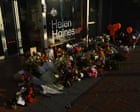
Federal parliament will commence on Monday morning with speeches paying tribute to Helen Haines. It should be a unifying, bipartisan moment for an increasingly febrile, unpleasant political bubble.
Our political representatives talk of turning down temperatures and being kinder, but the challenge is whether they will actually change their own behaviour – not just hector their opponents to do so. Already, we are seeing cracks that the parliamentary kumbaya moment will not last long, and that real contributors to the anger and dislocation present in some parts of Australia may be too hard to fix.
One immediate thread is Labor’s digital duty of care, up for debate this week. The shadow communications minister, Sarah Henderson, claimed the government was “using this horrific attack” on Haines to push its reforms – a charge Labor denies.
The alleged attack on Haines has ripped open a much wider examination of safety and security for MPs and political staff, particularly women, and in relation to online abuse. This is an overdue discussion; stomach-churning reports aired last week, often kept private by MPs, include MPs being mailed human faeces, forced to move house, and Tanya Plibersek revealing “regular” rape threats.
Monday morning will see Anthony Albanese give a tribute speech in parliament, expected to be followed by many fellow MPs. There is discussion inside government about immediate safety improvements for MPs, and a broader project on national civility and respect; not just for politicians but retail workers, emergency services, nurses and more. Expect that to percolate over coming weeks. But senior Labor ministers pointed to the DDOC as one piece of the puzzle.
On ABC radio last week, Hamish Macdonald asked Albanese “what’s the answer?” to address such vile online abuse.
Albanese said the government tried “a range of measures” including “a very modest digital duty of care legislation before the parliament. We’ll wait and see whether it receives support.”
The housing minister, Clare O’Neil, told Radio National there “has to be a reckoning” about anger online, calling out “companies making billions of dollars off making Australians angry and disrespectful”. She didn’t mention digital duty of care specifically, but touched on some of its main aims.
The communications minister, Anika Wells, wouldn’t draw specific links between social media or DDOC and the alleged attack on Haines, but last week called for “an honest conversation about the broader online environment we are living in”, saying platforms should “redesign” products.
Henderson, who wants DDOC be dumped entirely and said the Coalition wouldn’t negotiate, was unhappy.
“It is inappropriate to be speculating about any causal link between Helen Haines’ alleged attacker and social media which is a matter for the courts,” she told Guardian Australia.
“I regret the government appears to be using this horrific attack to support its flawed policy agenda … More action is required to keep Australians safe online but Labor’s digital duty of care is a dangerous step in the wrong direction.”
Nationals MP Sam Birrell, a fellow regional Victorian who is close to Haines, told me he would be “be disappointed if people use this tragedy to make a political point” about DDOC.
The government rejected such assertions. Wells’ office said the duty of care would “mitigate harm before it occurs”, and update existing industry codes.
“The codes and standards are a complex, patchwork approach that any parent or person who has been harmed online will tell you is not working,” a spokesperson said.
Wells, among the youngest cabinet ministers in history, has become a target for ridicule and anger from conservative opponents, accused of an “Orwellian” system of “censorship” – charges she strongly denied.
Is that the kind of rhetoric Albanese means when he calls to “turn down the temperature”?
Speaking to numerous MPs across the political divide, common phrases included talk of “disagreeing better”, “improving the tone”, “rising to the occasion”.
Most agreed standards had to improve. But few were confident that would happen.
Crossbenchers have long raised alarm about the venomous nature of question time, calling for more civil discourse. Monique Ryan told me last week: “If that doesn’t happen now, I’m terribly concerned it never will.”
One Labor MP said the government genuinely wanted things toned down, but conceded “it’s hard to legislate courtesy”.
“You’d hope this would be a week of reflection for people who inflame tensions,” they said.
Another Coalition MP, however, said they didn’t want question time changes.
“I don’t want it vanilla. I like it robust, it’s important,” they said.
How the parliament and government will respond to the alleged Haines attack remains unclear. Police have declined to speculate on the motivations of Haines’ alleged attacker. But experts say a more holistic look at social factors causing dislocation and stress must be part of any political response.
Debra Smith, professor of political science at Victoria University who focuses on violent political extremism, said “grievance-fuelled” violence can develop through mental health issues, but also alongside general feelings of social instability or a deterioration of living conditions.
Respected mental health expert Prof Patrick McGorry wrote online the surge in abuse of MPs was connected to “the threadbare state of state mental health systems which must be completely rebuilt”, adding “we can’t jail this away”.
These expert analyses raise wicked problems for any government to fix.
Labor’s modus operandi of telling Australians that things are going well, of spin such as workers’ share of GDP is growing or that the Reserve Bank card changes could make your coffee cheaper, is clearly no longer cutting it and being tuned out by struggling Australians – see the surge to One Nation.
A fifth interest rate rise is on the cards next month as the Reserve Bank struggles to lower inflation, and Jim Chalmers is preparing for a worse budget and higher unemployment.
Will any of these lighten the mood for Australians? What about unleaded petrol at a national average of $2.42 a litre, jacking up prices for everything with Christmas on the way?
David Pocock gave a shocking window into everyday struggles at the National Press Club, recounting a story of a woman sobbing in his office, so destitute on the miserable jobseeker allowance that she ate a neighbour’s dog food because she hadn’t eaten meat in so long.
Not every Australian experiencing mental health issues, poverty or mortgage issues will turn to violence, as the Australian federal police commissioner, Krissy Barrett, said on Insiders on Sunday. But the government cannot ignore key reasons contributing to Australians feeling sadder, angrier and more desperate.
KioskNews shows a cleaned-up reading view extracted from the publisher’s page — the original always lives on their site, not ours.