Vodka, gold and guns: How Russia’s Wagner Group is expanding its grip on Central African Republic
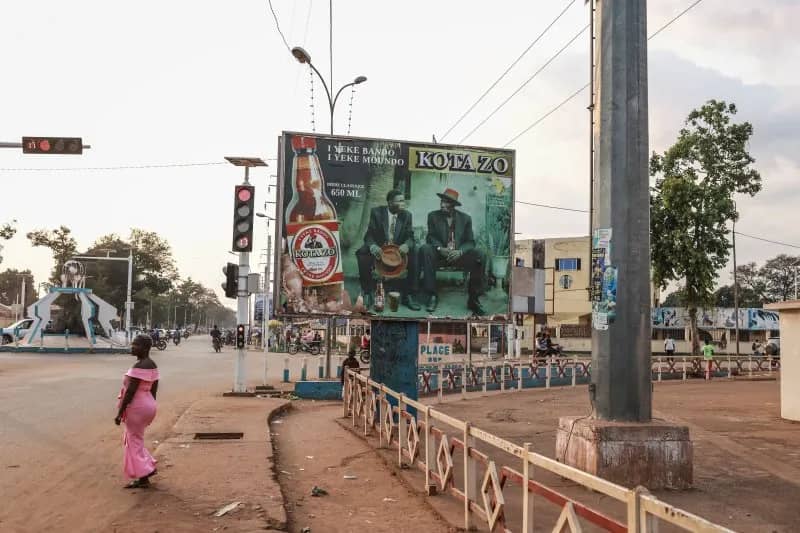
General view of an advert for Kotazo, a local beer, in the city of Bangui in the Central African Republic, on November 8, 2026. — AFP pic
BANGUI (Central African Republic), Nov 28 — With a vodka or a beer in hand, young Central Africans watch a football match in “Moscow”, a Russian-run bar in the capital, Bangui.
On some bottles is printed “Made in the Central African Republic with Russian technology” in Sango, one of the country’s two official languages.
The Central African Republic is one of the world’s poorest countries and the last bastion of the Russian paramilitary Wagner Group once led by the late Yevgeny Prigozhin.
Elsewhere on the continent, it is gradually being replaced by the Africa Corps, which reports directly to the defence ministry in Moscow.
On the streets of Bangui, it is not uncommon to come across Russians in uniforms, their faces hidden and with weapons on their belts.
Outside restaurants and supermarkets, their camouflaged vehicles stand out and are so recognisable that all cars stop quickly to give way to them.
Sachets of vodka
Deployed in 2018 at the request of President Faustin-Archange Touadéra to support the Central African army, Wagner fighters have become the government’s main security partners in exchange for lucrative contracts in the gold and diamond sectors.
The group is now diversifying and strengthening its presence by establishing itself in drinks manufacturing and distribution.
Russian water, soda, beer and vodka are made locally and sold at significantly lower prices than those of the competition.
Street vendors even sell 50-millilitre sachets of coconut-flavoured vodka for 150 CFA francs (RM1.03).
“They seek to conquer the smallest possible spaces. They are the only competitors of the Castel group,” Central African researcher Soleil-Parfait Kalessopo told AFP.
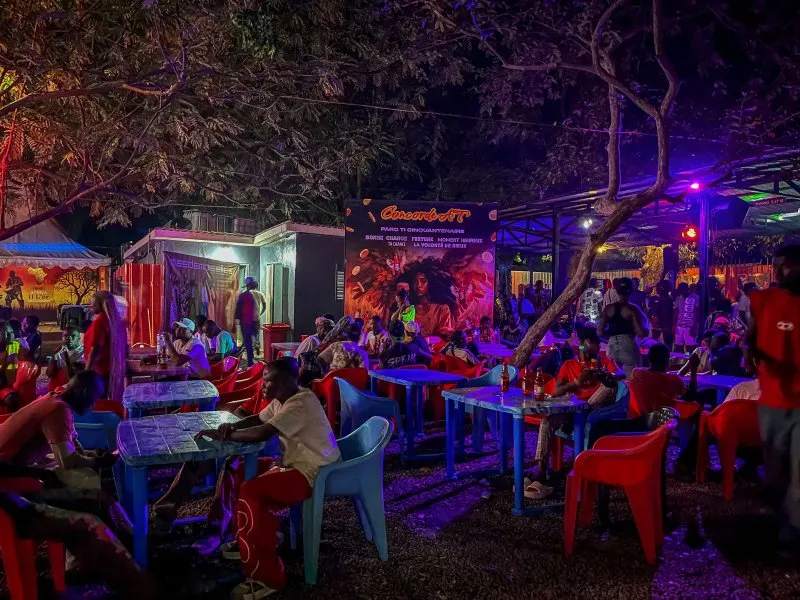
Right in the downtown area of the capital, the Concorde AT bar, known as ‘Moscow,’ serves only alcohol produced by the Russians: 65 cl plastic-bottled beers, flavored vodkas, and Bamara bearing this inscription in Sango: ‘Made in the Central African Republic with Russian technology.’ — AFP picOn the streets, it’s not unusual to come across men from the Russian paramilitary group Wagner in military uniforms, faces covered, weapons at their hips. In restaurants as in supermarkets, they’re immediately recognized by their vehicles, whose camouflage is so distinctive that every car brakes to a halt when they drive by. (Photo by Daniel BELOUMOU OLOMO / AFP)
The Mocaf brewery, a subsidiary of the French group Castel, has been in the Central African Republic since 1953, and had a monopoly on the alcohol market before the Russians arrived.
Castel did not provide any figures on its production in the country when asked by AFP.
In March 2023, one of its factories was set on fire by four masked men dressed like Wagner mercenaries, according to security camera footage, which showed them throwing Molotov cocktails.
“The events of 2023 are now behind us,” the Castel group said, when asked about its performance since the arrival of Russian competitors.
At the head of the First Industrial Company, which markets drinks produced by the Russians, is Dmitry Sytyi, according to Jeune Afrique magazine.
Sytyi is also director of the Russian House in Bangui, and is described by the All Eyes on Wagner collective as “one of the pillars of the Wagner network” in Central Africa.
‘Danger for democracy’
The Russian House, opened in 2021, offers many free cultural and sporting activities to people in Bangui, as well as Russian language lessons.
Every afternoon, children play on the roundabout, trampolines and swings in the garden to the sound of a promotional video for Russia.
In front of the cultural centre, along the Ubangi river, stands a statue of Prigozhin, who was killed when a private plane crashed in 2023, two months after his aborted mutiny in Russia.
Another symbol of the Russian presence is a fresco at a market showing President Vladimir Putin shaking hands with Touadéra.
Most Central Africans appear to fear the Russians, refusing to mention their existence for fear of reprisals.
“They have methods of repression, of operating, which really terrorise the population,” said Kalessopo.
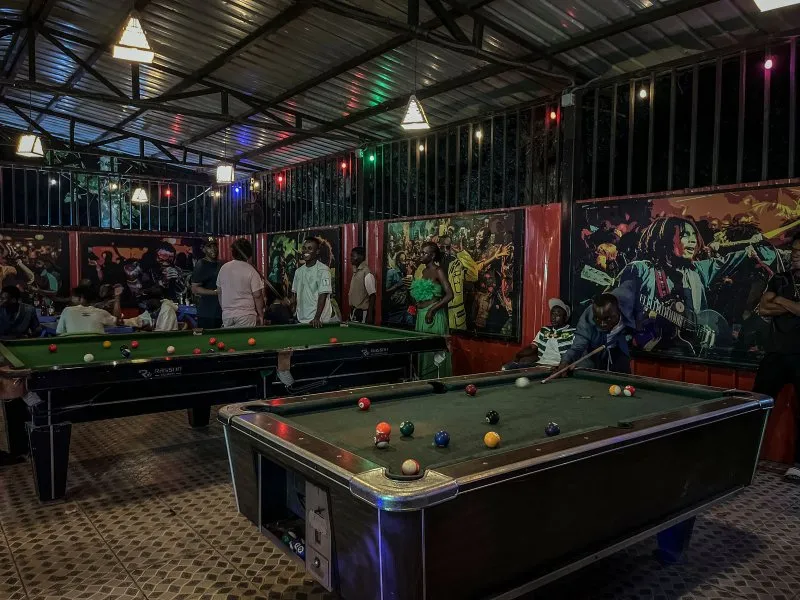
Patrons enjoy the evening at the Concorde AT bar, in Bangui, Central African Republic on November 7, 2026. — AFP pic
Several human rights groups have accused Wagner paramilitaries of serious abuses, notably torture and murder, in several countries, including the Central African Republic.
For lawyer Crépin Mboli-Goumba, a member of the opposition Republican Bloc for the Defence of the Constitution (BRDC), Wagner fighters represent “a danger for democrats and democracy” by their involvement in the economy and politics.
Blurred lines
As in Mali, where the Africa Corps has supplanted Wagner, Moscow has looked to impose its new structure on the Central African authorities, although not without resistance from Touadéra, whose personal security has relied on the group for several years.
A Central African minister confirmed to AFP that the Africa Corps was in the country but the subject remains sensitive.
“There was an agreement, they are here with the others,” said Pascal Bida Koyagbele, a minister in charge of major public works and a close ally of the president.
Wagner operatives, he added, have “the advantage of knowing the terrain” and “generally guide the Africa Corps personnel”.
Asked about the matter, communications minister Evariste Ngamana sidestepped the question. “Wagner or Africa Corps, it makes no difference. Ask the Russians. It’s an internal issue,” he said.
The arrival of the Africa Corps has not ousted Wagner from the Central African Republic.
The development of “military-technical cooperation” with Africa Corps “would not, in itself, constitute a replacement for the Wagner Corps”, said Russian military expert Sergey Eledinov.
But the blurred lines could become “a factor of destabilisation”, warned Anicet-Georges Dologuele, a Central African former prime minister now in opposition.
Touadéra has taken significant risks, he said, adding: “I don’t know many human beings who would dare to disobey President Putin.” — AFP
KioskNews shows a cleaned-up reading view extracted from the publisher’s page — the original always lives on their site, not ours.