Fantastic 'Atonement' Examines the Human Cost of the Iraq War | TIFF Review

Tania Hussain is an Executive Editor at Collider responsible for creative, editorial, and managerial duties. In addition to leading content ideation and development, she works to generate innovative and compelling ideas for feature articles and reviews with her editorial team across Features, Lists, Reviews, and Interviews. She also serves as the primary editor overseeing Collider’s Signature Series profiles, spotlighting some of the most influential voices in film and television. Tania has helped cover and ideate content for major events for Collider, including the Toronto International Film Festival. She has also conducted more than 100 interviews since her start in the business more than 15 years ago. Some favorites include Joel McHale, Charlie Cox, Jennifer Garner, Tina Fey, Kate Winslet, Bob Odenkirk, Andy Richter, Jordan Schlansky, Jamie Dornan, Yeardley Smith, Rafe Spall, Esther Smith, and a reasonable toss-up between Cookie Monster and Kermit the Frog. She has covered set visits, in-person junkets, and red carpets for several films and TV shows, including most recently, The Sheep Detectives, Masterchef, and Star Trek: Starfleet Academy.
Sign in to your Collider account
About 15 minutes into Atonement, there’s a moment when the matriarch of a close-knit family is trapped in a car with her grown children and grandchild, as U.S. Marines and Iraqi insurgents exchange gunfire around them. Mariam, played with heartbreaking restraint by Hiam Abbass, tries desperately to make it clear that they are civilians, but everything happens way too quickly for logic to even register. With no way to know where the bullets are coming from, the whole scene soon becomes unbearable to watch. It’s a tense, heart-pounding moment, and director Reed Van Dyk shoots it with such immediacy that it feels less like watching a war scene and more like being dropped into the middle of one, with no idea where safety is.
Of all the movies I've seen so far at the Toronto International Film Festival, Atonement really got to me. And not because the story is devastating, but because of everything it leaves you thinking about afterward. From solid writing to gritty filmmaking and outstanding performances, this is a movie about what war takes from ordinary people, its treatment of soldiers, and what happens when everyone is expected to move on. And with Boyd Holbrook giving what might be the best performance of his career, alongside remarkable work from Abbass and Kenneth Branagh, Atonement feels like the kind of film that could easily become an awards season contender. It is sharp and striking, but also deeply affecting; truly one of the best films of 2026, it reminds us that in war, the bullet goes both ways.
What Is ‘Atonement’ About?

Inspired by Dexter Filkins’ 2012 New Yorker article, Atonement begins in Baghdad in 2003, shortly after the start (or restart, depending on how you look at the three-time invasion) of the Iraq War. Mariam and her family have temporarily left their home because of nearby military action, bringing three generations together under one roof, including her son, his wife, and their newborn. But after another bombing hits close by, they decide to drive back to their home that afternoon, only to be trapped in a brutal firefight between U.S. Marines and Iraqi insurgents. Lou D’Alessandro (Holbrook) is among the Marines positioned above the street, and his split-second decision to open fire leaves Mariam’s husband and two sons dead. It’s a moment that also finds the young soldier in denial, especially as he gets a visit from New York Times reporter Michael Reid (Branagh), asking for details of what went wrong on the mission.
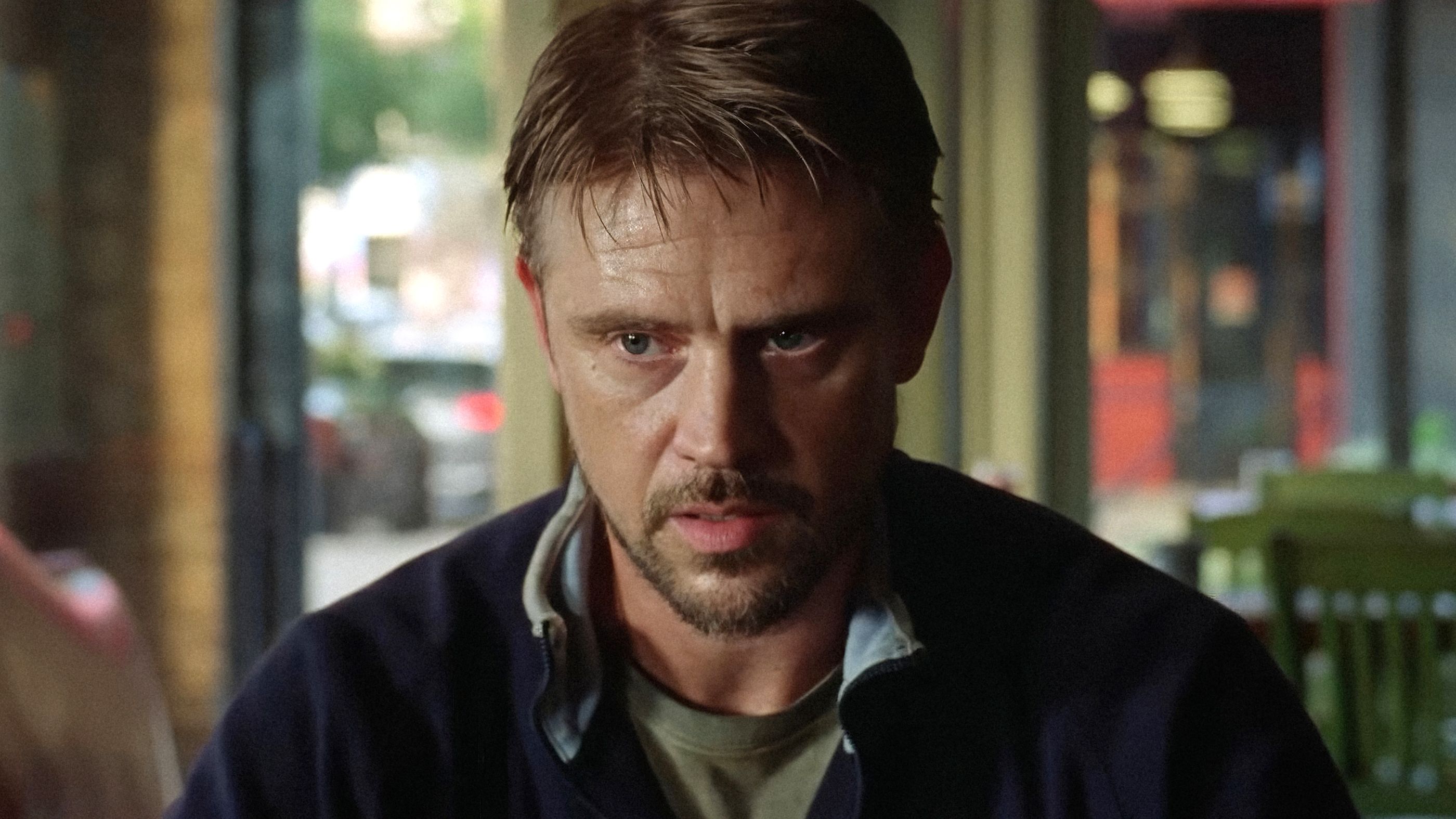
Ten years later, we learn Lou is back in the U.S., but having a deep psychological breakdown after eight deployments and a dishonorable discharge. He works as a bouncer at a nightclub, pockets drugs he finds on the dance floor, and seems like a ghost of the man we met in Baghdad — bright and cheery and a friend to his fellow soldiers. Whatever confidence he once had is long gone, replaced by guilt and anger; he is struggling with a mental health crisis that has left him largely on his own. As he tries to pull himself out of a hole and attend law school, Lou reaches out to Michael, hoping the journalist can arrange a meeting with the widowed Mariam and her daughter Nora, who is also the last surviving member of their family. What he actually expects to get from that meeting — whether it’s forgiveness, closure, or just the chance to finally say he is sorry — is hard to answer and an emotional rollercoaster to watch unwind.
‘Atonement’ Is a Showcase for Its Three Leads
In addition to Van Dyk’s masterful direction, Atonement works as well as it does because of its three central performances, led by Holbrook, who shows off some of the strongest work he's ever done. Giving what might be the most lived-in performance of his career thus far, there are stretches where it barely feels like you’re watching him act at all. From the exhaustion behind his eyes to a weary physicality, Holbrook gets so lost in Lou that every part of this pained soldier feels worn into him. Not to mention, Lou’s guilt never feels like something switched on for the big emotional scenes, either. Holbrook makes sure to always keep it there, hanging over him even when he is doing something completely ordinary.
Meanwhile, Branagh is just as compelling as Michael, bringing a calm and steady presence without ever pulling focus from those at the center of the tragedy. There’s a real warmth to his performance, along with a distinct sadness that makes us realize Michael has seen far too much over the course of his time reporting. While he’s curious, he’s never intrusive, and Branagh makes you feel how carefully Michael is choosing his words, knowing how one wrong move could make an already fragile situation even harder.
And finally, while Holbrook wears Lou’s pain all over him, Abbass does almost the opposite for her character, keeping so much of Mariam’s grief contained in the smallest looks and pauses. It’s a powerful performance and one that never needs a big speech to explain to us what this woman has carried for years. Gheed, as Mariam’s daughter Nora, also makes a strong impression with limited screen time, especially in the way she balances her love for her mother with her own complicated feelings about Lou being there, seeking what he needs from the mother-daughter pair.
‘Atonement’s Writing Refuses to Give Us Easy Answers

Alongside its masterclass performances, the writing is where Atonement really becomes something much heavier than a story about one terrible mistake. The director, best known for shorts including the Academy Award-nominated DeKalb Elementary, structures the film around three very distinct points of view without ever making one feel more important than another. We understand Lou’s guilt, but we are never asked to forget what Mariam lost in order to feel for him. For a film filled with examinations of varying aspects of pain, that kind of balance is hard to pull off. But Van Dyk never turns forgiveness into some easy destination that characters simply need to reach. For what it’s worth, even the dialogue stays restrained so that no one is suddenly delivering the perfect message that explains the entanglement of war and grief with redemption, because there probably isn’t one.
That restraint is also seen in the filmmaking itself. After depicting the chaos of Baghdad, Van Dyk and cinematographer Jon Peter gradually strip things back, so that quieter rooms speak for themselves and all those pained expressions do more of the work. But as there are so many scenes that stand out through the simplicity of the framework, with people simply sitting across from one another, unsure what to say, the movie never chases some giant emotional release. Instead, so much of it lets the moment breathe, so that every awkward silence or small gesture between Mariam and Lou feels heavier. It’s a very sharp and controlled way to make a deeply affecting movie that will sit with you long after the credits roll.
But in all its writing and production value, there is also a larger question sitting underneath Atonement: Who actually pays for the choices made in war? Governments make these decisions, but civilians live with the destruction, while soldiers come home not knowing what to keep out. Lou’s eight deployments and the death by suicide of one of his men can’t help but make you think of how much we ask of our veterans, yet so little help is offered to them. Atonement never uses that pain to excuse Lou or lessen Mariam’s suffering, but it does remain a powerful drama about how difficult it is to forgive when nothing can be undone.
After all the enormous questions the film asks, it ends on something completely ordinary. That restraint is exactly why the movie works as well as it does. With exceptional performances, absorbing writing, and some seriously sharp filmmaking that never loses sight of the people in this story, Atonement is easily one of the year’s best and strongest films, and one that will stick with you for a long time.

- Release Date
- October 2, 2026
- Runtime
- 118 minutes
- Director
- Reed Van Dyk
- Writers
- Reed Van Dyk
- Producers
- David M. Wulf, Reed Van Dyk, Steven Demmler, Tim White, Trevor White
Cast
-

Michael Reid
-

Lou D'Alessandro
Pros & Cons
- Boyd Holbrook delivers a career-best performance that feels completely lived in.
- The film balances grief, guilt, and forgiveness without ever offering easy answers.
- Reed Van Dyk's immersive filmmaking makes both the violence and quieter moments hit hard.
- Its deliberate pace may test viewers expecting a more conventional war drama.
KioskNews shows a cleaned-up reading view extracted from the publisher’s page — the original always lives on their site, not ours.