European fisheries struggling to cope with rising sea temperatures
By Ben Welsh, Simon Jessop and Kate Abnett / Reuters


As drought spread and wildfires raged across Europe this summer, the extraordinary heat did not stop at the shoreline.
European waters had their hottest summer months since satellite sensors began providing reliable data in 1982, according to analysis of sea surface temperatures.
Records were broken from the English Channel to the Mediterranean Sea. An offshore buoy near Mallorca recorded a temperature of 33.02°C on Aug. 5, the highest ever registered in the Spanish port authority’s buoy network.
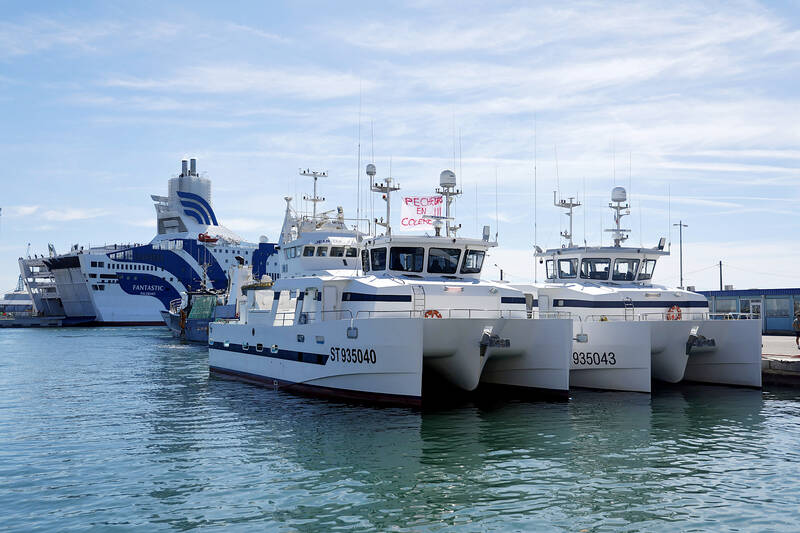
A banner reading ‘fishermen angry’ to protest protest the surging cost of marine diesel and the restrictions imposed by the EU’s WestMed management plan hangs on anchored fishing boats in the port of Sete, France, on Sept. 14.
Photo: EPA
Scientists say that events such as marine heatwaves are becoming more frequent, more intense and more widespread as greenhouse gas emissions drive up atmospheric temperatures around the globe. Oceans absorb the majority of the excess heat and retain it longer than the land or atmosphere.
That is transforming marine ecosystems, with catastrophic consequences for European fisheries and the people who rely on them. Species that have sustained coastal communities in Spain and southern England for generations are disappearing, as unfamiliar arrivals surge into warming waters.
“What is surprising is the speed at which this occurs,” Jean-Pierre Gattuso, senior research scientist at France’s National Centre for Scientific Research, said of the warming seas. “Records are broken almost every day in many places.”
Taken together, European seas averaged 21.6°C between June and last month, the highest in 45 years of available data.
Few areas strayed further from the norm than the Bay of Biscay, off the Atlantic-facing coast of France and Spain.
Stretching from Cape Ortegal in Galicia to the Pointe de Penmarch in southern Brittany, the bay’s traditionally cool waters averaged 21.4°C between June and last month, more than 2.4°C above the 1991-2020 average. Readings from the US National Oceanic and Atmospheric Administration peaked on Aug. 13 at 23.2°C, the highest of the satellite era.
Scientists define a marine heatwave as five or more days of water temperatures well above an area’s historic norm. In the 1980s, the Bay of Biscay averaged a handful of heatwave days per year. By the end of last month, it had logged 186 this year, more than three out of every four days, Reuters found.
DISAPPEARING SEA LIFE
The Bay of Biscay’s cool waters, long prized by those seeking relief from the heat of the Mediterranean coast, were enshrined in Ernest Hemingway’s famous novel “The Sun Also Rises.” The book’s protagonist recovers after weeks of dissolution on the beaches of San Sebastian.
“Now if you want to swim in cold water, you have to go to the westernmost portion of Galicia,” in the far northwestern corner of Spain, said Jose Manuel Rico Ordas, a marine ecology professor at the University of Oviedo..
Galicia benefits from strong winds that push warm surface water away from the coast during the summer months, allowing cold, deep-sea water to take its place in a process known as upwelling.
Ordas has spent summers on the bay since he was a child and studies its transformation.
Back then, there were extensive underwater forests of kelp, which provide vital food, shelter and nurseries for dozens of species that sustain the region’s small-scale fisheries. He estimates about 95 percent of the large, brown seaweed stands have disappeared, based on sampling along the Asturias coast since 2010. He attributes the decline primarily to climate change.
Kelp needs cold water — typically below 20 C (68 F) — to survive. Higher temperatures were once rare in the bay, Ordas said.
“Now, it’s the opposite,” he said.
Fish overgrazing — in particular by dreamfish, which thrive in warmer temperatures — has added to the kelp’s decline, he said.
The impacts are stark.
“We are finding no more lobster, no more crayfish, no more sea urchins and many other species that are associated with the good status of kelp forests,” Ordas said.
Concerned fishing crews are working with scientists and environmental activists to try to restore kelp forests by planting seedlings grown in laboratories.
Manuel Angel Reiriz Gonzalez, president of a local fishing guild in Galicia, ferried members of one such project in a boat he uses for sport fishing charters out of the port of Ribeira. The group brought a box full of small stones seeded with kelp, which they tossed into the choppy waters.
Climate change threatens a way of life that has sustained Gonzalez’s community for generations, he said. His family has been diving for sea urchins and harvesting clams for more than a century. Recurring heatwaves are hurting shellfish stocks, he said.
The area has also seen an influx of Portuguese man o’ war and triggerfish from warmer climes to the south — species that prey on local fish and crustaceans.
“We had some very bad years for clam production, but we worked on seeding them and the species gradually adapted,” Gonzalez said.
He hopes the seabed restoration efforts can do the same for kelp forests.
The disappearance of kelp could lead to the decline of sea urchins and other species fishing crews depend on, he said.
“At that point, as a fishing guild, we would cease to exist,” he added
OCTOPUS APOCALYPSE
In other European waters, new, invasive species from the Red Sea and beyond are entering the Mediterranean through the Suez Canal, displacing native populations, reshaping food chains and threatening fisheries, researchers say. In all, there are more than 1,000 nonindigenous species in the Mediterranean, according to a report by the Cyprus Academy of Sciences, Letters and Arts, based on surveys by scientists in 11 countries.
Some native species are coping with the warmer temperatures better than others.
A massive swarm of jellyfish shut down reactors at France’s Gravelines nuclear power plant last month when they clogged its cooling system — for the second time in as many years. The plant in northern France is cooled from a canal connected to the North Sea.
Fishing crews on the south coast of England are reporting a surge in landings of common octopus. About 2,600 tonnes were caught last year and upwards of 3,000 tonnes so far this year, according to figures compiled by the UK Marine Management Organisation. Before last year, annual landings were less than 30 tonnes.
Octopus larvae are carried into British waters on currents from breeding grounds near the Channel Islands, Brittany and places further south, said Bryce Stewart, senior research fellow at the Plymouth-based Marine Biological Association (MBA).
Many would not survive the frigid temperatures. However, since 2022, the English Channel has been under heatwave conditions for around six months out of the year on average, logging more than 900 days in all, the Reuters analysis found.
“Now they’re actually breeding in UK water quite prolifically,” Stewart said.
For Ian Perkes, owner of the eponymous fish merchants in the south Devon seaside town of Brixham, the octopus bloom has proved a boon.
There is a ready market in southern Europe for the once-rare species and no fishing quotas, he said. “There was one week where we had 200,000 kilos.”
Not everyone profits from the shellfish-loving octopuses, which feed on local lobsters, brown crabs and scallops.
For members of the South Devon and Channel Shellfishermen’s cooperative, this year has been an “octopus apocalypse,” according to its executive officer, Beshlie Pool. One fishing trip yielded a single crab all day, she said.
The MBA estimates the octopus bloom could account for about £10 million (US$13.25 million) in lost shellfish catches against about £12 million in octopus landings between January and September of last year.
The benefits are not evenly distributed. Some shellfishers have switched to catching octopuses, but many do not have the necessary equipment, Pool said. Four of the co-op’s 90-some vessels have gone out of business in the past 12 months.
The unpredictability of the changes makes it hard to adapt, Stewart added.
“Will the octopus still be here next year?” he asked. “If they’ve eaten all the crabs and lobsters, and the octopus die off, then what do we do?”
KioskNews shows a cleaned-up reading view extracted from the publisher’s page — the original always lives on their site, not ours.