Taiwan firms plan new US investment
GROWTH: SEMI has raised its global chip revenue forecast to US$1tn this year and US$2tn by 2030, which would require expansion by Taiwanese firms to meet, minister Kung said
By Meryl Kao / Staff reporter


Taiwanese companies’ planned additional US$20 billion investment in the US would come mainly from semiconductor companies and their supply chains and artificial intelligence (AI) server-related businesses, the Ministry of Economic Affairs said yesterday.
The new investment, on top of a US$35 billion pledge made by 20 firms that participated in the SelectUSA Investment Summit in May, reflects rising global demand for AI and semiconductors, as well as Taiwanese manufacturers’ growing interest in expanding in the US, Minister of Economic Affairs Kung Ming-hsin (龔明鑫) said.
US Secretary of Commerce Howard Lutnick on Wednesday said in an interview with CNBC’s Squawk Box that Taiwan is expected next week to announce plans to invest an additional US$20 billion to US$30 billion in the US as part of a bilateral trade agreement focused on semiconductors, AI and energy.
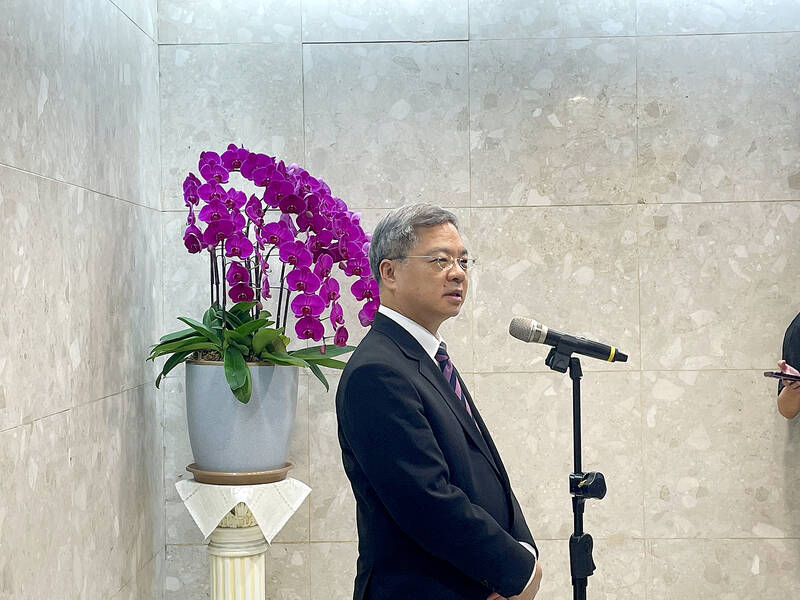
Minister of Economic Affairs Kung Ming-hsin speaks at the ministry in Taipei yesterday.
Photo: Meryl Kao, Taipei Times
Robust semiconductor orders were also evident at the Semicon Taiwan trade show in Taipei this week, Kung said.
Event organizer SEMI has raised its forecast for global semiconductor revenue to US$1 trillion this year and US$2 trillion by 2030, from an earlier estimate of US$1 trillion by 2030.
Based on those figures, Taiwanese companies, which play key roles in advanced chipmaking and AI server manufacturing, must expand capacity at home and abroad, including the US, to meet rapidly growing demand, Kung said.
Regarding Lutnick’s remarks on potential tariffs on semiconductors, Kung said Taiwanese firms investing in the US could receive duty-free import quotas equal to 2.5 times their US production capacity under a memorandum of understanding on Taiwan-US investment signed on Jan. 15.
Taiwan’s major semiconductor firms and contract electronics makers have invested in the US, he said.
The ministry is also working with the Taiwan Electrical and Electronic Manufacturers’ Association (台灣電機電子公會) to develop technology parks overseas to help more suppliers and small and medium-sized enterprises expand into the US, he said.
Separately, regarding printed circuit board maker Unimicron Technology Corp’s (欣興) alleged breach of country-of-origin rules, Kung said the case is in judicial proceedings, and investigators and the courts would determine whether origin laundering occurred.
Origin laundering typically involves goods from China or elsewhere undergoing only minor processing in Taiwan or a third location before being relabeled for export to the US, without meeting substantial-transformation rules or a 35 percent value-added threshold, he said.
Taiwan’s standards apply to its own export controls, while US Customs and Border Protection makes the final determination on whether goods meet its country-of-origin rules, he said.
In contrast, the suspected May transshipment to China of servers equipped with Nvidia Corp’s advanced chips, involving three Taiwanese defendants, is an export-control issue, Kung said.
The government is considering amendments to the Foreign Trade Act (貿易法) or adding specific products to controlled lists to address the issue, with relevant agencies coordinating on the matter, he said.
KioskNews shows a cleaned-up reading view extracted from the publisher’s page — the original always lives on their site, not ours.