Agusan del Sur slashes poverty to 13.9%
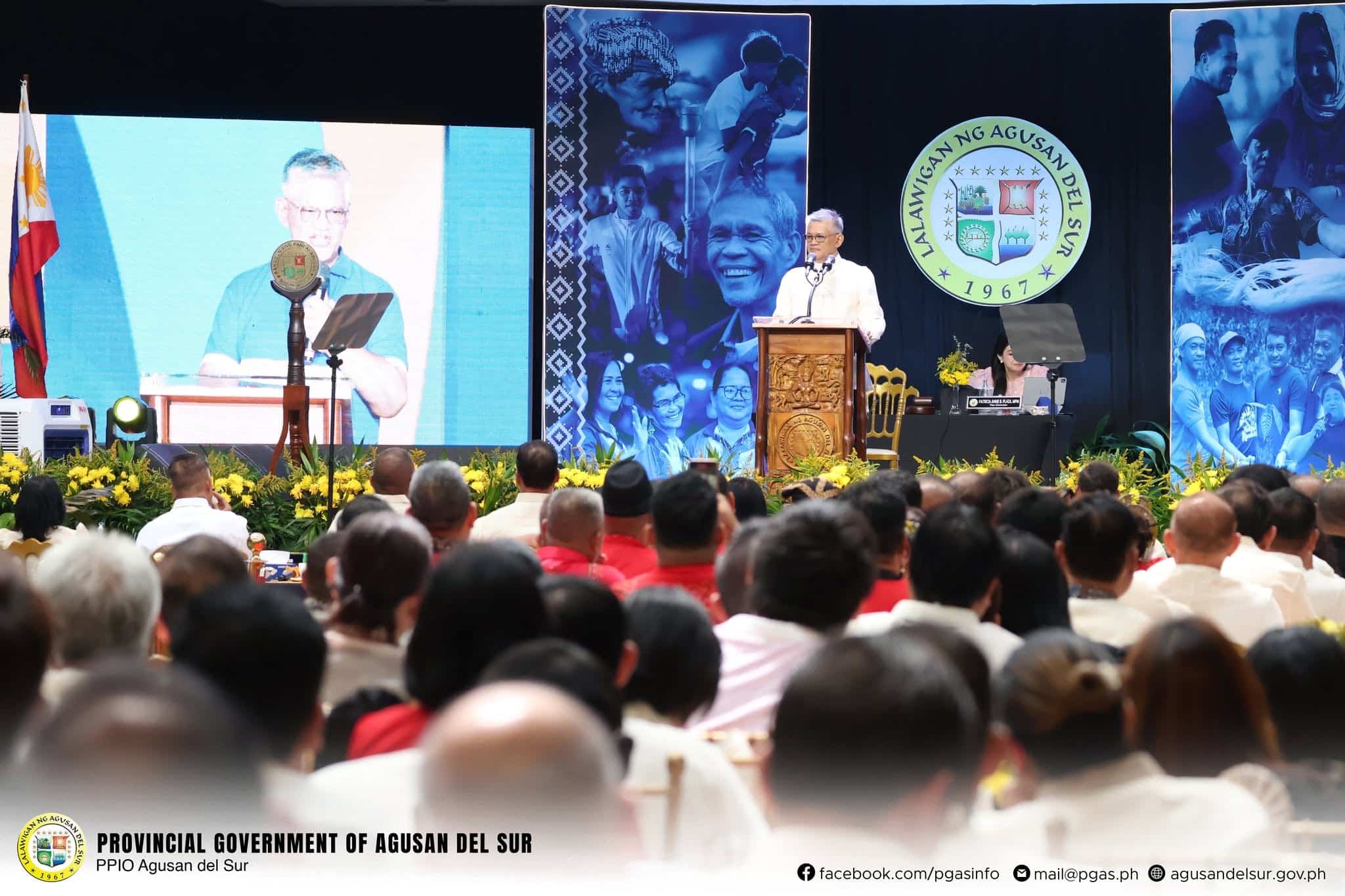

PROSPERIDAD, Agusan del Sur — Family poverty in Agusan del Sur has dropped sharply from 23.4% in 2023 to 13.9%, putting the province ahead of schedule on its medium-term development roadmap, Gov. Santiago B. Cane Jr. announced during his annual State of the Province Address (SOPA) on Friday.
Delivering the address under the banner “A Province that Delivers” at the Gov. Democrito O. Plaza Government Center Covered Court, Cane cited precision agriculture, key rural road links, and targeted healthcare investments as the primary drivers behind the nearly 10-percentage-point decline.
The latest Philippine Statistics Authority (PSA) Family Income and Expenditure Survey figures reflect a structural shift across the province: roughly one in seven households now lives below the poverty threshold, down from nearly one in four just two years ago.
Article continues after this advertisement
READ: From soil to survival: Agusan del Sur shows way to defeat poverty
FEATURED STORIES
NEWSINFO
NEWSINFO
NEWSINFO
Building on that momentum, Cane committed to driving family poverty down to 13.4% by 2028—a cumulative 10-point reduction from the 2023 baseline.
Cane pointed to data-driven agriculture as the cornerstone of rural income growth, spearheaded by the provincial government’s internationally accredited Biogeochemistry Laboratory. The facility processed 1,812 soil samples and delivered 1,589 custom fertilizer formulations across 2,883 hectares, reducing input waste and lowering production overhead for local growers.
Under the Upland Sustainable Agri-Forestry Development (USAD) program, 1,482 smallholders are currently tapping 719 hectares of mature rubber trees, tracking between P86 million and P108 million in projected annual revenues.
In basic services, the newly opened hemodialysis unit at the Democrito O. Plaza Memorial Hospital logged 1,198 sessions for 128 kidney patients, saving local families an estimated P12 million in out-of-town transit and medical costs.
Article continues after this advertisement
The capitol also funded 803 academic scholars, including 43 doctors and five nurses who have completed their rural service assignments.
Despite these inroads, Cane delivered a candid assessment of ongoing bottlenecks, acknowledging that capitol livelihood initiatives reached only 5,587 farmers and fishers—under 4% of the province’s 145,000-strong agricultural workforce.
Article continues after this advertisement
“A good start, and a long way from enough,” Cane admitted, pointing out delays in flagship undertakings, including the P700-million World Bank-assisted Provincial Health Complex, the Patin-ay IT Park, and a centralized food processing plant./coa
KioskNews shows a cleaned-up reading view extracted from the publisher’s page — the original always lives on their site, not ours.