The German town where the right has banned new ‘stumbling stones’ for Nazi victims
The town hall of Heidenau, Germany has a freshly restored cream-coloured facade, tidy flower boxes on the windowsills and a charming shingled clocktower.
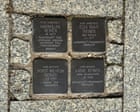
At the entrance, closer inspection reveals a single brass plaque embedded in the pavement honouring the former mayor Paul Gröger, whom the Nazis hounded into killing himself.
The plaque is one of 128,000 Stolpersteine (stumbling stones) across Europe, a donor-funded project keeping alive the memory of individual victims of the Nazi era.
It is by some measure considered the world’s biggest grassroots memorial project, and has become an integral part of Germany’s “remembrance culture” for the atrocities committed under Adolf Hitler.
But last week at the same town hall, the council of Heidenau voted to halt the laying of future stumbling stones.
In a decision that drew a national outcry, the far-right Alternative für Deutschland (AfD) party joined forces with the conservative Christian Democratic Union (CDU) of Germany’s chancellor, Friedrich Merz, to help form the majority.
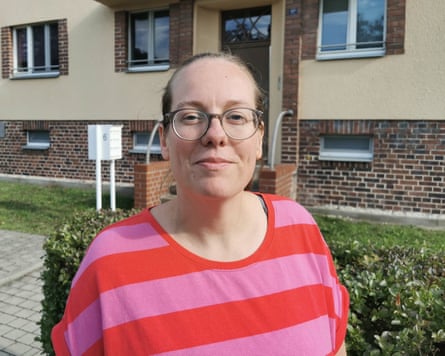
“They want to drive the victims’ memory out of the city centre, just like the victims themselves were driven out,” said Anne Nitschke of AKuBiZ, a citizens’ group coupling history education with pro-democracy work in Saxony state, a hotbed of rightwing extremism.
“The point of the Stolpersteine is that you stumble across them every day and then think about who lived here and who was forced to leave,” said Nitschke, 40.
Her organisation had filed for permission to lay another 12 plaques for Holocaust victims, until the Heidenau council stopped them.
The vote came in a month in which the anti-immigrant, pro-Kremlin AfD widened a lead at the top of the national polls, won two state elections and performed strongly in a third, in the capital, Berlin.
Like the other mainstream parties, Merz’s CDU has ruled out cooperation with the far right in a stance known as the “firewall”. But political realities have often made the AfD an unavoidable partner in municipal policymaking, particularly in the former communist east.
Supporters of the stumbling stones ban criticised that their placement on the ground meant they were walked on and exposed to the elements. They called for a “memorial space” in a Christian cemetery north of town “for the victims of war, terrorism, dictators and forced displacement”.
Nitschke noted that the council had not made any plans or committed funding for such an endeavour, and said the broad spectrum cited served to deny the “singularity of the Holocaust”.
Merz’s national CDU referred queries to the Heidenau chapter, which did not respond to a request for comment.
The AfD began as a Eurosceptic party 13 years ago and has morphed into an increasingly nationalist force. It has long targeted memory culture as detrimental to patriotism.
One of its founders, Alexander Gauland, compared the Nazi period to a “speck of bird shit in over 1,000 years of successful German history”.
The Saxony-Anhalt chapter, which won a record 44% of the vote in September, pledged to “liberate” Germans from shame over the Holocaust while offering “more Bismarck, less Hitler” in schools.
And the part’s co-leader, Alice Weidel, falsely called the Nazi leader “a communist, socialist guy” in a campaign appearance with Elon Musk last year. (The tech billionaire told AfD supporters at the event there was “frankly too much of a focus on past guilt” in Germany.)
Many residents of the town said they supported the Stolpersteine and were sceptical of the councillors’ motives.
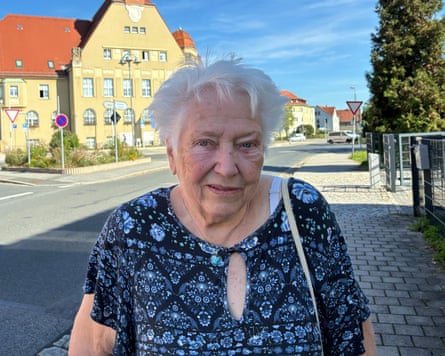
“Why would they have anything against the Stolpersteine? It’s easy enough to walk around them if you don’t want to step on them,” said Christine Bauer, 85, who uses a rolling walker to move about town.
“I’m a child of the war and remember its awful aftermath,” said Bauer, who worked on Elbe river ships until she retired. “It’s not as if the town council didn’t have bigger problems to worry about now,” she added, mentioning affordability.
after newsletter promotion
But Silke Schutz, 63, a baker who called herself a “staunch AfD voter”, described the Stolpersteine as “a waste of money, regardless of who pays for them”.
“There are so many victims no one cares about,” she said, citing people killed in traffic accidents. “We had nothing to do with the war and at some point it [remembrance] has got to come to an end. But when I express my opinion, I’m insulted as a Nazi.”
Started by the artist Gunter Demnig in the 1990s, the Stolpersteine are laid before a Nazi victim’s last home or workplace and inscribed with stark biographical details: date of birth and the date and circumstances of their death.
Heidenau has five, all laid personally by Demnig. He reacted angrily to the town council’s decision, calling it a “unprecedented” and wrong.
Four plaques are laid just a few minutes’ walk from the Heidenau railway station in honour of the Reiner family. Its Jewish patriarch, Maximilian, ran a local department store until he was deported to the Theresienstadt concentration camp in 1943.
He survived and, after liberation two years later, emigrated to the US and died soon after, in 1949.
Gröger, the Social Democratic mayor until 1933, refused to run up the swastika flag at the town hall and was removed from office. In June, Nazi officers spirited him away to the Hohnstein concentration camp, where they beat and tortured him. In August, he took his own life.
School pupils raised the funds for his plaque, while AKuBiZ sponsored the remaining four Stolpersteine.
Descendants often travel from abroad to attend their installation, as most Holocaust victims lack a gravesite. Local residents support the project by regularly polishing the Stolpersteine, and digital apps provide detailed information about the victims’ fates.
Nitschke said no plans had been announced to remove any of the existing Stolpersteine, but for now the 12 planned plaques were on hold, including for Fritz Goldstein, a Jew whom the Nazis stripped of his property and deported to the Soviet Union with his wife, Martha.
He died a broken man aged 50, five years after his return to Heidenau.
Juliane, 29, a music teacher who declined to give her last name, said she found it moving to learn about the victims through the Stolpersteine. “It is so important we don’t forget, so we don’t make the same mistakes again.”
But 28-year-old Philipp, a cook, said he supported the town council’s ban. “It’s not relevant to me – it’s in the past. So there’s no point in dwelling on it now. At some point, you’ve got to put it behind you.”
He said Germany’s memory culture had been imposed from abroad. “Other countries just want Germany to constantly have to justify what it did.”
Nitschke said her team planned a legal challenge to the ban.
This weekend they will lead a march through town to the sites of the planned new Stolpersteine, recounting the stories of each of the victims.
KioskNews shows a cleaned-up reading view extracted from the publisher’s page — the original always lives on their site, not ours.