India was against plurilateral deals. Is that stance shifting after BRICS summit?
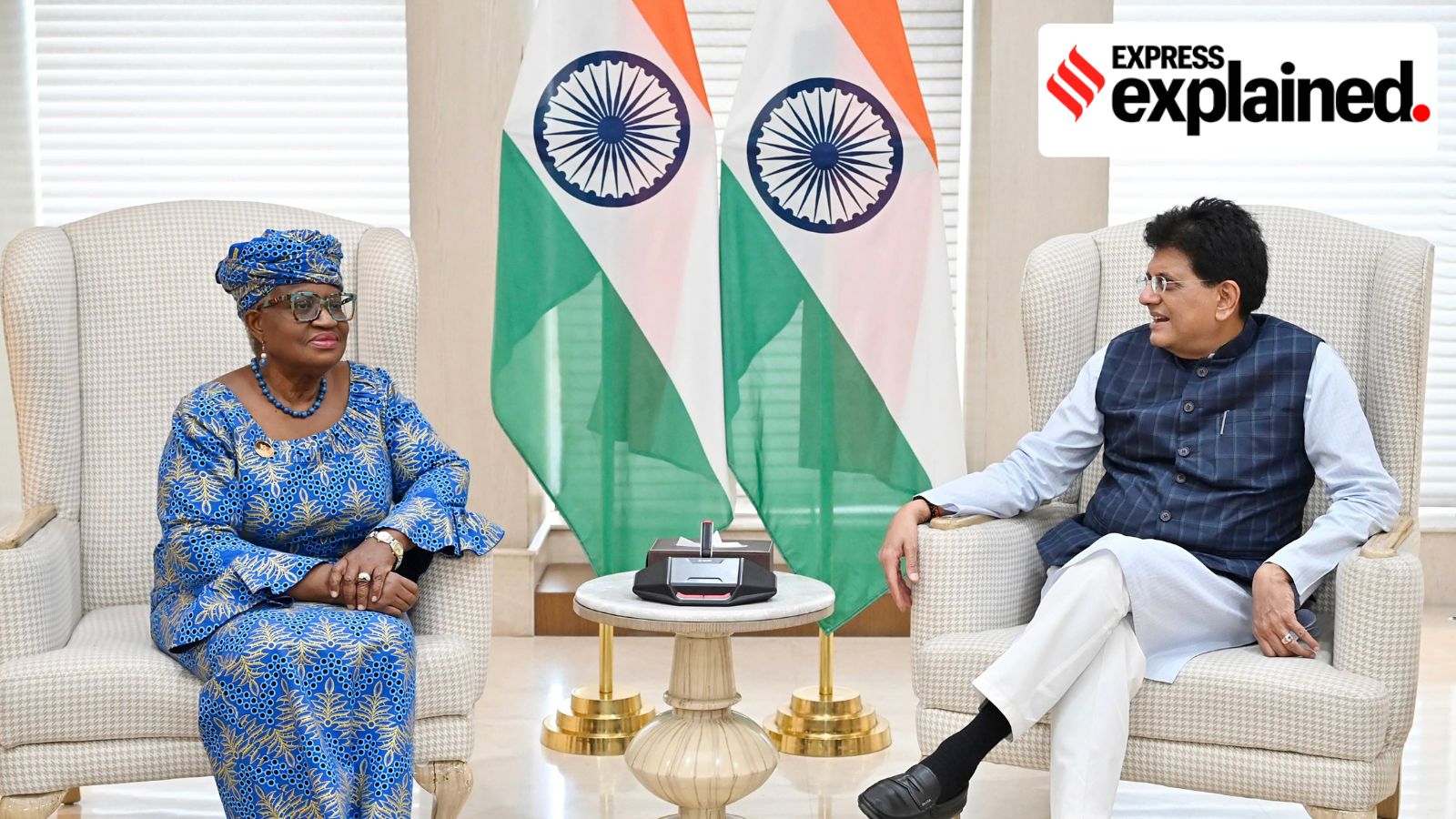
Union Commerce and Industry Minister Piyush Goyal meets Director-General of the World Trade Organisation, Ngozi Okonjo-Iweala, in New Delhi on Saturday. (@PiyushGoyal X/ANI Photo)
India has consistently opposed plurilateral trade agreements — that is, agreements negotiated and implemented by exclusive groups rather than by all World Trade Organisation (WTO) members.
But, going by the 2026 BRICS Summit declaration, India appears to be warming up to the idea of such deals backed by major trading powers, including China.
The New Delhi Declaration said BRICS members recognise the importance of identifying “pathways” for plurilateral initiatives in the WTO legal framework.
This comes just months after India lodged its strong reservations against such pacts at the WTO’s 14th Ministerial Conference (MC14) in Cameroon.
“We will ensure the implementation of the MC14 outcomes and continue to engage constructively towards the resolution of outstanding issues. We will engage constructively in the WTO reform to enhance the WTO’s authority, effectiveness, inclusiveness, and relevance, and build an open world economy. In this regard, we recognise that it is important to identify appropriate pathways for plurilateral initiatives into the WTO legal framework including on development-oriented issues, and to explore the formulation of forward-looking rules in the WTO,” the BRICS declaration said.
Guardrails against plurilateral pacts
Plurilateral agreements are increasingly being featured in various WTO reform-related proposals.
At the Cameroon Ministerial Conference of the WTO held earlier this year in March, New Delhi had talked about developing guardrails on plurilateral agreements.
Story continues below this ad
A trade expert, who requested anonymity, said that it is significant that the term “guardrails” is missing from the declaration despite India being the BRICS chair.
“The BRICS statement mentions plurilateral on development-related issues. To illustrate, if we want a permanent solution on food security, can we start a plurilateral? But if developed countries don’t join the plurilateral, we will get nothing meaningful out of it. Similarly, if we want a reduction in farm subsidy of the developed countries and developed countries don’t participate in that plurilateral, the outcome will be irrelevant. On development related issues, plurilateral cannot be the route, it has to be multilateral,” the expert said.
India has blocked the insertion of the China-backed Investment Facilitation for Development (IFD) plurilateral pact into the WTO rulebook. Under WTO rules, a plurilateral agreement can be included into the family of agreements “exclusively by consensus”.
The IFD initiative, launched by the WTO in 2017, is aimed at enhancing foreign direct investment (FDI) flows. India said that IFD’s incorporation risks eroding the foundational principles and functional limits of the WTO. India indicated that as part of WTO reform discussions, members are seeking guardrails and legal safeguards for plurilaterals before integration of any specific plurilateral outcome.
Story continues below this ad
“Hence, India did not agree to incorporation of the IFD into the WTO framework as an Annex 4 agreement. In view of the systemic issue at hand, India showed openness to first have good faith comprehensive discussions and constructive engagement under the WTO Reform Agenda,” the Commerce and Industry Ministry said in March this year.
India against WTO agreement on Electronic Commerce
So the direct implication of India identifying “pathways” for plurilaterals could be to lift its reservation on the IFD plurilateral agreement. This would represent a significant change in India’s stand on plurilaterals. India was the only country opposing it citing systemic risks and on grounds that investment is not a core trade issue. However, India had also questioned the push for another plurilateral agreement backed by Western countries. In a July 9 letter to the WTO, India questioned the “legal basis” under which the WTO DG was assigned the role to act as the “depositary of the Agreement on Electronic Commerce (ECA)”.
“The Marrakesh Agreement requires consensus to add an Agreement to Annex 4. Consensus was not reached on two occasions. In the absence of consensus, we would like to understand the institutional basis on which the Interim Arrangements are operating,” India said.
As per the WTO Secretariat, 66 members, covering approximately 70% of global trade, have adopted a pathway to bring into force the WTO Agreement on Electronic Commerce through “interim arrangements” while continuing to work towards its incorporation into the WTO legal framework of rules.
Broad spectrum of countries in support of IFD
Story continues below this ad
The Indian Express last month reported that several countries targeted India during its trade policy review last month. While Canada most prominently opposed India’s stand on plurilateral agreements, the EU said that over the past decade, India has benefited significantly from its integration into global trade and has increased its share in world trade.
A European Union representative also said that the bloc “encourages India to rethink its approach to plurilateral agreements” and to “consider them as an opportunity to shape the agenda of the WTO and to modernise the organisation rather than as a threat to multilateralism — which they are not, if we build them properly”.
While Gambia and Costa Rica asked India to withdraw its opposition to the IFD agreement, several countries asked India to join negotiations for plurilateral agreements such as the fossil fuels subsidy reform initiative, dialogue on plastics pollution and environmentally sustainable plastics trade. As many as 129 members have supported IFD, but India remains the primary holdout, citing systemic risks and stating that investment is not a core trade issue.
BRICS on WTO reforms
The statement also said that BRICS members strongly advocate for the immediate restoration of an accessible, effective, fully functioning, two-tier binding WTO dispute settlement mechanism as a foundation for trust and predictability for all WTO members, and the appointment of new Appellate Body members without further delay.
Story continues below this ad
“We look forward to working towards strengthening the organization through the necessary reform while upholding the foundational principles of the WTO and facilitating the negotiation process within the WTO framework, and to restoring the credibility of the multilateral trading system. Echoing the aspirations of the Global South to fully integrate into the multilateral trading system, we strongly support Ethiopia and Iran’s bid for accession to the WTO. We acknowledge China for expanding its zero-tariff treatment to cover 53 African countries with which it has diplomatic ties,” the statement said.
© The Indian Express Pvt Ltd

Ravi Dutta Mishra is a Principal Correspondent with The Indian Express, specializing in economic policy and financial regulations. With over five years of experience in business journalism, he provides critical coverage of the frameworks that govern India's commercial landscape. Expertise & Focus Areas: Mishra’s reporting concentrates on the intersection of government policy and market operations. His core beats include: Trade & Commerce: Analysis of India's import-export trends, trade agreements, and commercial policies. Banking & Finance: Covering regulatory changes and policy decisions affecting the banking sector. Professional Experience: Prior to joining The Indian Express, Mishra built a robust portfolio working with some of India's leading financial news organizations. His background includes tenures at: Mint CNBC-TV18 This diverse experience across both print and broadcast media has equipped him with a holistic understanding of financial storytelling and news cycles. Find all stories by Ravi Dutta Mishra here ... Read More
KioskNews shows a cleaned-up reading view extracted from the publisher’s page — the original always lives on their site, not ours.