Alibaba Cloud plans six-year stroll to 20GW of datacenters, reveals chip to power them
USA alone has 37GW under construction, but Alibaba doesn't think the AI boom will run out of steam
Chinese tech giant Alibaba has outlined an ambition to expand its datacenter fleet to 20GW of capacity, and chip that will help it get there.
CEO Eddie Wu announced those ambitions today at Alibaba’s Apsara conference, where he delivered a speech that likened current AI applications to light bulbs, because electric light was an early application of electricity but the really important stuff came along decades later.
He also compared AI to steam engines.
REG AD
“Steam and combustion engines were designed merely to do what horses and laborers were already doing: pumping water, weaving, and hauling,” he said. Over time, the CEO said, engines proliferated to the point at which “machine power already drives 99.9% of the world’s physical work.”
REG AD
The CEO thinks AI – which he prefers to call “Machine Thinking” – will one day do 99.9% of all cognition, and usher in various utopian outcomes.
“In the future, every niche domain will have millions of AI scientists and domain experts constantly driving breakthroughs and tackling challenges,” he said, before asking his audience to imagine an AI charged with building a starship capable of reaching Mars.
“For such an ultra-complex, long-horizon task, AI will break it down into tens of millions of subtasks, executed by millions of agents working non-stop until completion,” he said. “A human only needs to define the intent and the goal to mobilize massive intellectual resources.”
Going large
Alibaba Cloud , he said, has decided to play its part by mobilizing resources to scale its global datacenter fleet to 20GW.
By way of comparison, commercial real estate outfit Cushman and Wakefield last week said it can see 37.7GW of datacenters currently under construction in the USA alone. Some of that will go to the Stargate project, which has promised to bring 10GW online by 2029. OpenAI is a member of Stargate and has promised to implement 10GW of Broadcom accelerators by 2029. Meta has announced plans to build a 5GW datacenter campus for its own use. In late 2025, Amazon said it added 3.8GW of capacity in the previous twelve months.
We could go on but you probably get the idea: Alibaba Cloud is going to build a lot of infrastructure, but perhaps more slowly than its rivals – and may still end up with a relatively modest datacenter fleet.
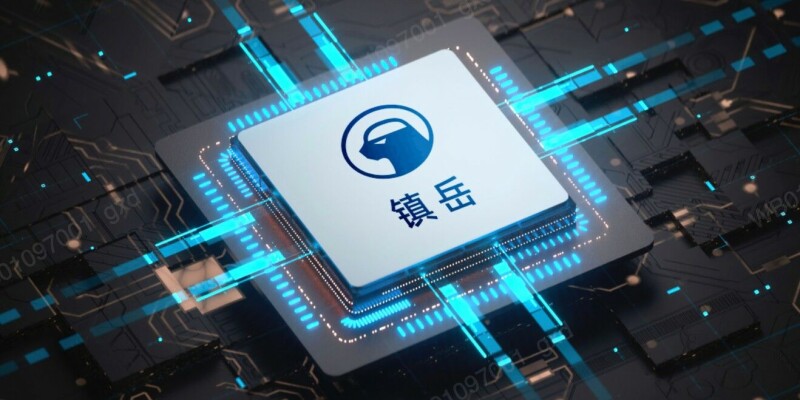
The company will, however, apparently fill its bit barns with China’s most advanced AI chip – the Zhenwu V900
REG AD
Wu announced the processor in his keynote and described it as “the most powerful AI chip in China today, delivering three times the performance of its predecessor, the Zhenwu M890.”
Apparently, Alibaba can build a single cluster packing up to half a million V900s, and the resulting machine will “power frontier model training and inference.”
The chip comes from Alibaba’s T-Head semiconductor business, which has published basic specs describing the processor as possessing 216GB of memory and 1200 GB/s inter-chip interconnect bandwidth.
Machine translation of the spec sheet explains the chip possesses the following qualities:
Native support for FP32 through FP4, and optimized for cutting-edge AI models and AI application workloads;
An improved Tensor Core arithmetic unit that significantly improves instruction precision in FP8/FP4 formats;
Richer scaling factor formats and Block Size configurations under MXFP8 and MXFP4, which apparently make for more stable performance when running training and inferencing workloads.
Wu said he expects “significant growth in the annual AI chip shipment volumes,” but didn’t say when the chip will go into production, or when Alibaba will make enough to power one of its giant clusters.
The CEO also used his speech to announce that Alibaba has started training its next-generation model, Qwen 4, and has two successors on its roadmap that it expects will scale to five and ten trillion parameters respectively.
Alibaba may develop those models using Recursive Self-Improvement (RSI) – the technology that sees models design new models. “Currently, Alibaba’s Qwen team is exploring RSI and has made meaningful progress,” Wu said, before mentioning that the team plans to train models with the same number of parameters as the planned Qwen successors.
REG AD
One matter Wu didn’t touch on is where Alibaba plans to build its new datacenters. The company is China’s top cloud and has a colossal domestic market to address. Alibaba Cloud has also targeted growth in Southeast Asia and has presences in Europe and North America.
New datacenter builds face considerable community opposition in all those locations, and Chinese tech firms are often viewed with even more suspicion than their US counterparts. China, meanwhile, is promoting construction of giant datacenters in the country’s west where renewable energy is plentiful and cheap. The Register would not be surprised if that’s where Alibaba does most of its building. ®
KioskNews shows a cleaned-up reading view extracted from the publisher’s page — the original always lives on their site, not ours.