Ministry touts Taiwanese pineapple export success
PROMISING FEEDBACK: More than 90 percent of local consumers have a positive opinion of Taiwanese pineapples, a survey conducted by local retailers found
By Yang Yuan-ting and Jonathan Chin / Staff reporter, with staff writer


The Ministry of Agriculture yesterday touted the success of Taiwanese pineapple exports to New Zealand and Australia, while setting its sights on the US market by the end of next year.
Deputy Minister of Agriculture Hu Jong-i (胡忠一) made the remarks in an exclusive interview yesterday with the Chinese-language Liberty Times (the sister paper of the Taipei Times).
Following China’s ban on Taiwanese fruit exports on grounds that Taipei called politically motivated, Taiwan has been exploring foreign markets outside of China, with Japan being the largest, he said.
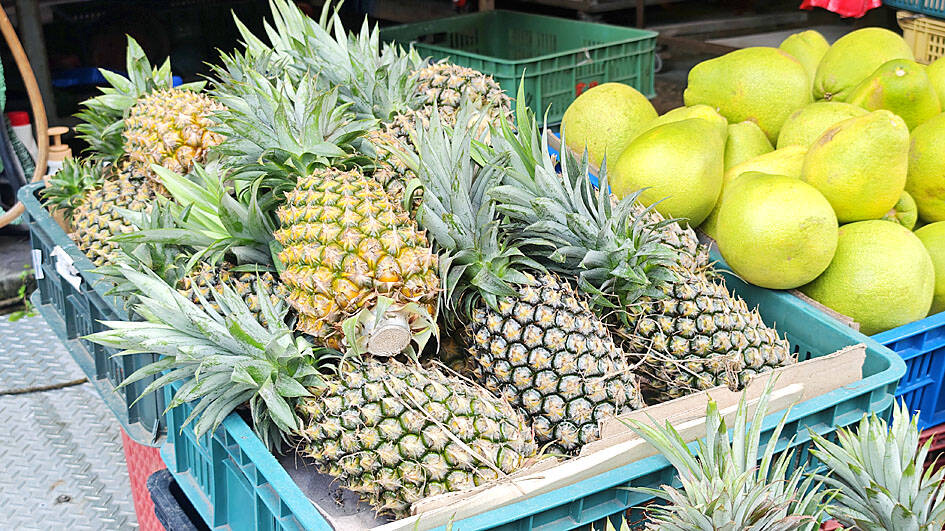
Pineapples are displayed at a market in Changhua County on Aug. 27.
Photo: Chen Kuan-pei, Taipei Times
Last year, a ministry delegation visited Australia and New Zealand to investigate local conditions and found that local cold chains need at least two weeks to transport Taiwanese pineapples from customs to consumer shelves, Hu said.
The ministry’s experts selected the “mango pineapple” cultivar for export to the Commonwealth countries, as the cultivar’s sweetness is enhanced by weeks of storage at 13°C, the temperature of local cold chains, he said.
Surveys conducted by local retailers showed that more than 90 percent of local consumers have a positive opinion of Taiwanese pineapples, he said.
The ministry’s experience in Australia and New Zealand could be beneficial to Taiwan’s bid to export to the US market, which could happen next year, Hsu said.
Taiwan’s favorite pineapple, the Golden Diamond, or Tainung 17, is unsuited for export, as its flavor and presentation fade relatively quickly, while mango pineapple keeps well, has an edible core, and is sweet, he said.
The nation cultivates mango pineapples on 50 hectares, a number the ministry aims to boost to 1,000 hectares over the next few years, Hsu said.
The ministry has successfully negotiated with Japanese importers to lengthen the average contract to five years from the current 18 months, which imposes daunting initial investment costs on small farmers, he said.
Farmind, Japan’s largest fruit and vegetable importer, has already agreed to the arrangement, which could serve as a model with Taiwan’s future international customers, Hsu said.
KioskNews shows a cleaned-up reading view extracted from the publisher’s page — the original always lives on their site, not ours.