ExplainSpeaking | India’s corporate investments have risen, but their future depends on an old worry
Since the day it came to power, the Narendra Modi government’s approach to the economy has been to pull back the role of the government and incentivise the private sector to play its part. To be sure, this is very much in line with the change in India’s approach since the 1991 economic reforms. Despite criticism of growing unemployment — it hit a 45-year high in 2017-18 according to the government’s own Periodic Labour Force Survey — the government stayed the course with its “Minimum Government, Maximum Governance” mantra.
The government’s view has been that the private sector must be incentivised to invest and, in the process, create jobs, economic growth and prosperity, while the government’s focus should be to make it easier for businesses to function.
To this end, it unleashed several reforms, such as the introduction of the Insolvency and Bankruptcy Code (IBC) in 2016 and the Goods and Services Tax in 2017. The biggest such incentive was the historic cut in corporate tax rates introduced in 2019.
However, as the events since then have shown, investment rates, which had been trailing off since 2011-12, did not rise as the government had hoped.
What was the problem?
By the end of 2022, the government’s exasperation with corporate investments, despite subsidies such as the Production Linked Incentive (PLI) Schemes, was made clear. Finance Minister Nirmala Sitharaman even compared India Inc. to Hanuman from an episode in the Ramayana, where Hanuman displays diffidence about his immense abilities.
“Is it like Hanuman you don’t believe in your own capacity?” She had asked.
Story continues below this ad
In the years since, and especially as the 2024 general elections loomed, the government’s approach shifted to addressing the underlying issue: weak consumption levels. In other words, if the average consumers did not consume at a fast enough rate, companies had no incentive to make fresh investments.
To address this issue, the government’s focus shifted to providing tax breaks to consumers — both personal income tax and GST — apart from substantial direct benefit transfers. The focus shifted from PLI to the Employment Linked Incentive (ELI) scheme — that is, the subsidy was tied not to production but to companies providing employment because without jobs, there can’t be much consumption.
Even when investments rose, they were patchy, reflecting the K-shaped recovery in consumption — when different parts of the economy are growing at different rates.
However, data suggests a turnaround may be underway.
What’s happening to corporate investments?
On Wednesday (November 11), Bank of Baroda published new research that looked at the balance sheets of more than 2,000 companies that have announced their corporate earnings so far, and it reveals a steady growth in gross fixed assets (read: investments into boosting the productive capacity of companies). BoB only looked at non-financial firms from the sample “to focus more on how investment has behaved for the manufacturing and services segments”.
Story continues below this ad
Here’s what BoB’s study found. The 2,010 companies were categorised into 31 sectors, and 22 of them witnessed an improvement in the growth rate in fixed assets in the first half of the current financial year (see TABLE 1).
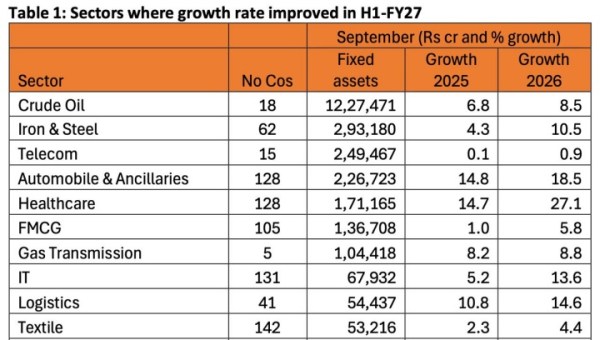 Table 1.
In the remaining sectors, the growth rate was lower than in the first six months last year. But in three of these remaining sectors (see TABLE 2), the growth rate was still in double digits.
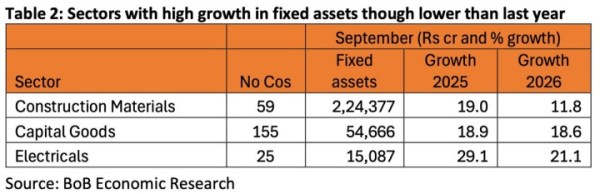 Table 2.
In only about one-fifth of the total sectors, the growth in investments was lower than in the first half (H1) this year as compared to H1 last year (see TABLE 3).
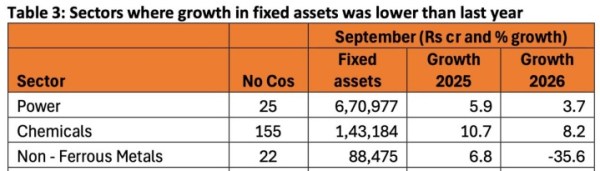 Table 3.
“What is important here is to note that these are not investment intentions but actual investments,” says Madan Sabnavis, Chief Economist of BoB.
Story continues below this ad
So, why have companies started investing more?
Typically, companies start making fresh investments when existing capacity starts getting used up because demand from consumers is up. Sabnavis says there is evidence that capacity utilisation is also going up.
To assess what is happening to capacity utilisation, the BoB researchers map the asset turnover ratio. This is the ratio of a company’s sales to its fixed assets. It is an indication of the utilisation of its existing assets (read machinery) in terms of total output generated.
A declining asset turnover ratio would mean that the industry has capacity to scale up production; as such, there may be less investment in physical capital in the short run. A rising ratio, on the other hand, would mean buoyancy in output relative to existing investments; as such, it could result in enhanced investment.
The BoB study finds that, for the sample companies considered, the asset-turnover ratio improved from 1.14 in September 2025 to 1.30 in September 2026. “This is a very good indicator of better utilization of capacity by India Inc. 23 of the 31 industries have witnessed an improved ratio which does indicate higher investments in future,” says the report.
Are we there yet?
Story continues below this ad
The data shows two positive trends. One, actual investments by companies seem to be going up across a large number of sectors. Two, capacity utilisation is going up, which suggests a natural incentive for companies to invest in the future as well.
The immediate impact of these numbers could be that when the official GDP numbers for the second quarter are released by November-end, the actual growth rate can be expected to beat forecasts. For instance, RBI has pencilled in a growth rate of 7.2% for real GDP growth in Q2 (July, August and September), but more and more economists are expecting the actual rate to be higher — BoB expects 7.4%, State Bank of India expects 7.8%, and HSBC expects 7.5%.
But does that mean Indian companies can be expected to continue to invest from hereon, and that long-standing policy goal of higher investments by private companies has been achieved?
Here, the picture is a little hazy. That’s because while investments and GDP have grown fast in the first half of the year, the outlook for consumption is weak.
Story continues below this ad
HSBC Global Investment Research pointed out that while rural demand has remained steady so far, “the decline in real rural wages cannot be ignored” (see CHART 4).
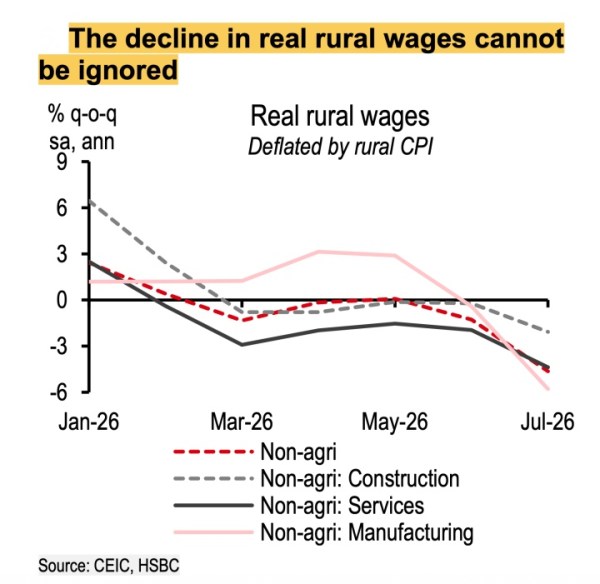 Chart 4.
“Winter sowing has started on a weak note with low soil moisture and depleted reservoirs. If El Niño-related heat leads to pre-maturing of crops by shortening the grain-filling period, this will further impact yields and hurt rural demand. Tractor sales have slowed, and non-durable demand remains weak (see CHART 5),” states the HSBC report. In the urban informal sector too, real wages are barely growing.
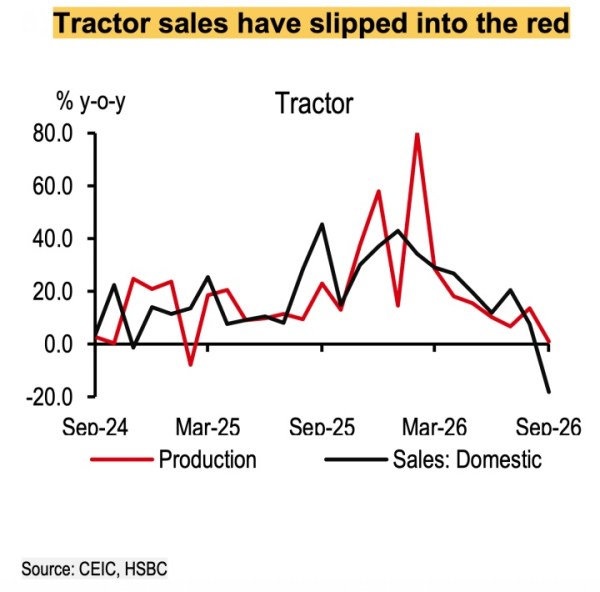 Chart 5.
In short, the old hurdle of weak consumption may hamper sustained investments by companies.
How do you look at the state of the Indian economy? Do you feel India’s economy is growing as fast as the official data claims?
KioskNews shows a cleaned-up reading view extracted from the publisher’s page — the original always lives on their site, not ours.