As King Charles heads to the Caribbean, he should know that Winston Churchill admitted to imperial plunder 90 years ago | Kenneth Mohammed
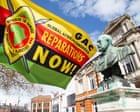
For us in the Caribbean, there is something surreal about Britain’s renewed nostalgia over empire. As Britain’s monarch prepares to visit the Caribbean, and at a time when we in the former colonies are demanding to have a serious reckoning with slavery and reparations, UK politicians are invoking a dumbed-down distortion of history.
Rewriting the facts: the Reform MP Robert Jenrick has argued that colonies owed Britain a “debt of gratitude” for the institutions empire bequeathed them. Jacob Rees-Mogg, a former minister in a Conservative government, has described British colonialism as “one of the greatest civilising, prosperity-creating forces the world has ever seen”. The opposition leader, Kemi Badenoch, has disputed colonialism’s contribution to Britain’s prosperity. Then there is Suella Braverman. The Reform MP suggested in July that rather than Britain paying reparations, former colonies should repay Britain for the investment and infrastructure provided under empire. This prompted Mia Mottley, the prime minister of Barbados, to call that proposition “asinine”. At best it is historical amnesia. At its worse it is an insidious misrepresentation of facts.
The question from a global development perspective is: who developed whom? We can ask Eric Williams, Walter Rodney, George Padmore or generations of African, Caribbean and Indian scholars. But there is one inconvenient witness that stands as a testimony to the truth. Winston Churchill.
On 20 July 1937, Churchill addressed the West India committee dinner at London’s Dorchester Hotel. Peter Hulme, emeritus professor of literature at the University of Essex, painstakingly reconstructed the provenance of that speech.
In it, Churchill reflected on how Britain became a global economic power. His words stark when placed alongside today’s politically sanitised recounts of empire. Britain’s possession of the West Indies and India, Churchill explained, provided “the strength, the support, but especially the capital, the wealth” that allowed Britain to survive its wars, dominate international commerce and establish its global commercial and financial leadership. Churchill was acknowledging that colonial wealth had financed the development of Britain.
Churchill’s surviving notes contained an even more revealing phrase: Britain’s Caribbean possessions had provided “that unexpected margin of capital”, an advantage Hulme describes as arising from two centuries of Caribbean slavery.
The conventional imperial story begins with what Britain left behind: railways, ports, courts, schools, parliamentary institutions, the English language and Christianity. It rarely begins with what Britain and Europe took away, or rather extracted, through exploitation and genocide. Railways and ports were integral to transporting colonial commodities to overseas markets. Colonialism was an exploitative and violent system designed solely for the benefit of the coloniser.
The Caribbean provides the clearest illustration. For generations, extraordinary wealth was produced through sugar by enslaved Africans and their descendants. Yet when slavery was abolished, Britain compensated not the enslaved but the enslavers.
Hulme’s reconstruction of Churchill’s dinner provides an almost grotesquely appropriate snapshot of that political economy. Among those present was Lord Hailsham, whose family fortune was connected to Caribbean sugar and enslavement; his ancestor Charles McGarel received £129,464 in compensation following abolition for 2,489 enslaved people. About £101m in today’s money, by Hulme’s calculation. The Register of British Slave Traders presents data on the 13,000 investors in the transatlantic trafficking of enslaved Africans. It reveals the impact on Britain’s development during its formative era. So, while the slave trade built generational wealth in Europe, it kidnapped and displaced about 13 million Africans, stealing and destroying their generational wealth.
While Churchill celebrated imperial achievement at the Dorchester, Caribbean workers were rebelling against their economic conditions. The 1930s saw strikes and disturbances across the British Caribbean. Movements demanding political representation and self-government were gathering strength. These must seem strange expressions of gratitude to the rehabilitators of colonialism. They ask what Britain built rather than what Britain extracted. They count railways but not resources. They celebrate institutions while ignoring who those institutions were originally designed to govern and whose interests they protected. That is the part of the “gratitude” argument that is so troubling. It asks us to judge colonialism through the eyes of the coloniser.
Most importantly, they treat development as something Britain bestowed upon the rest of humanity rather than a global historical process in which the labour, resources and markets of colonised peoples contributed heavily to Britain’s transformation. That is why the question of who developed who is consequential.
Which brings us to King Charles. From 27 October to 4 November, he will visit the Bahamas, Guyana and Antigua and Barbuda, culminating in the Commonwealth heads of government meeting. Buckingham Palace describes the visit in terms of community and a shared future. But is this royal diplomacy an attempt to contain or dissuade Caribbean demands for reparatory justice and constitutional independence?
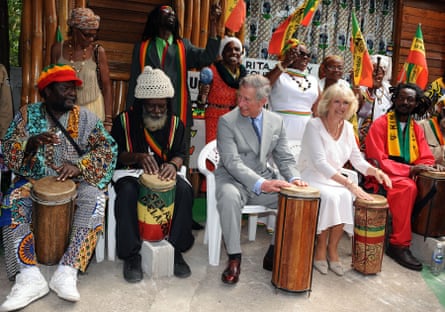
Britain faces growing demands to confront its colonial responsibilities. Jamaica is pursuing a legal route now. However, in 2014, several Caribbean countries attempted to sue the British government for reparations. Britain then used jurisdiction issues arising from the Commonwealth to block the claim. Caribbean and some African governments continue to press for dialogue yet several, seemingly suffering from Stockholm syndrome, persist in retaining the British monarch as head of state: Antigua and Barbuda, Bahamas, Belize, Grenada, Jamaica, St Kitts and Nevis, St Lucia, and St Vincent and the Grenadines.
Buckingham Palace has already confirmed that Charles will not formally apologise for Britain’s involvement in slavery. Apparently, apologies and reparations are matters for government, which opposes paying reparations. Charles has expressed personal sorrow over slavery and described it as an atrocity. But sorrow without accountability is a meaningless attempt at appeasing the “natives”.
after newsletter promotion
The Commonwealth presents itself as an association of equal, independent nations, committed to democracy, development and cooperation. Its supporters point to diplomatic access, technical assistance, educational opportunities, election observation and collective influence on the climate crisis, debt and development. But membership must be judged by outcomes, not colonial sentiment.
If Commonwealth countries cannot secure meaningful engagement from Britain on one of their most consequential historical grievances, how equal is the relationship in practice? What influence do smaller members genuinely exercise over the priorities of the organisation’s wealthiest and most powerful states? And does membership provide sufficient economic and diplomatic benefits to justify its continued symbolic association with an empire whose historical injustices remain unresolved?
These questions are particularly relevant to Caribbean states confronting climate vulnerability, high debt burdens and persistent structural economic disadvantage. The Commonwealth cannot remain an instrument of British soft power, where royal receptions and appeals to shared history substitute for substantive economic justice. Therefore, proposals on reparations warrant serious negotiation, even where governments disagree about legal liability and historical responsibility.
As King Charles arrives in the Caribbean, there will be welcoming ceremonies and speeches about friendship and solidarity. But these crucial questions remain unanswered.
Churchill concluded, on that now-forgotten evening in London: “We could never forget the patriotism and loyalty of the West Indies in those historic times to the mother country.”
The Caribbean should welcome genuine partnership. It need not accept neocolonialism and historical amnesia as its price.
KioskNews shows a cleaned-up reading view extracted from the publisher’s page — the original always lives on their site, not ours.