US orbital weapons acknowledgement a "landmark" move, US Space Command official says
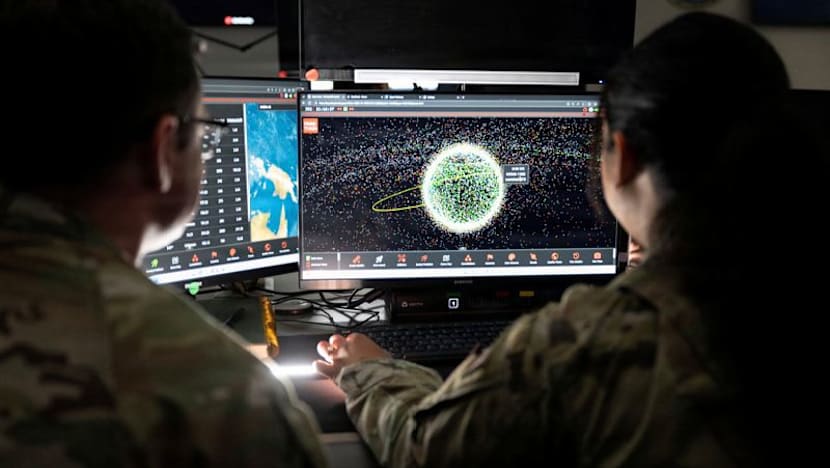
US Air Force Secretary Troy Meink acknowledged on Monday that the US has weapons in space.
16 Sep 2026 02:36AM
WASHINGTON: The US Air Force chief's acknowledgment this week that the Pentagon has weapons in orbit is a "landmark" moment in the rising militarisation of space aimed at deterring aggression against Washington's allies and economic interests, a US official said.
US Air Force Secretary Troy Meink at a conference in Washington on Monday said Washington "has on-orbit space control weapons capable of defending the Joint Force against hostile adversary action," the strongest admission yet by a Pentagon official on US weapons in space amid rising space tensions with Russia and China.
"The acknowledgment of these space-control capabilities is fundamental to ensuring that we prevent deterrence from failing, and that we are postured and ready should deterrence fail to employ them effectively," Richard Palmer, the director of Capability and Resource Integration Directorate at US Space Command, said on Tuesday.
Speaking at a space-defence conference hosted by consulting-firm Novaspace in Paris, Palmer added that there are “some actors across the globe who are very much interested in undermining the collective interests of the countries and allies gathered here in this audience and across Europe and the rest of the world.” He declined to discuss the nature or capability of those weapons.
"The bottom line is that our joint force and our allied forces require space. Our economies require space,” added Palmer. “We are ready in the US to preserve that."
It underscores how the world’s major space powers are preparing for the prospect of conflict extending into space. Satellites have become indispensable to modern warfare, as conflicts in Ukraine and the Middle East have demonstrated.
For decades they have provided communications, navigation and intelligence services to armed forces on Earth, and once placed in orbit typically remained on fixed paths. Increasingly, however, militaries view them as active weapons platforms capable of launching attacks by disrupting a satellite’s operations through jamming or laser dazzling, or even capturing enemy spacecraft.
The head of US Space Command has warned that adversaries are developing capabilities to deny the United States access to key systems and reduce military effectiveness, and that adversaries would likely seek to target US space assets early in a conflict. He has argued that the US must adopt a more active warfighting posture, including calling for orbital interceptors and other weapons.
Some other countries are also looking to develop orbital weapons. That includes Germany, which has a 35-billion euro military space spending plan aimed at countering growing threats from adversaries.
Major General Michael Traut, the head of German Space Command, has previously said that as part of that the country will channel funding into intelligence‑gathering satellites, sensors and systems designed to disrupt adversary spacecraft. Traut emphasized that Germany would not field destructive weapons in orbit that could generate debris, but said a range of non-kinetic options existed to disrupt hostile satellites, including jamming, lasers and actions against ground control stations.
KioskNews shows a cleaned-up reading view extracted from the publisher’s page — the original always lives on their site, not ours.