John Ivison: There’s more to the Stelco shutdown than Trump winning and Canada losing
“We’re going to win everything… Canada is going to come in and say: ‘Sir, we are very sorry’.”
Sign In or Create an Account
U.S. President Donald Trump told reporters in the White House on Monday that he thinks a trade deal with Canada that gets rid of tariffs will be struck, possibly within three to four weeks.
The impression left by the president is that all the pain from the trade war is being felt on a Canadian side that is ready to kow-tow and submit to his authority.

Columnist Jesse Kline keeps you up to date with what’s happening in Israel and the effects of antisemitism on life here in Canada. Friday mornings.
By signing up you consent to receive the above newsletter from Postmedia Network Inc.
A welcome email is on its way. If you don't see it, please check your junk folder.
The next issue of Channel Israel will soon be in your inbox.
We encountered an issue signing you up. Please try again
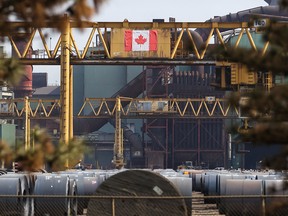
Steel producer Stelco has told customers that it is “indefinitely idling” the cold-rolled and coated lines at its Hamilton, Ont. works because of tariffs, impacting 350 jobs.
On the same day, Trump unveiled plans for a US$15-billion steel mill in Iowa that will create 1,750 jobs: a timely announcement, given Iowa’s Senate seat is a toss-up in the looming midterm elections.
“The steel industry is roaring back to life. Everyone’s building their plants here because they don’t want to pay tariffs,” the president said.
On this evidence, there is so much winning for the White House — and, just as importantly, so much losing for Canada.
The whiners on social media were out in force. “(Mark) Carney is the world’s best talker and the world’s worst negotiator,” was the reaction of one person, and there were many others lamenting Canada’s lack of leverage.
To be fair to the president, there are signs that his efforts to lure manufacturing jobs back to the U.S. are paying off.
American voters will decide in the midterm elections whether a marginal increase in manufacturing employment is worth the increase in the cost of living and the scapegoating of loyal allies.
But the Stelco case does not indicate that Canada is heading for humiliating defeat.
For one thing, the Canadian economy is proving more resilient than many predicted. The GDP numbers for July were flat, but advanced estimates for August indicate the economy remains on course for third-quarter growth (annualized) of 1.8 per cent.
Canada’s economy is still expanding, despite the trade war.
The government pointed to Tuesday’s announcement by LNG Canada (a consortium of five global energy companies) that it plans a massive $30-billion expansion to its Kitimat, B.C. terminal as indicative of the sense of possibility that still exists.
At the announcement in B.C., Wael Sawan, Shell’s global CEO, said the expansion is a sign of confidence in Canada as a place to invest and do business.
Carney said the commitment to build the second largest LNG facility in the world is a demonstration that “Canada is working.”
“(We) fully value export diversification and the greater sovereignty it confers,” he said.
Another reason that too much should not be read into the Stelco announcement is that it is an atypical case. The company is owned by the U.S.-company Cleveland Cliffs, whose chairman, Lourenco Goncalves, is a vocal supporter of the president and his tariff policy.
Canadian officials say privately it seems as if Goncalves wants to shut the Hamilton plant. They say the company made unrealistic demands on Ottawa, including a call for billions in loans, without employment security or payback conditions.
The federal government has responded to U.S. tariffs with support programs like the $1-billion liquidity fund administered by the Business Development Bank and $500 million for smaller firms through the Regional Tariff Response Initiative.
Canadian primary steel producers have traditionally exported half their output to the U.S.
Tariffs have closed that market and companies such as Stelco were forced to sell exclusively in Canada.
Canadian production was in decline, even before the tariffs, falling to 12.2-million tonnes in 2023 from 16.6-million tonnes in 2000.
The government has responded by trying to boost domestic demand and limiting imports.
Tariff rate quotas have been adjusted to reduce the amount of subsidized foreign steel entering Canada, which used to account for two-thirds of demand.
Steel volumes from countries without free-trade agreements with Canada are now set at 20 per cent of 2024 levels tariff-free, after which a 50 per cent tariff applies. Officials suggest imports of flat-rolled steel have fallen by a third, which directly benefits domestic businesses.
Yet Stelco refused all help, including last-minute emergency funding that would have sustained operations and avoided layoffs, one official claimed.
The Stelco news is a reminder of the real human impact of Trump’s zero-sum games.
Anyone who has ever lived in Hamilton (as I have) knows steel is at the core of its identity, its economy and its blue-collar culture. Hundreds of well-paying jobs are not easily replaced.
Fingers will be pointed in Ottawa’s direction, but the blame rests squarely in the White House and in the executive suite at Cleveland Cliffs.
Strangely, the Stelco news makes a deal more likely. Carney’s biggest challenge may have been convincing Canadians that any kind of accord with Trump is desirable. The prospect of job losses may dampen bravado.
But if a deal is struck, it will not be because Trump is “winning everything.”
The president was specific about an agreement in “three to four weeks,” conveniently in time for the crucial U.S. midterm elections on November 3.
Predictive markets suggest Senate seats in Republican strongholds including Alaska, Iowa, Ohio, Maine, Michigan, North Carolina and Texas are in play. Most of those states count Canada as their No. 1 export destination.
Ottawa has leverage and Canadians should hold their nerve.
A deal is likely, but no one is going to rush, cap in hand, to the White House to apologize and accept whatever terms the president dictates.
If an agreement emerges, it will be because domestic pressures on both sides of the border have forced the protagonists to seek a messy mutual accommodation where neither side gets everything it wants.
National Post
Join the Conversation
This website uses cookies to personalize your content (including ads), and allows us to analyze our traffic. Read more about cookies here. By continuing to use our site, you agree to our Terms of Use and Privacy Policy.
KioskNews shows a cleaned-up reading view extracted from the publisher’s page — the original always lives on their site, not ours.