US, China botanists sign landmark proposal on cooperation, global issues and projects
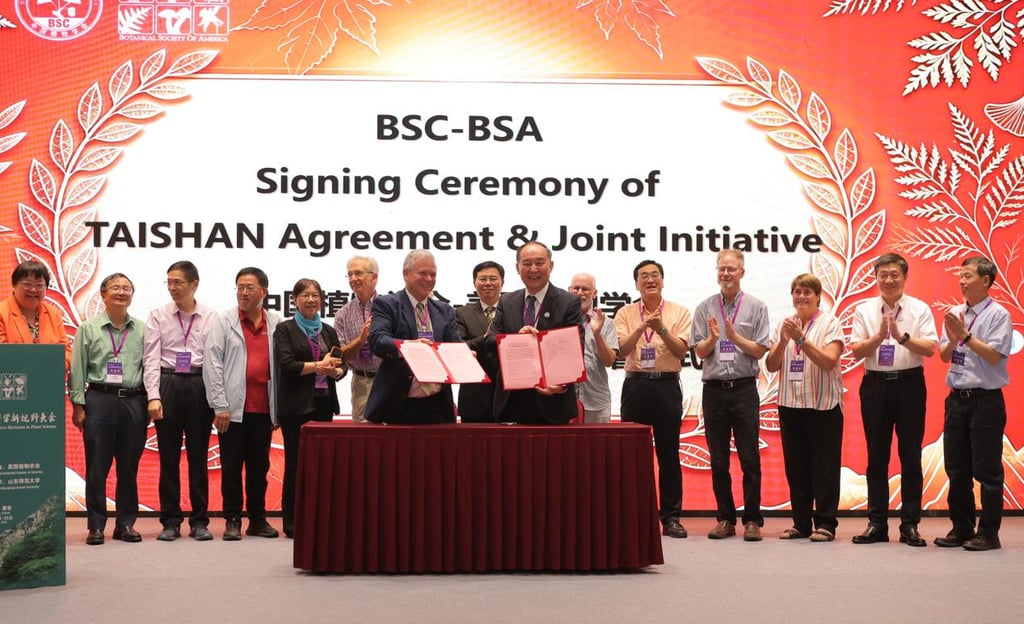
The botanical societies of the United States and China have signed a plant science cooperation initiative, vowing to strengthen bilateral ties and foster an open scientific community to tackle global issues.
The joint initiative was signed during a Sino-American botany conference last month in Taian, in China’s eastern Shandong province, which brought together hundreds of experts from institutions in both countries.
The conference, held from September 19 to 23, aimed to “further deepen botanical exchange and cooperation between China and the United States and to establish an international platform that fosters interdisciplinary integration in plant science”, according to the Botanical Society of China.
01:16
Xi recounts US teacher’s donation to fight desertification in China as example of Sino-US friendship
Topics such as conservation, plant biotechnology, climate change and an international plant megaproject were discussed, the China Science Daily reported.
In proposals under the initiative, the Botanical Society of China and the Botanical Society of America noted that plant science was a critical pillar for addressing global ecological issues, particularly as climate change intensifies.
“Now more than ever, our scientific communities share a vital responsibility to maintain and strengthen international collaboration,” they said.
“Open academic interchange is vital for addressing global challenges, promoting the cross-border flow of talents, insights, as well as data and scientific methodologies sharing.”
The societies said they remained committed to ensuring that international cooperation was an “uninterrupted bridge” for progress and that they would improve mechanisms for cooperation, including academic exchange, joint research and resource sharing.
The conference and joint initiative came just ahead of Chinese President Xi Jinping’s highly anticipated visit to Washington and summit with US President Donald Trump.
While scientific collaboration between China and the US has taken a major hit in recent years because of heightened geopolitical tensions and anti-China initiatives, the botany and plant science communities have continued to maintain cooperation.
Harvard China Fund executive director Dorinda Elliott has written about how “Covid and worsening US-Chinese relations haven’t stopped that collaboration [between botanists] – despite the difficulties in international travel during the pandemic.”
The collaboration included the sharing of specimens and joint research, she says in the article on the Harvard China Fund website.
In 1972, then-US president Richard Nixon took a redwood sequoia sapling to China on a visit that ended decades of isolation between the two countries. The tree is still living at the Hangzhou Botanical Garden.
In 1978, a delegation from the American botanical society visited China to tour institutes and carry out exchanges with Chinese scientists, laying the groundwork for future collaborations and visits.
A paper published in the journal BioScience the following year by a member of the delegation said that Chinese scientists “admitted openly the great gap in science between our country and theirs; they are determined to catch up by the year 2000”.
The first Sino-American botanical expedition in China was conducted in 1980, where researchers collected thousands of samples that were distributed to botanical institutions globally, according to Harvard University’s Arnold Arboretum.
In the 2026 Nature Index, which tracks high-quality research publications, the Chinese Academy of Sciences ranked first among leading institutions in the field of plant biology, with Chinese institutes making up all but one spot in the top 10.
Plenary and keynote speakers for the 2026 Sino-American Conference included researchers from the Chinese Academy of Sciences, Peking University, Fudan University, Yale University, Harvard University and the University of British Columbia.
Zhong Kang, also known as Chong Kang, president of the Chinese Botanical Society, told the conference that deepening strategic cooperation was a pragmatic move between the societies to focus on the long-term development of the field, according to the China Science Daily.
05:43
‘Green miracle’: retired US teacher visits China forest he helped fund over 2 decades ago
The two botanical societies urged the plant science community to expand research into fundamental biological processes. This work would aim to enable environmental conservation and the sustainable production of food, fuels, pharmaceuticals and industrial products, they said under the initiative.
“We must build bridges, not silos, to realise the conceptual and technological innovation that will be required to meet the challenges of increasing demand for resources in the face of global change,” they pledged.
They also proposed that research standards and frameworks be set for the responsible development of plant science, including frontier areas such as synthetic biology and biotechnology.
KioskNews shows a cleaned-up reading view extracted from the publisher’s page — the original always lives on their site, not ours.