Not a Bahima: Meet the Couple Behind Egypt’s Viral Driving Etiquette Page
Imagine driving in Egypt for years, confident you know your way around the road. Then you move to a foreign country, sit behind the wheel for a driving test, and fail. Three times.
In Egypt, a parking spot can become a battleground, and a one-way street can turn into a head-on standoff. And it is all because someone decides the rules are optional. If you have ever sat behind the wheel wondering whether you are the problem or everyone else has lost their mind, Not a Bahima (Not A Brute) is the Instagram page that gets it and turns the chaos of Egyptian roads into comedy,
Launched on 7 October 2026, the page uses a character called Bahima to demonstrate exactly what not to do behind the wheel. In just a couple of weeks, it has attracted around 67,000 followers, striking a chord with drivers all too familiar with the daily frustrations it pokes fun at.
Behind the animated character are Tarek Elsamni and his wife, Yasmen Khorshed, the couple who created the page. In an exclusive interview with Egyptian Streets, Elsamni reveals his identity and explains how years of driving, living abroad, and growing increasingly exasperated with Egyptian roads inspired the project.

It started with one word: Bahima
For Elsamni, who is now 36 years old, the idea did not begin with a carefully planned social media strategy. It began on the road.
He says he has been driving since he was around 16, but his understanding of driving changed after moving abroad. Having spent the past 12 years living between Britain and several European countries, he eventually learned to drive in Denmark, where he had to take the driving test three times before finally passing.
The experience made him reconsider habits he had previously taken for granted.
“When I learned to drive in Denmark, I realised there were so many things I had been doing wrong in Egypt,” he says.
After returning to Egypt in 2024, he began noticing those habits everywhere. His wife, who was also adjusting to driving in Egypt, would ask him why someone had made a particular crazy manoeuvre on the road. His answer became a running joke between them: “Bahima.”
The word, which translates roughly to “animal” or “beast,” became their shorthand for the absurdities they encountered on the road. But, Elsamni eventually grew tired of merely reacting to them.
He recalls stopping his car to explain traffic rules to other drivers, sometimes spending what felt like a quarter of his day trying to explain what someone had done wrong.
“It became exhausting,” he says. “So I decided to create a character, make videos, create a sound, and build a brand around it while translating everything I see on the street every day.”
That character became Bahima who is a comedic stand-in for the driver who blocks an intersection, parks across a lane, or behaves as though the rules of the road apply to everyone except them.
The idea was not simply to tell people how to drive. It was to make bad driving look ridiculous enough that people might recognise it in themselves.
It is Not Just About the Roads
For Elsamni, bad driving cannot simply be blamed on the condition of Egypt’s roads. He points to the fact that the same behaviour can be found inside gated compounds such as Mivida, where drivers still make the kinds of decisions that Not a Bahima criticises.
He also argues that road markings are not the whole explanation. While some streets may lack clear lane markings, he says roads in other governorates have visible lines that drivers can follow. Their presence, however, does not automatically mean that everyone respects them.
For Elsamni, the issue is therefore not only the infrastructure drivers have to work with, but also how they choose to behave within it. Poor road conditions may create challenges, but they cannot serve as a blanket excuse for ignoring basic driving etiquette.
The joke is on the behaviour, not the person
The name might sound like an insult, but Elsamni says the distinction lies in what the page is criticizing.
“We are not insulting people,” he explains. “We are talking about a character. There can be a character called Bahima.”
He argues that the behaviour being mocked is often something drivers themselves would never want to do to others. Nobody wants to block an ambulance, he points out, or leave their car in the middle of the street and make life harder for everyone else.
“We want to be as far away from those actions as possible,” he says. “We do not want to do the things that Bahima does.”
The humour, then, is meant to make the behaviour look ridiculous rather than turn road safety into a lecture. Instead of simply telling viewers to stay in their lanes or respect traffic signals, the page gives bad driving habits a personality that is easier to recognise, laugh at, and hopefully reconsider.
And, the character is beginning to travel beyond the couple’s own videos. Elsamni says the page has attracted attention from people beyond its regular audience, including Egyptian rapper Wegz. The interest reflects how a subject as familiar as driving can find an audience well beyond those who initially follow the account.
As the page grows, Elsamni says, messages and suggestions from viewers have also helped inspire new scenarios. The audience is not just watching Bahima; it is helping shape what the character does next.
From QR-code stickers to a board game
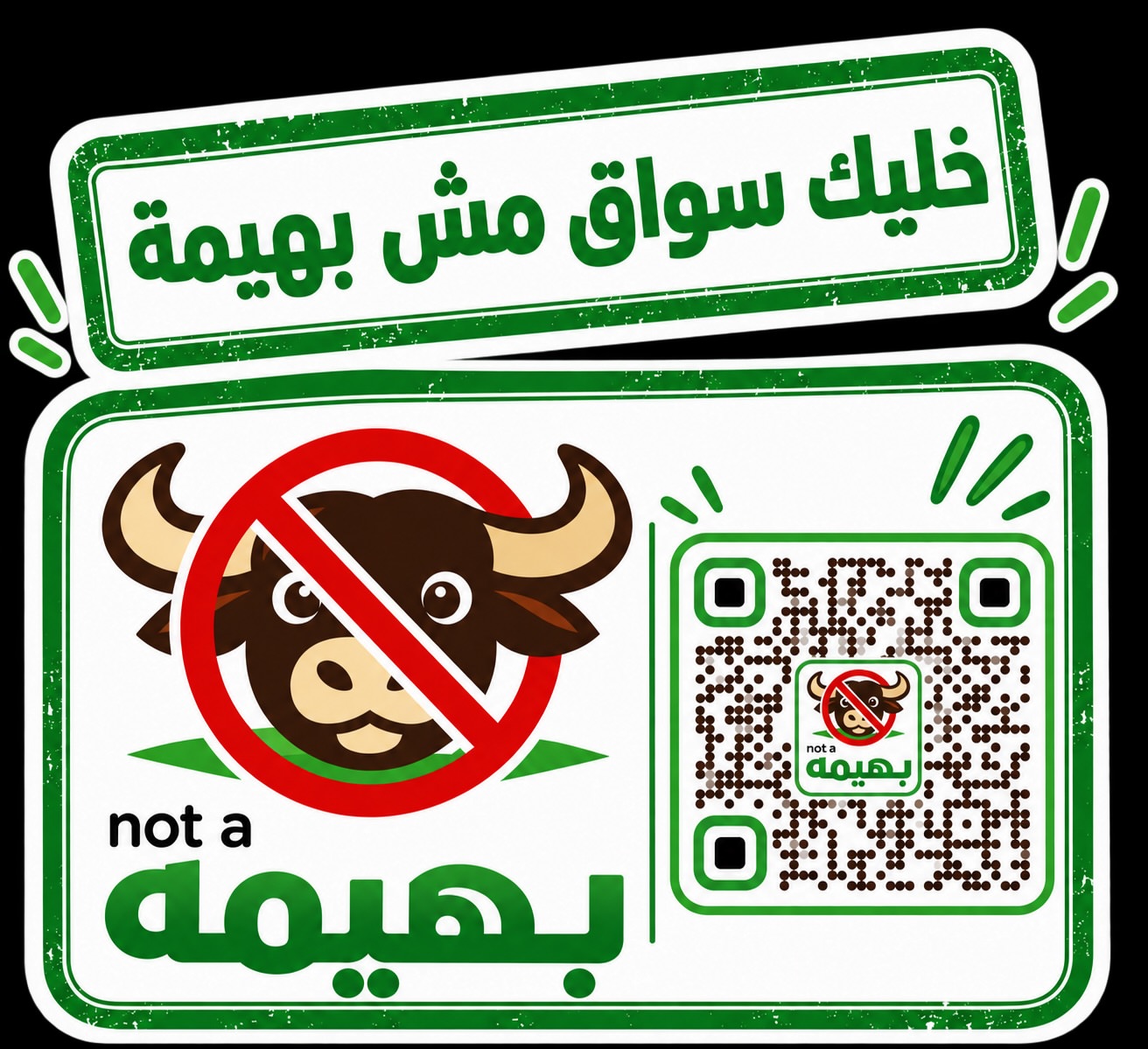
And apparently, the name itself has become part of the appeal.
Elsamni recalls a friend using a sticker featuring the page’s identity to call attention to another driver’s mistake. The concept has since prompted the team to consider producing stickers of its own, potentially making them available for sale.
The idea is simple: a driver could show another driver a sticker with a QR code that leads to a video explaining the particular driving mistake in question.
Rather than getting into an argument at the next traffic light, the sticker could offer a more useful quick explanation of what went wrong and why.
It would also give the page a physical presence on Egypt’s roads, turning its online videos into a possible tool for everyday interactions between drivers.
For a project born out of the exhaustion of repeatedly explaining traffic rules to strangers, it is an appropriately on-brand solution. Why argue for ten minutes when you could point someone towards a 45-second video? The sticker idea is still a possibility the team is exploring.
There is another idea in the works, too: a Not a Bahima board game.
Elsamni says the couple have been thinking about a game for between two and eight players, built around familiar traffic situations and the decisions drivers make. A player might find someone blocking their parking spot, for example, and have to work through what happens next. A guide would explain the traffic rules connected to the situations in the game.
The concept would bring the page’s central idea into a different setting, allowing people to engage with driving etiquette through play rather than a lecture. It could also take the brand in a new direction, using the same everyday frustrations that fuel the reels to create an offline experience.
For now, the board game is an idea being explored, not a product with an announced release date. But it points to a larger ambition: making traffic rules and considerate driving part of everyday conversation, both online and off.
Behind the reels: A carefully built identity

The videos might feel spontaneous, but the creative process behind them is more structured than viewers might expect.
Elsamni says the team has worked to establish a consistent identity for Bahima, from the character’s appearance and car to the colours, captions, and distinctive sound used in the videos. The setting also mattered. They made sure the recognisable Egyptian details help the character feel rooted in the streets viewers know.
The videos are short, usually between 30 and 60 seconds, and each begins with a driving behaviour the page wants to address. Elsamni and Khorshed use AI tools to help develop scripts and visual concepts, refining the results until the story and dialogue work for the intended comedic effect.
Khorshed and Elsamni then assemble the video, add its captions and sound, and prepare the final version for social media.
AI has also contributed to some of the page’s biggest surprises.
Elsamni recalls a video he had initially planned to produce in another format but ended up creating in a very minimalistic way after a busy day disrupted his plans. The result performed better than the team expected, reaching around 1.5 million views in 24 hours, according to his account.
It was a reminder that even the people making the content cannot always predict what audiences will embrace.
“You should always test things,” he says, explaining that creators should not rely solely on their own assumptions about what will work.
The team also experiments with how it introduces videos to audiences, using Instagram’s tools to test content with people who do not already follow the page before sharing it more widely.
Still, the production process is only part of the explanation for the account’s growth. The other part is the subject itself.
As the page has grown, Elsamni says messages have started arriving across its social media platforms from people describing the driving problems they encounter. Those messages have become another source of ideas for future videos, giving the page a steady supply of material drawn directly from everyday experiences.
In other words, the audience is not just watching Bahima. It is helping write the next episode.
Can a few funny videos change how Egypt drives?
For all the jokes, Elsamni is clear that he does not believe social media videos alone can solve Egypt’s traffic problems.
He points to the frustration people feel when they repeatedly encounter dangerous or inconsiderate driving, while recognising that changing behaviour on a wider scale is difficult.
“We don’t know whether we can change a community with a few posts on social media,” he says. “But we can try.”
For him, the point is not to pretend that a viral reel can replace enforcement, better planning, or effective traffic rules. It is to create a small opening for people to recognise their own behaviour and perhaps reconsider it before someone else has to slam on the brakes.
The message also forced Tarek to look at his own driving.
One morning, while driving his daughters to school, Tarek found himself doing exactly the kind of thing that Not a Bahima was created to call out. His daughters pointed out that his behaviour behind the wheel was no different from the driving habits he criticised in his videos.
The moment made him confront the gap between the rules he wanted other drivers to follow and his own actions on the road. Rather than risk repeating the same mistake by rushing to get them to school on time, he decided to leave home 15 minutes earlier. The change was a small but personal reminder of the page’s message. Better driving starts with recognising your own mistakes, not just pointing out everyone else’s.
He also sees the page as a way to offer people a little hope when they feel that nothing is changing.
“Sometimes people feel completely hopeless, and then suddenly they see a glimmer of hope,” he says.
That hope is modest, but the ambition behind the page is bigger than its punchlines suggest. Elsamni wants the content to connect with the everyday reality of driving in Egypt, where a seemingly minor decision such as stopping in the wrong place, cutting across a lane, or ignoring who has the right of way can affect everyone sharing the road.
And, if the message lands better when delivered by a ridiculous character than through another stern reminder to follow traffic rules, so be it.
KioskNews shows a cleaned-up reading view extracted from the publisher’s page — the original always lives on their site, not ours.