Federal government has paid out $83.2 billion to First Nations over lawsuits since 2007: report
A new report from the Fraser Institute calculates that the federal government has paid out more than $110 billion to First Nations for lawsuit and class action settlements since 1974, with the vast majority of that amount coming from recent class action lawsuits.
Sign In or Create an Account
Class action payments since 2007 have cost the government an estimated $83.2 billion, the report found. That’s 73.5 per cent of all payouts since 1974.
This is outside of what Canada already spends on Indigenous issues. Last year, the budget included $25.3 billion for the Department of Indigenous Services, and $16.5 billion for the Department of Crown-Indigenous Relations and Northern Affairs. That was more than the country spent on its defence budget of $33.9 billion.

Get a dash of perspective along with the trending news of the day in a very readable format.
By signing up you consent to receive the above newsletter from Postmedia Network Inc.
A welcome email is on its way. If you don't see it, please check your junk folder.
The next issue of NP Posted will soon be in your inbox.
We encountered an issue signing you up. Please try again
The report, Compensation for Past Treatment of Indigenous People, focuses on federal Indigenous spending based on rectifying past grievances and offering compensation through treaty negotiations, lawsuits and settlements, with an emphasis on British Columbia. It was released this month.
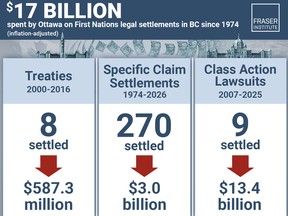
In B.C. alone, treaty settlements from 2000 to 2016 amounted to $587 million in payouts, and specific claims settlements, of which there were 270, came to $3 billion. But a small number of class action lawsuits settled between 2007 and 2025 added a further $13.4 billion to the total.
Numbers from the rest of Canada tell a similar story. In the past 52 years, the federal government has given an estimated $113.2 billion (adjusted for inflation) to First Nations in Canada as payouts for lawsuits and class action settlements.
“Most Canadians are not aware of the enormous payments Ottawa has made to First Nations to settle legal claims and class action lawsuits,” said Tom Flanagan, Fraser Institute senior fellow and co-author of the report.
Of this, some $29.4 billion or about a quarter of the total amount was to settle specific claims — essentially cases where a court ruled the federal government had violated treaty rights or the Indian Act in the past.
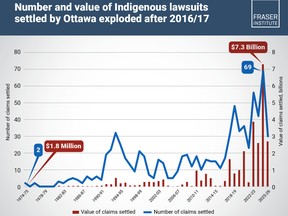
There has been a distinct increase in the number and value of those claims settlements by Canada for violations of the Indian Act or of historic treaties, the report found.
The Indian Act, first introduced in 1876, is the primary law the federal government uses to deal with First Nations governments and the management of reserve land. It also outlines governmental obligations to First Nations peoples.
Manitoba Premier Wab Kinew this week called on the federal government to abolish the Act, showing his status car to reporters in Ottawa. Kinew is Anishinaabe from Onigaming First Nation in Ontario.
“I don’t know how many folks in Canada have seen one of these before, but this is a status card, and it says your friend Wab Kinew is an Indian, within the meaning of the Indian Act,” he said. “I’m not sure if that lines up with your vision of Canada, that we still have a race-based form of identification in this country. But this is a reality.”

In 1974, there were two settlements valued at $1.8 million. But the numbers started to rise significantly beginning in 2017. By 2024, the peak year for payouts so far, there were 69 settlements valued at $7.3 billion. The following year saw a decrease to 30 settlements valued at $2.7 billion.
However, specific claims are only one form of legal compensation for First Nations. Increasingly, class actions and other litigation based on claims of mistreatment or rights violations have been brought against the federal government, including for residential schools, the “sixties scoop” and safe drinking water. Settling class action suits has cost Canada an estimated $83.2 billion since 2007.
Since that year, nine class actions or their legal equivalent have been settled by the federal government. The total value of $83.2 billion includes payments to individual Indigenous people ($49.4 billion) and payments to First Nations and other organizations ($33.8 billion).
“Because Ottawa’s compensatory payments are for historical wrongs, the number of claims — and the amount taxpayers need to pay — should be going down, not up, but that is not the case,” Flanagan noted.
“The significant amount of money that the federal government has paid out, particularly in recent years, acts as an incentive to attract even more legal claims and class action lawsuits to be filed,” he added. “This all begs the question of whether or not these efforts are improving the wellbeing of Indigenous populations in Canada.”
The report found that, as of Aug. 11, 10 claims had been settled for a total of $250 million in fiscal 2026–27. “It is too early to tell whether this decline in the pace of settlement is a harbinger of the future,” it noted.
The report combed through data from various government agencies, and includes more than three pages of references.
“As of September 8, 2026, there were still 694 claims being considered in the administrative process of the Specific Claims Branch, plus another 99 in active litigation, either before the Specific Claims Tribunal or ordinary Canadian courts,” it added. “With so many unsettled claims, the future will depend on how much resistance subsequent federal governments wish to display in the courts or at the negotiating table.”
Data specific to British Columbia found that eight treaties were finalized by the federal government with B.C. First Nations between 2000 and 2016, representing $587.3 million. This represented an average payment of $68,318 for the 8,596 Indigenous People covered.
Our website is the place for the latest breaking news, exclusive scoops, longreads and provocative commentary. Please bookmark nationalpost.com and sign up for our newsletters here.
Join the Conversation
This website uses cookies to personalize your content (including ads), and allows us to analyze our traffic. Read more about cookies here. By continuing to use our site, you agree to our Terms of Use and Privacy Policy.
KioskNews shows a cleaned-up reading view extracted from the publisher’s page — the original always lives on their site, not ours.