SkyGuardian drones bought from US tested, source says
The first two of the four MQ-9B “SkyGuardian” drones Taiwan purchased from the US underwent their first flight tests at an air base in eastern Taiwan early yesterday, a source familiar with the matter said.
The unnamed source did not disclose further details about the test flights, saying that they were conducted at Hualien Air Base.
The tests were conducted after the military and the drone manufacturer completed the assembly of the two drones delivered to Taiwan earlier this year, the source added.
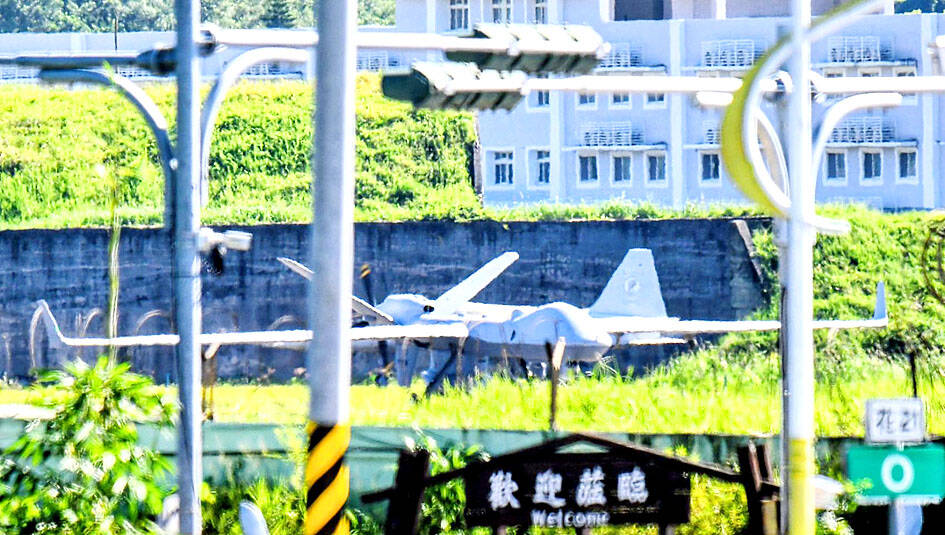
An MQ-9B drone taxis at Hualien Air Base yesterday. A retired F-5E jet serving as a decoy aircraft is visible in the background.
Photo: Yu Tai-lang, Taipei Times
On March 17, Deputy Minister of National Defense Hsu Szu-chien (徐斯儉) and Representative to the US Alexander Yui (俞大?) attended a handover ceremony in the US for two of the MQ-9Bs.
The US has agreed to deliver the four MQ-9Bs to Taiwan in two batches this year and next year.
The MQ-9Bs would provide Taiwan with “intelligence, surveillance and reconnaissance, target acquisition, and counter-land, counter-sea and anti-submarine strike capabilities,” according to the US Defense Security Cooperation Agency.
Su Tzu-yun (蘇紫雲), a research fellow at the government-funded Institute for National Defense and Security Research (INDSR), previously said that the role of the MQ-9Bs in Taiwan is to enhance battlefield reconnaissance and surveillance capabilities rather than serve as a primary offensive weapon.
INDSR researcher Hsieh Pei-shiue (謝沛學) wrote in 2020, when the US first approved the sale to Taiwan, that the drone is capable of linking to satellite communications networks shared among US allies.
That means Taiwan and the US could share battlefield intelligence instantly, providing opportunities for the two sides to cooperate during a conflict.
For example, if a cross-strait conflict breaks out, Washington could take advantage of anti-ship missile systems deployed along the First Island Chain to prevent Chinese People’s Liberation Army vessels from sailing into waters east of Taiwan to blockade the nation, Hsieh said.
MQ-9Bs are capable of long-term, long-range surveillance, meaning the drones could fly near Chinese vessels and provide critical intelligence for US forces to target them, Hsieh wrote at the time.
Another INDSR researcher, Kao Chih-jung (高志榮), yesterday cautioned that while the MQ-9B can detect and classify a large number of targets at once, it still requires final visual identification by human operators.
That limits the drone to conducting detailed, continuous surveillance on only two or three targets simultaneously, Kao said.
Consequently, the military should not rely solely on a handful of large drones, but should instead utilize the MQ-9B to conduct wide-area scans and designate high-value targets, he said.
That intelligence could then be distributed to small and medium-sized drones, shore-based radars and other combat units to build a more resilient “integrated reconnaissance and strike” network, he added.
KioskNews shows a cleaned-up reading view extracted from the publisher’s page — the original always lives on their site, not ours.