India seeks to expand navy’s reach with 4 amphibious warships
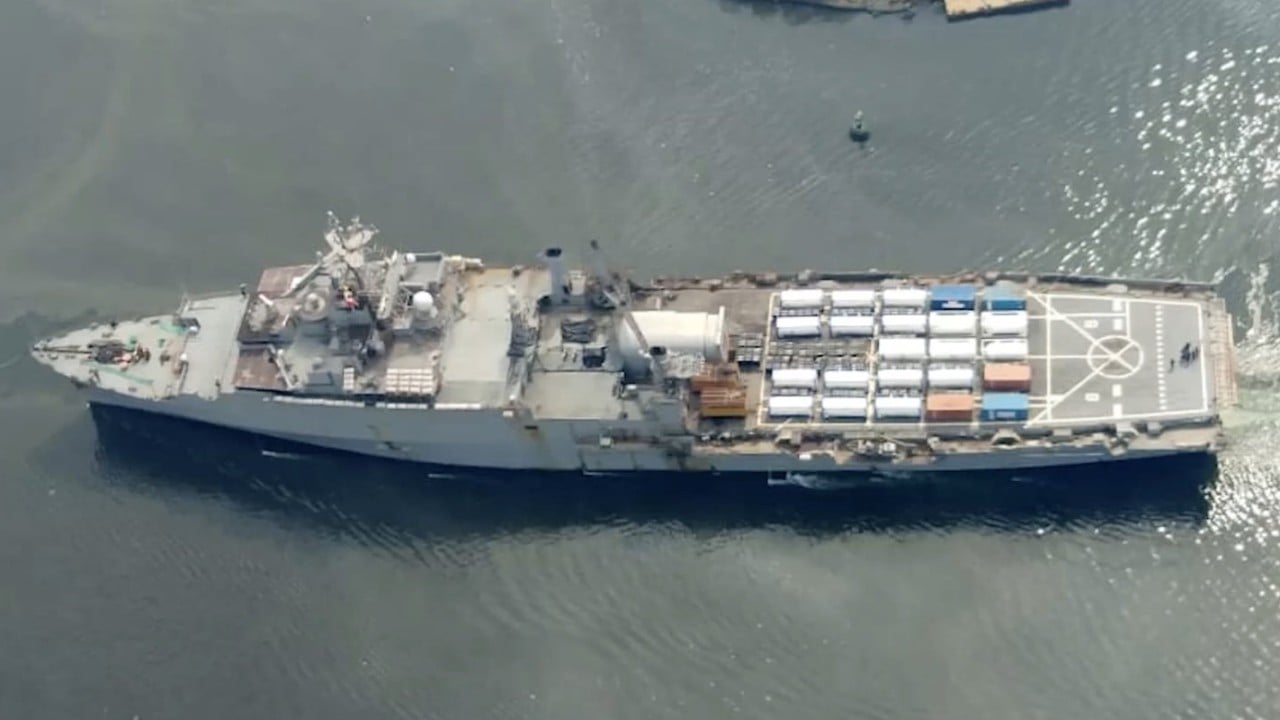
India’s planned acquisition of four large amphibious warships would strengthen its ability to support naval logistics and humanitarian missions across the Indian Ocean, with security experts saying their value depends on how the navy could effectively utilise them during a crisis.
The Indian Navy has invited bids for four landing platform docks (LPDs), each with a displacement of more than 30,000 tonnes. Indian Navy Vice Chief Vice Admiral Ajay Kochhar said at a media briefing on Monday that a request for proposal had been issued to shortlisted shipyards the previous week.
The four LPDs will be built in India, with their electric propulsion systems being developed under an India–UK defence partnership. The latter was announced during a meeting between Indian Prime Minister Narendra Modi and then UK prime minister Keir Starmer in Mumbai in October last year.
With a length of 220 metres each, the ships are estimated to cost nearly US$5.3 billion in total and can accommodate up to 900 fully equipped army personnel, vehicles, tanks and artillery. They will feature specialised landing craft to ferry troops and equipment ashore, two heavy-lift helicopters and 12 helicopters for special operations, as well as onboard workshop facilities.
Walter Ladwig, a senior lecturer in international relations at King’s College London, said the ships would significantly improve the Indian Navy’s ability to deploy and sustain its forces across distant waters.
“These ships could evacuate civilians, deploy peacekeepers and provide logistical support to friendly states,” he said, adding that their helicopter decks, medical facilities and landing craft would be useful to respond to natural disasters and other emergencies.
Given the complexities of modern conflicts, the LPDs would require substantial support from other naval assets to deal with threats from submarines, drones and anti-ship missiles, he added.
The ships would not be effective for amphibious assaults, said Ladwig, noting that the last major amphibious campaign that took place during a conflict against a conventional military was the Falklands War.
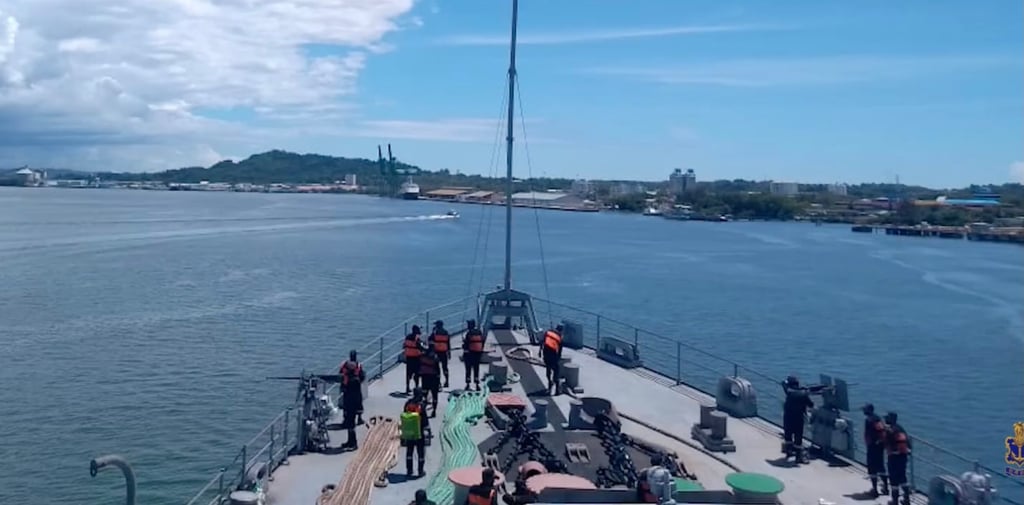
The LPDs are set to be the second-largest India-made combat ships after INS Vikrant, India’s 45,000-tonne aircraft carrier. The navy currently operates one LPD, INS Jalashwa, acquired from the United States.
With one LPD currently, the Indian Navy could not maintain a continuous amphibious operation, according to Ladwig. The Navy could do so in future with one LPD if it were to acquire four such vessels, with the other three on standby for other missions, he added.
C. Uday Bhaskar, director of the Society for Policy Studies think tank and a former Indian naval officer, said India’s geographical circumstances made the acquisition important.
India needs to boost its amphibious capabilities to protect its island territories, including the Andaman and Nicobar Islands and Lakshadweep, while the LPDs could also support humanitarian missions across the Indian Ocean, stretching from the east coast of Africa to Southeast Asia, according to Bhaskar.
He added that the LPDs would help the Indian Navy react quickly to an emergency. “Navies acquire capabilities and hone their professional skills so they can respond when the need arises. The December 2004 tsunami is a classic example of how the Indian Navy responded at short notice.”
However, India has faced setbacks in acquiring LPDs in past years. A 2011 proposal stalled over accounting issues between Indian and foreign manufacturers, while a 2013 tender was scrapped in 2020 after the navy’s requirements changed.
Bhaskar said India would need a more disciplined approach to avoid a repeat as it explored foreign partnerships with domestic shipyards to build the LPDs.
“Delays in decision-making and awarding contracts, and time-cost spillovers in shipyards are systemic challenges that will have to be surmounted,” he added.
Atul Kumar, a fellow at the Delhi-based Observer Research Foundation’s strategic studies programme, said the Indian government needed to cut through red tape to accelerate the launch of the LPDs.
Their acquisition is important to India’s ability to respond to a changing regional security environment in tandem with its expansion of commercial and security infrastructure across its island territories, according to Kumar.
China’s growing naval power has made the activation of LPDs in nearby waters a key consideration for India, he said.
“Safeguarding these remote outposts against an external power requires robust power projection. Given the exponential growth of China’s Navy, four of these multirole ships represent the bare minimum for India to maintain a credible deterrent,” Kumar added.
Dongkeun Lee, a policy fellow at the Asia-Pacific Leadership Network, said the LPDs’ primary value for India was their deployment for humanitarian missions rather than amphibious battles.
Referring to the INS Vikrant and INS Vikramaditya, a former Russian aircraft carrier acquired and modified by India, Lee said: “The purposes of acquiring LPDs and aircraft carriers are quite different. Aircraft carriers are designed to project air power, primarily for sea control purposes, whereas LPDs are intended to support amphibious operations, which involve projecting land power ashore. Although both types of ships are relatively large, their operational purposes are fundamentally different.”
Ultimately, the LPDs could extend the Indian Navy’s regional influence across vast distances, Lee added.
“Given their non-combat nature, such missions could be conducted across a much broader geographical area of the Indo-Pacific, encompassing both the Indian Ocean region and Southeast Asia, allowing the Indian Navy to expand its naval presence while also supporting its naval diplomacy objectives.”
KioskNews shows a cleaned-up reading view extracted from the publisher’s page — the original always lives on their site, not ours.