MAC approves China travel for APEC
‘MANAGEABLE’: ‘We hope that, as the APEC host, China will treat our delegation appropriately in accordance with existing practices and APEC rules,’ an official said
By Shelley Shan / Staff reporter


The Mainland Affairs Council (MAC) yesterday said that it had conducted risk assessments and contingency planning for all government officials scheduled to attend APEC ministerial meetings in China this year, and has determined that they can proceed.
The council made the remarks as Minister of Labor Hung Sun-han (洪申翰) is scheduled to attend the APEC Human Resources Development Ministerial Meeting in Nanjing on Sept. 21, making him the first minister to travel to China since President William Lai (賴清德) took office in 2024.
“So far, officials’ trips have gone smoothly. We think the overall risks this time would be manageable,” MAC Deputy Minister and spokesman Liang Wen-chieh (梁文傑) told a news conference in Taipei.
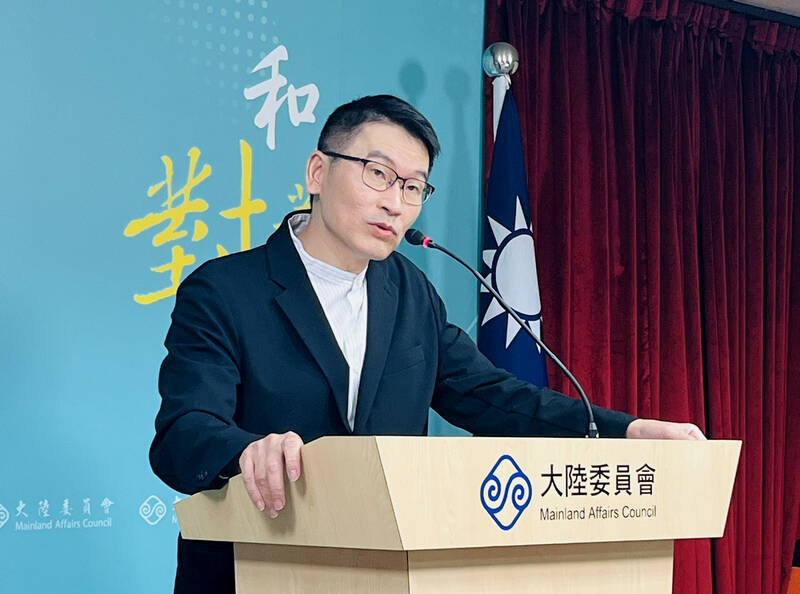
Mainland Affairs Council Deputy Minister Liang Wen-chieh speaks at a news conference in Taipei yesterday.
Photo: Chen Yu-fu, Taipei Times
Officials including Deputy Minister of Economic Affairs Chiang Wen-jo (江文若) and former chief trade negotiator at the Office of Trade Negotiations Yang Jen-ni (楊珍妮) have traveled to China to attend APEC-related meetings this year, Liang said.
Hung would enter China by presenting APEC’s invitation and following the organizer’s arrangement, without having to present a Mainland Travel Permit for Taiwan Residents, Liang said.
Hung’s participation and remarks at APEC already demonstrate the existence of the Republic of China (Taiwan), with no need for any additional declaration of sovereignty, he added.
Any interaction with Chinese officials during the meetings can proceed naturally, and Hung need not avoid or make a deliberate attempt to meet, he said.
“We hope that, as the APEC host, China will treat our delegation appropriately in accordance with existing practices and APEC rules,” Liang said.
Liang also responded to reports that a Taiwanese man was interrogated by Chinese immigration officers during a business trip to Shanghai due to his past work as an intern for Amnesty International.
China views international human rights organizations as engaging in anti-China activities, and Taiwanese who were participants of these groups risk being interrogated or persecuted, Liang said.
“This would cause people to censor themselves and avoid joining activities hosted by civil groups, constituting a major threat to Taiwan’s democratic system,” Liang said.
So far, about half of Taiwanese who were interrogated or detained during trips to China are current or retired civil servants, Liang said.
While China’s Taiwan Affairs Office tried to assure the public that they should not be concerned about its new entry and exit regulations, which are to take effect on Sept. 15, so long as they do not engage in criminal activities in China, the travel risks do not disappear, he said.
“They could still be interrogated for what they have done in Taiwan and elsewhere,” he said, adding that the best way to counter the problem is to disclose such incidents in public.
Liang said that the purpose of asking people to register trips to China is so that the government can provide timely assistance in case of emergencies.
KioskNews shows a cleaned-up reading view extracted from the publisher’s page — the original always lives on their site, not ours.