Forbidden planet: was Pluto’s 2006 demotion a big mistake?
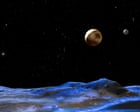
Twenty years ago, Pluto got demoted. After a vote by the International Astronomical Union (IAU) in August 2006, Pluto was relegated from major planet to dwarf planet status. Our solar system dropped from nine planets to eight. At the time, many scientists were unhappy with the decision. Two decades on, the debate is, if anything, even more polarised.
“The definition of a planet they created, you can’t use it at all,” says Philip Metzger, the director of the Stephen W Hawking Centre for Microgravity Research and Education at the University of Central Florida. “It makes the definition of a planet completely non-useful in science.”
Metzger is one of a number of scientists and lay people who consider Pluto’s demotion a big mistake.
For some, Pluto’s downgraded status is the source of their affection for the ex-planet. “Pluto represents the underdog that so many people root for, the small kid on the block that is being picked on,” says Kevin Schindler, historian at the Lowell Observatory in Arizona, where Pluto was discovered in 1930.
For others, the IAU’s decision, and the way it was taken, is central to the debate. “My being involved with advocating for Pluto started on the day of the vote,” says writer, actor and amateur astronomer Laurel Kornfeld. “I was like: wait a minute, this is wrong.” When we meet on Zoom she is wearing a T-shirt that says: “Pluto Resistance, 20 years: 2006-2026.”
The campaign to reinstate Pluto – with its passionate advocates, ongoing debates, occasional protests and petitions – seems to be largely confined to the US. “It is more of an issue in the United States,” says Metzger. “This was the one we discovered.” So, the planet’s demotion was a source of wounded pride? “I’ll admit there was some of that – among the public, not the scientists.”
More recently, the campaign has taken on a populist tinge, with Trump’s Nasa administrator, Jared Isaacman, telling a congressional committee in April that he was in favour of a rethink. “I am very much in the camp of Make Pluto a Planet Again,” he said.
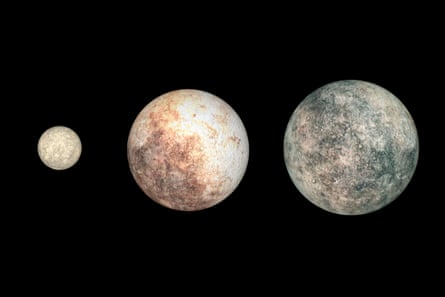
The event that sparked the IAU’s 2006 vote was the discovery of a distant celestial body that would come to be called Eris. Eris was out in the Kuiper Belt, beyond Neptune – where Pluto also resides. It was roughly the same size as Pluto (less volume, but more mass). If Pluto was a planet, the argument went, then so was Eris. And if Eris wasn’t a planet, how could Pluto continue to be one?

Eris and Pluto were by no means alone in the Kuiper Belt. Other smaller bodies were discovered around the same time, including Haumea, Makemake and Sedna. Were these also planets? There were likely many more similar objects still to be found. How would schoolchildren manage a planetary roster that might number in the hundreds?
In search of a solution, the IAU came up with a three-point definition of a planet: it must orbit the Sun; it must have sufficient mass to pull itself into a round shape; and it must have “cleared its neighbourhood” – meaning it must gravitationally dominate the area in which it orbits. Nothing beyond Neptune that we knew about qualified; Pluto was out.
It was the last point in particular that upset a lot of Pluto advocates, because a body’s ability to clear its neighbourhood depends a lot on the neighbourhood. “One of the biggest flaws with the IAU definition is that you can have the same object in two different orbits,” says Kornfeld. “In one, it’s considered a planet, and in the other, it’s not considered a planet.” If the Earth were towed out to Pluto’s position, the planetary scientist Alan Stern argued, it wouldn’t be able to clear its zone either, and would no longer meet the IAU definition of a planet.
“You could even have small asteroids, that are too small to be round, clearing an orbit if they’re close to a star,” says Metzger. “It just goes to show that orbit clearing isn’t really that meaningful of a category.”
To its detractors, the IAU definition seemed crafted with a specific intent. “A reason was invented to exclude Pluto,” says Kornfeld.

Pluto’s demotion created two opposing scientific teams: the so-called geophysical camp, which believes the physical properties of a celestial body should count toward its planethood; and the dynamicists, who are more concerned with the position a body occupies, its surroundings and its direction of travel. You could characterise the split as planetary scientists v astronomers. Many planetary scientists, including Metzger, simply do not use the IAU definition.
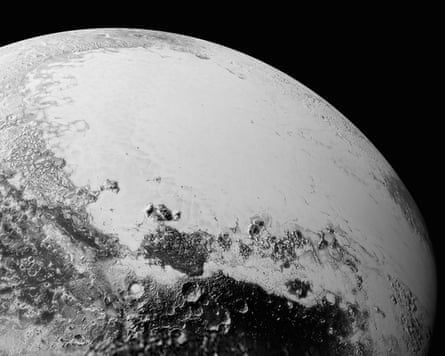
When the New Horizons spacecraft made its flyby of Pluto in 2015, the geophysical camp seized what it saw as an advantage. Pluto definitely had the geophysical makings of a planet, they maintained. It had mountains, evidence of recent geological activity, and water ice hills floating on frozen nitrogen. It might even be able to support life. How could that not be a planet?
Those agitating for Pluto’s planetary status do not, by and large, recognise any problems stemming from reinstatement. They welcome a definition broad enough to take in hundreds of new planets, as taxing as that might be for children and their wallcharts. “The more the merrier,” says Paul Byrne, associate professor of earth, environmental and planetary sciences at Washington University in St Louis. “There are 1,025 official Pokémon species, and I’ve never heard a kid say that’s too many.”
Those against Pluto’s reinstatement say the problem isn’t with a larger number of planets, per se – but with a primarily geophysical definition that would encompass, among other bodies, planetary moons, including our moon.
“I have no problem with having a larger number of planets,” says the astronomer Mike Brown, over email. “My argument is simply that we decided long ago that the moon is not a planet and that also precludes Pluto.” Brown is often described as The Man Who Killed Pluto, because he led the team that discovered Eris back in 2005, setting the whole de-planetisation in motion. It’s a title he leans into: he even wrote a book called How I Killed Pluto and Why It Had It Coming.
Brown often says that the moon is bigger than Pluto; it’s round and has a complex geophysical history, and would certainly meet the criteria for a planet if you excluded any requirement concerning orbit. What he’s saying is: if Pluto’s a planet, so is the moon.
“I don’t have an issue with calling the moon a planet,” says Byrne. “Because I can be a brother and a husband at the same time, and it doesn’t require that I be one or the other. And so I don’t see why the moon can’t be a satellite and a planet.”
For the outsider, this debate can often seem mired in political, even procedural questions, with Plutonians contending that the IAU vote was incorrectly conducted and therefore void. “You could make the argument that they never officially voted on a planet because they didn’t follow the procedure that was required,” says Metzger.
Brown denies there was anything political about the decision. “The only people who complain about the voting procedure were the ones who didn’t like the outcome.”
So the question remains: why does any of this matter?
“It was almost like a coup,” says Kornfeld. “And as a result, kids are learning less. They’re learning eight planets, and that’s it.”
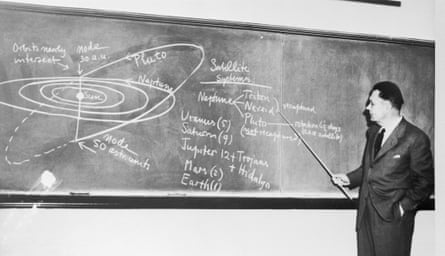
For Metzger, the planetary definition excluding Pluto is based on an outmoded notion of the solar system. “They were creating a reactionary view towards an orderly cosmos, rather than the more modern scientific view where it’s chaotic,” he says. “The second problem was that I think they misread the room. The public of today is not the public of the 1800s. They’re perfectly happy understanding a dynamic, chaotic cosmos, and we missed the opportunity to teach that.”
Pluto’s nature has always been elusive. In 1915, the astronomer Percival Lowell published calculations based on peculiarities in the orbits of Uranus and Neptune, predicting the existence of a new, ninth planet, which he called Planet X, with a mass somewhere between Earth’s and Neptune’s. In 1930, the long search for Planet X bore fruit: the new body, discovered at the observatory that bore Lowell’s name, was christened Pluto.
Gradually, however, it became clear that whatever Pluto was, it wasn’t Planet X. It didn’t seem anywhere near large enough to account for irregularities in Neptune’s orbit. Scientists offered theories to explain why Pluto looked so small, but the truth was, it was small – even smaller than the moon. Only in 1992 did we learn that Lowell’s calculations were based on an overestimation of Neptune’s mass. There was no Planet X.
Pluto’s reputation as an underdog, the picked-on kid, may stem from the 2006 vote, but one could argue it was punching above its weight for years. How would they have voted on Pluto’s planetary status if they had known the truth in 1930? And will it take another vote to satisfy Pluto’s defenders?
“People have locked in,” says Metzger. “We would have a less useful vote today than we did back in the 2006 timeframe. So we don’t want another vote. What we want is for people to recognise that voting was a mistake, and we’re not going to do that any more. We’re going to go back to the scientific method.”
KioskNews shows a cleaned-up reading view extracted from the publisher’s page — the original always lives on their site, not ours.