Defence minister: Strengthening cooperation, system resilience among focuses in tackling cyber threats in Malaysia
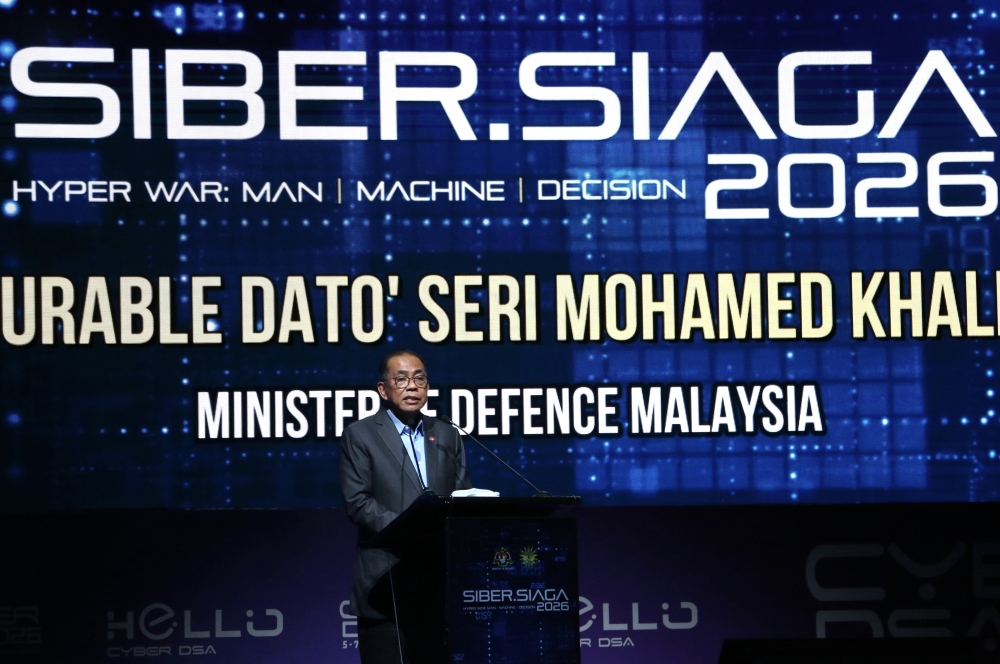

Defence Minister Datuk Seri Mohamed Khaled Nordin said new forms of cyberattacks could paralyse essential systems and daily services. — Bernama pic
First Published: Tuesday, 06 Oct 2026 9:35 AM MYT
KUALA LUMPUR, Oct 6 — Cyber threats have the potential to destroy national critical infrastructure and escalate into a national crisis.
Defence Minister Datuk Seri Mohamed Khaled Nordin said new forms of cyberattacks could paralyse essential systems and daily services.
He said critical infrastructure at risk includes airports, ports, banking systems, healthcare facilities and internet networks.
“Jammed communications can create uncertainty and panic. Interruptions to transportation can halt the movement of people and goods.
“Disruptions in energy supplies can paralyse almost every sector of our economy. When these systems fail, what begins as an invisible attack can quickly escalate into a national crisis,” he said.
He outlined four key considerations to strengthen cyber resilience, namely maintaining human accountability, ensuring system resilience, investing in human capital and strengthening cooperation.
Mohamed Khaled said resilience in defence systems involves preventing cyberattacks and the ability to withstand disruptions, recover quickly, and continue operations.
He said this in his speech at the opening of the Siber Siaga 2026 programme held in conjunction with the Cyber Digital Services, Defence and Security Asia (CyberDSA) 2026 exhibition at the Malaysia International Trade and Exhibition Centre (MITEC) here yesterday.
Meanwhile, the Malaysian Armed Forces (MAF) Headquarters said in a statement that the Siber Siaga programme is MAF’s main strategic initiative to build comprehensive national cyber resilience.
The statement said the initiative led by the Cyber and Electromagnetic Command (PSEP) positions MAF as a pioneer in integrating multi-stakeholder strategic cooperation.
Efforts to construct the cyber resilience ecosystem combine collaboration between MAF, the National Cyber Security Agency (NACSA), CyberSecurity Malaysia, and higher learning institutions such as the National Defence University of Malaysia (UPNM).
With the theme “Hyperwar: Man, Machine, Decision”, Siber Siaga focuses on the security forces’ approach to new-generation warfare involving artificial intelligence, automation and autonomous systems. — Bernama
KioskNews shows a cleaned-up reading view extracted from the publisher’s page — the original always lives on their site, not ours.