Employers, workers groups protest caregiver policies
Employers and migrant worker advocacy groups yesterday protested outside two government ministries in Taipei, demanding solutions to live-in care issues, but differing over how to protect care recipients and migrant workers.
Outside the Ministry of Labor, an employers’ group challenged Minister of Labor Hung Sun-han (洪申翰) to a public debate, accusing the government of neglecting households facing disruptions to care when migrant caregivers go missing or become temporarily unavailable, including during maternity leave.
“We really cannot wait any longer,” International Association of Family and Employers with Disabilities chairwoman Heidi Chang (張姮燕) said.
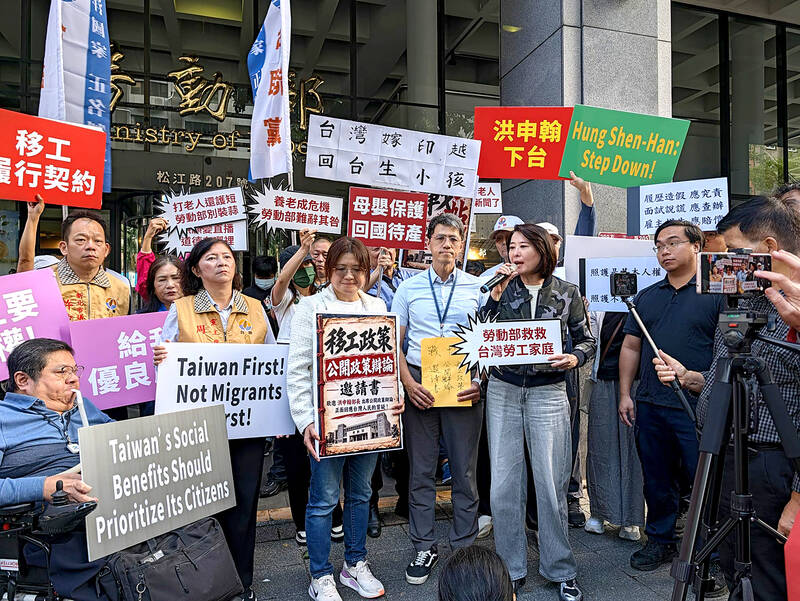
Workforce Development Agency official Su Yu-kuo, center, receives a petition from a representative of employers and migrant worker advocacy groups during a protest in front of the Ministry of Labor in Taipei yesterday.
Photo: Lee Ching-hui, Taipei Times
She called the ministry’s response inadequate to demands the group raised at a May 2 protest on Ketagalan Boulevard.
A woman at yesterday’s protest surnamed Tseng (曾) said that a migrant caregiver hired to care for her mother disclosed she was pregnant, and they agreed to terminate her employment.
Since then, family members have been taking turns traveling to Kaohsiung to care for her partially paralyzed mother, who does not want to move into an assisted living facility, said Tseng, who lives in Taichung.
She said she waited about 20 days for employment termination paperwork and was quoted an NT$18,000 (US$555) fee by a recruitment agency to arrange for a replacement, which she has yet to secure.
“We really feel helpless,” she said, adding that relatives are struggling to balance work, household expenses and caregiving responsibilities.
The association, joined by Chinese Nationalist Party (KMT) Legislator Wang Hung-wei (王鴻薇), called for faster replacement procedures and emergency care arrangements to prevent prolonged gaps between caregivers.
“Even one month is too long,” Chang said, adding that she once waited three to four months for a replacement caregiver to arrive from overseas.
Meanwhile, outside the Ministry of Health and Welfare, groups including the Taiwan International Workers’ Association and Independent Living Taiwan said that gaps in care stemmed from inadequate public services rather than migrant caregivers exercising their rights to maternity leave.
The groups urged the government to expand affordable substitute care services, subsidize lower-income households and establish emergency backup arrangements.
They also proposed a system under which institutions, rather than individual households, employ migrant caregivers, allowing workers to take shifts, while ensuring continuous care through replacement staff.
Marni, a caregiver and a representative of Indonesian migrant caregiver union SBIPT, said migrant caregivers sometimes struggle to take time off and in some cases have to pay for substitute workers.
“We are not care machines,” she said.
The health ministry said households employing live-in migrant caregivers have been eligible for community-based care services, including daycare, since September last year, regardless of whether their caregivers are on leave.
The health ministry advised families to request a long-term care needs assessment from a care management center when applying to hire a migrant caregiver, so services can be arranged in advance.
Separately, the labor ministry said that approximately NT$2 billion had been allocated to subsidize respite and short-term substitute care services, which eligible households employing migrant caregivers can use for a combined total of up to 52 days per year.
It said it would work with the health ministry to expand public care resources, improve access to services and enhance caregiver training.
The labor ministry did not say whether Hung would accept the association’s debate invitation.
KioskNews shows a cleaned-up reading view extracted from the publisher’s page — the original always lives on their site, not ours.