The 8 Best Sci-Fi Audiobooks of All Time, Ranked

Jeremy has more than 2800 published articles on Collider to his name, and has been writing for the site since February 2022. He's an omnivore when it comes to his movie-watching diet, so will gladly watch and write about almost anything, from old Godzilla films to gangster flicks to samurai movies to classic musicals to the French New Wave to the MCU... well, maybe not the Disney+ shows.
His favorite directors include Martin Scorsese, Sergio Leone, Akira Kurosawa, Quentin Tarantino, Werner Herzog, John Woo, Bob Fosse, Fritz Lang, Guillermo del Toro, and Yoji Yamada. He's also very proud of the fact that he's seen every single Nicolas Cage movie released before 2022, even though doing so often felt like a tremendous waste of time. He's plagued by the question of whether or not The Room is genuinely terrible or some kind of accidental masterpiece, and has been for more than 12 years (and a similar number of viewings).
When he's not writing lists - and the occasional feature article - for Collider, he also likes to upload film reviews to his Letterboxd profile (username: Jeremy Urquhart) and Instagram account.
He has achieved his 2025 goal of reading all 13,467 novels written by Stephen King, and plans to spend the next year or two getting through the author's 82,756 short stories and 105,433 novellas.
Sign in to your Collider account
Audiobooks feel like a solution to a modern-day problem, and that problem is something along the lines of “Uh, it’s hard to find time to sit down and read every single day.” It can feel like something of a luxury when you are able to do that, honestly. But also, audiobooks aren’t really modern, and have existed before the 21st century and stuff, only they were a bit more inconvenient in the old days, when you'd need multiple tapes or CDs to hold hours’ worth of recordings.
They're hard to escape now, and it’s gotten to the point where it’s somewhat surprising if a decently known book isn't available to be listened to as well as read. In the interest of highlighting a few that make for great listening experiences, here are some of the best sci-fi audiobooks of all time. It’s not the same as listing the best sci-fi books that can be listened to, though, because if it were, Dune would be here (the most easily accessible version of that, on Audible, honestly has some problems).
8 'The Hitchhiker's Guide to the Galaxy' (1979)
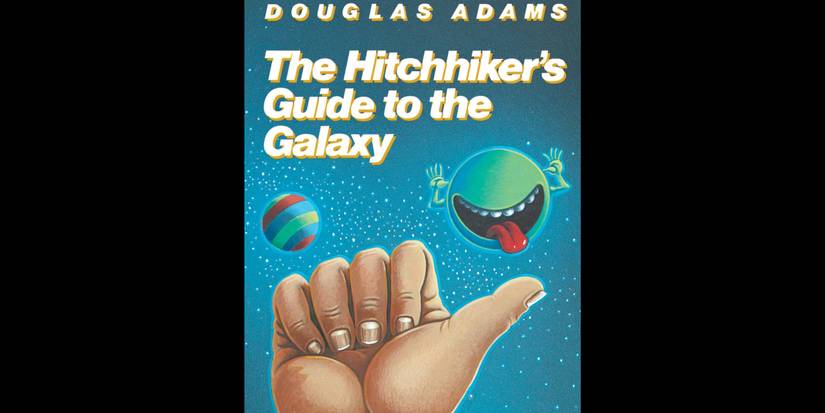
There’s a recording of The Hitchhiker’s Guide to the Galaxy done by the author himself, Douglas Adams, and it’s a great way to experience the original story, though you can’t go wrong with experiencing it in other ways. Like, reading it on its own is also quite effortless, and then there have been other recordings, too, like the ones by Stephen Fry, and then some sequels to the first book were read by Martin Freeman.
Fry narrated the movie adaptation, and Freeman starred in it, but that movie adaptation isn't the ideal way to experience The Hitchhiker’s Guide to the Galaxy… but it would be unfair to say it’s only the novel that has worth, since there was a radio play version and even a short-lived TV series, so it’s a big old franchise, really. Still, what a novel, if you're looking at/for the OG.
7 'Frankenstein' (1818)

Since it’s such an old text, there are different recordings of Frankenstein, and it’s in the public domain, owing to its age, so finding free recordings isn't hard, either. The narration being singled out here, though, is the reading done by Dan Stevens, and he’s the kind of actor whose voice honestly works really well for a rather theatrical and sweeping sci-fi/horror novel like this one.
Frankenstein is something you should definitely read or listen to at least once, no matter what, especially because no film adaptation to date has quite scratched the same itch.
Okay, Frankenstein is probably more of a horror book than a sci-fi one, but there are still science fiction elements here, and its overall influence on the genre to come can’t be denied. Frankenstein is something you should definitely read or listen to at least once, no matter what, especially because no film adaptation to date has quite scratched the same itch – nor done as much – as the source material (and most don’t bother, since there is so much here to think about and feel).
6 'Project Hail Mary' (2021)

Sometimes highlighted as one of those books that’s actually better to listen to than read, Project Hail Mary is well-suited to the audiobook format, quite clearly. There aren’t many characters in Project Hail Mary, and yet there is quite a bit of dialogue, or at least unique dialogue, and the central dynamic here (once it becomes a dynamic and all) is certainly enhanced with the exceptionally popular audiobook read by Ray Porter (who had a cameo voice role in the 2026 film adaptation).
The novel was acclaimed, the audiobook was acclaimed, people really dug the film… you can’t exactly go wrong with Project Hail Mary, just generally speaking, and regardless of which way you ultimately experience the story. And The Martian, also written by Andy Weir, deserves an honorable mention, since that one also has a premise and structure well-suited to the audiobook format.
5 'Nineteen Eighty-Four' (1949)

Like with Frankenstein, you’ve got a few different narrators to choose from if you want to listen to Nineteen Eighty-Four, but the best one is probably the Stephen Fry recording. He’s obviously got a great voice, and is definitely one of the better actors out there who've transitioned to audiobook reading (or acting, really… it’s like another kind of acting), and has been prolific as a narrator, having narrated some of his own works as well as famously doing the Harry Potter series.
There is a pleasantness to how he sounds that contrasts interestingly with all the darkness in Nineteen Eighty-Four, but then his voice also sounds polite (for lack of a better word), and that works well when so much of Nineteen Eighty-Four is about a repressive dystopian society where people can’t really speak out or be impolite in the eyes of the State. He’s a pro at narrating, is the main thing, and this recording demonstrates that exceptionally well.
4 'A Clockwork Orange' (1962)

Owing to the way A Clockwork Orange is narrated, and the fact that both the narration and dialogue include quite a bit of slang, listening to it can really help add some context and understanding, so the Tom Hollander recording is pretty great. It’s not a long listen, so it wouldn’t have been as challenging to maintain the consistency in that regard, but A Clockwork Orange is a dense and challenging book in other ways, and one can imagine various things an audiobook of such a novel could do wrong.
Otherwise, you know, it’s A Clockwork Orange. It is a pretty much perfect book even without having something to listen to, but it’s just as great when taken in that alternate way. So much of this remains relevant and thought-provoking, and it also stands out among other science fiction/dystopian novels, owing to it downplaying the sci-fi stuff and having everything feel uncomfortably believable, truth be told.
3 'Against the Day' (2006)

Calling this science fiction in the traditional sense might be a bit misleading, and not just because it takes place in the past, but more because Against the Day kind of refuses to be characterized with mere/broad genre descriptors. It’s Thomas Pynchon, after all, and not only that, but Thomas Pynchon doing something longer and more epic than usual, with parts of Against the Day feeling a bit like an adventure story, and other parts being more surreal and dreamlike.
It still sticks to some historical things, with events between 1893 and 1918 being important, but then most of the prominent characters are fictional, and a few are outright fantastical, or like they’ve stumbled in from some kind of steampunk novel. It’s wild and weird, but very rewarding if you can find the time to get through all 1000+ pages, or listen to the entirety of the 53-hour-long audiobook (impressively/ambitiously read by a single narrator throughout: Dick Hill).
2 'Hyperion' (1989)

Unlike the other audiobooks here, the Hyperion one has a cast, and it works better than a good many other audiobooks that have multiple narrators. The Dune audiobook was mentioned before as a not-so-great one, mostly due to there being inconsistency with characters sometimes narrated by the main narrator, and sometimes voiced by other cast members… it’s like, just have one narrator, or actually commit to always having the different voices where needed.
With Hyperion, consistency is maintained, it helps that there aren’t an overwhelming number of narrators, and then further, Hyperion has different characters telling stories about their pasts, in the lead-up to all ending up on the same pilgrimage. So, having multiple narrators makes sense and works for the novel’s structure, all the while making the audiobook feel a little more cinematic and epic than it might feel if you just read the book without any accompanying audio.
1 '11/22/63' (2011)

Plenty of Stephen King books work very well as stories to listen to, rather than read, but of his works that lean into science fiction the heaviest, 11/22/63 might well be the best of them audiobook-wise. The first-person narration here goes a fair way toward making 11/22/63 feel suited to such a form, and Craig Wasson’s narration is incredibly clean and seamless with the overall style of the book.
It’s very easy to get lost in a time travel story this immersive, and getting to hear the main character react to – and process – the situations he finds himself in adds a lot, with it also being easy to lose track of time while experiencing this particular story. It’s one of Stephen King’s best overall, and probably his single strongest novel of the 21st century, and the recording of it more than does the entire sci-fi epic justice.
KioskNews shows a cleaned-up reading view extracted from the publisher’s page — the original always lives on their site, not ours.