‘Opportunistic’: experts weigh Manila’s minilateral agenda ahead of Trump-Xi meeting
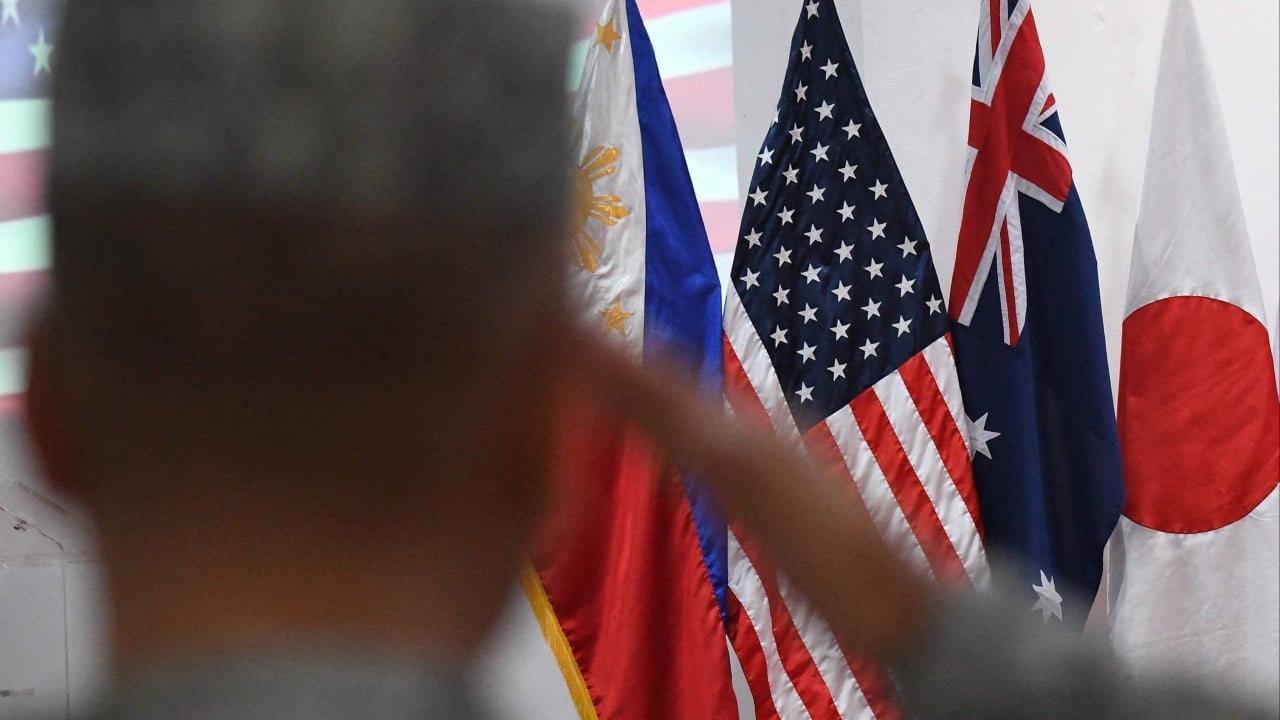
If realised, the talks would come just days before US President Donald Trump meets Chinese President Xi Jinping in Shenzhen on the Apec forum sidelines, in what would be their third summit meeting this year.
WATCH: US President Donald Trump hosts state dinner for Chinese President Xi Jinping
In the interview, Romualdez also expressed hope that Asean could one day take greater responsibility for its own security, much like Nato.
Meanwhile, US Secretary of State Marco Rubio has confirmed that the Quad will hold its first summit in more than two years during the Manila gathering.
Characterised as a “diplomatic partnership” by the US, the informal bloc with Japan, Australia and India – aimed at “fostering a free and open Indo-Pacific” – has not held a summit since Trump returned to power in 2025. As reported by the SCMP, Trump refused to travel to India for a Quad meet last year after the two sides failed to strike a trade deal to his liking.
The timing of the meetings has led analysts to question whether the US and its allies were seizing an opportune window to highlight minilateral security cooperation and how this push might affect Asean unity and regional flexibility towards Beijing.
Arrizal Jaknanihan, a researcher with the Asean Studies Programme at The Habibie Centre in Jakarta, said the prospect of Squad meetings signalled “the Philippines’ long-standing pursuit of expanding and deepening its network of security partnerships across the Indo-Pacific”.
Given the recurring maritime clashes with rival claimant Beijing in the South China Sea and limited guarantees from other Asean members, “it is only natural that leaders in Manila eye the US, Japan and Australia as trusted partners”, he added.
Hosting the meetings while chairing Asean, Jaknanihan contended, offered “a strategic opportunity to show its commitment to both deepening security partnership with extra-Asean countries, while remaining committed to the regional grouping in Southeast Asia”.
Maritime tensions between China and the Philippines have escalated under President Ferdinand Marcos Jnr, who has been more assertive regarding Philippine claims compared with his predecessor.
02:29
‘Stop grandstanding’: Beijing slams Philippine defence chief after minister exposes South China Sea note
Beijing claims most of the islands and rocks in the South China Sea and rights over their adjacent waters, with rival claimants including Malaysia, Vietnam and Brunei, in addition to the Philippines.
Manila also asserts sovereign rights within its exclusive economic zone, a position upheld by a 2016 international arbitral ruling that China rejects.
Chinese coastguard and militia vessels have repeatedly used water cannons and blocking manoeuvres against Philippine resupply missions to Second Thomas Shoal and around other disputed features, resulting in a series of collisions and injuries.
Manila has responded by expanding US military access under the Enhanced Defence Cooperation Agreement, while increasing joint patrols with Squad members.
He Xianqing of the Haikou-based National Institute for South China Sea Studies described the proposed Squad meetings as “both opportunistic and deliberate”.
“It’s simply convenient to hold this gathering on the sidelines of the Asean summit, with so many key officials already in town,” he said. “But it also shows Manila clearly favours a smaller, tighter group built on formal US alliances, different from the Quad.”
The format of the Squad grouping was “far more military-focused and centred on deterrence”, He said, noting that the Philippines, Japan and Australia were all formal US treaty allies.
He added that scheduling the talks just before the Trump-Xi meeting in southern China allowed Manila to “show it stands with US security support” without looking “like a troublemaker ahead of the crucial bilateral summit”.
Jennifer Kavanagh of Defence Priorities, a think tank in Washington, questioned the actual geopolitical weight of the Squad.
“Despite reports of a meeting of the Squad on the sidelines of Asean, I see no evidence the Trump administration has prioritised or is investing in this vehicle,” she said.
“It is not mentioned in any US strategic documents issued in recent years,” Kavanagh added, cautioning that without sustained joint training and institutional work, “the Squad will remain most irrelevant to Asian security, as it has been since it was announced under the [Joe] Biden administration”.
Pointing to Trump’s preference for bilateral engagement, she said: “A meeting of regional powers without the US would send a stronger signal to Beijing than a formulaic meeting of the Squad at this point.”
Commenting on the Quad meeting confirmed by Rubio, Ken Moriyasu of the Hudson Institute said: “If the leaders of the US, Japan, India and Australia were in the same venue and they didn’t hold a Quad, that would send quite the negative signal.”
But he cautioned against reading too much into a meeting alone, urging observers to focus instead on “the length and substance of the discussion, including the wording used in the joint statement”.
On the Squad, he said a gathering of US treaty allies “would provide an important opportunity for the Trump administration to demonstrate to the world that America’s alliance network in Asia remains ironclad”.
Ambassador Romualdez’s suggestion that Asean could evolve towards a Nato-style security alliance drew the sharpest scepticism from analysts.
Jaknanihan called the idea “both unrealistic and unnecessary”, as members held “differing perceptions regarding what they consider as a security threat, including China”.
An alliance built around a single threat “will be the complete opposite of Asean’s approach for decades”, he noted.
He of the National Institute for South China Sea Studies said an Asean Nato was “simply not realistic strategically”, pointing to the Asian group’s diverse political systems, non-aligned tradition and resistance to binding collective defence.
Manila is trying to walk a very fine line ... but right before the Trump-Xi summit, this delicate balance can easily break down
Kavanagh was more blunt in her assessment. “Asean will never function like Nato,” she said, noting that Nato was a US-led collective defence alliance organised around blocs, while Asean operated on consensus and had no collective defence role.
On Asean centrality, Jaknanihan said the grouping had long accommodated differing external alignments as long as it did not “directly harm the security interest of other Asean members”.
Provided the Philippines continued to engage Asean-led processes during its chairmanship, deeper minilateral ties “will not substantially undercut Asean centrality”, he contended.
But He took the opposite view, saying that concurrent Quad and Squad activity alongside talk of an Asean Nato “looks like US-led small group diplomacy [is] taking over regional security” and this “weakens Asean’s central role”.
From Beijing’s perspective, Jaknanihan said that given the proximity of the Trump-Xi summit, it would be less likely to “express frontal opposition or punitive measures in response to the potential Squad meeting to avoid escalating tension, but China will definitely signal displeasure towards the development”.
According to Kavanagh, Beijing “sees the Philippines as a US puppet and will interpret the ambassador’s comments as either directed by Washington or motivated by a desire to tell Washington what it wants to hear”.
Looking ahead to the Asia-Pacific Economic Cooperation meetings in Shenzhen and potential talks on the sidelines between Marcos and Xi, analysts expect a familiar Philippine hedging posture complicated by the surrounding optics.
Jaknanihan said the meetings “offer an opportunity to find the pathway towards a more stable relationship, while still maintaining a mitigation through deeper security partnerships with Indo-Pacific partners”.
He in Haikou called the dual approach “exactly the Philippines’ hedging style”, but cautioned that if Squad coordination dominated the narrative, “the Marcos-Xi meeting will end up being nothing more than a symbolic photo opportunity, with little chance for real tension reduction”.
“Manila is trying to walk a very fine line: it wants both military deterrence and diplomatic dialogue with China,” He said. “But right before the Trump-Xi summit, this delicate balance can easily break down.”
KioskNews shows a cleaned-up reading view extracted from the publisher’s page — the original always lives on their site, not ours.