Can China use widening yield gap between the US dollar and yuan to boost global role?
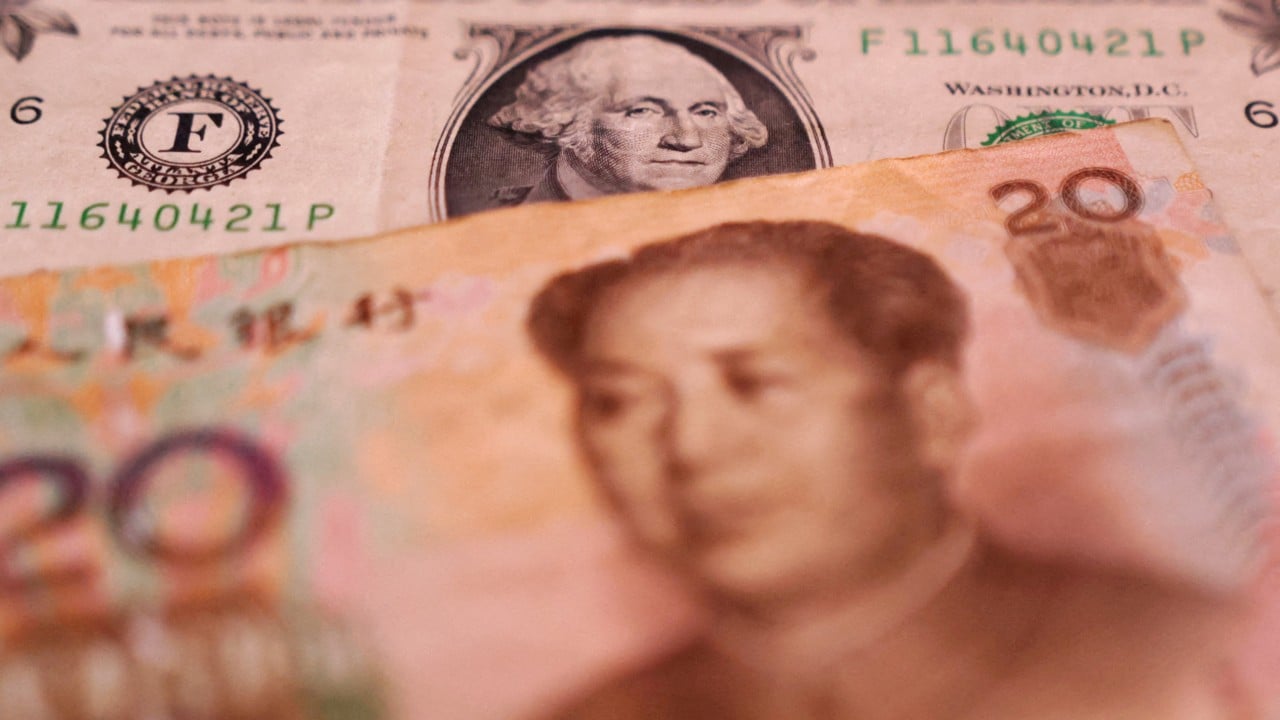
China should seize a window opened by the widening US-China yield gap to strengthen the financing, hedging and asset-absorption systems behind the yuan, turning its cyclical low-interest-rate advantage into lasting global use of the currency, according to a researcher from a Beijing-based governmental think tank.
The 10-year US Treasury yield was 5.22 per cent on Thursday, compared with 1.69 per cent for Chinese government bonds on their first trading day after the National Day holiday – a gap of about 3.5 percentage points, compared with a record 3.7 percentage points on September 9.
Jiang Zhenlong, an associate research fellow at the Chinese Academy of Social Sciences’ Institute of Finance and Banking, argued that higher US yields weaken the appeal of yuan assets and add pressure on the exchange rate and capital flows, but also raise dollar funding costs.
“The China-US yield inversion presents an asymmetric effect: pressure on the asset allocation side and benefit on the financing side,” he wrote in the latest issue of China Money Market, a central bank-affiliated magazine.
Borrowers have responded, with Jiang citing international media data showing yuan bond fundraising – onshore and offshore – had topped 1 trillion yuan by early September, a record.
But demand for yuan financing does not necessarily mean demand to hold yuan assets, he wrote, pointing out that “China’s financial market still lacks sufficient capacity to absorb and retain global capital”.
Official figures reflect the problem – the yuan made up 2.11 per cent of global official reserves in the second quarter, against 56.70 per cent for the US dollar, International Monetary Fund data shows.
He also warned that the wider gap may encourage carry trades – borrowing yuan, selling it and buying higher-yielding foreign assets – which could create persistent selling pressure on the currency. So far, the yuan has held steady at about 6.7 per dollar.
He called for measures including tying yuan borrowing to real trade and investment, bolstering offshore liquidity during stress, expanding longer-dated hedging tools and tracking how borrowed yuan was used to separate genuine financing from carry trades.
“The yuan’s low-interest-rate cost advantages can truly become a long-term driver of internationalisation only if it is embedded in real economy and trade activity,” Jiang wrote.
Improving the liquidity, convenience and collateral function of yuan assets was “more important than simply chasing yield levels,” he added.
KioskNews shows a cleaned-up reading view extracted from the publisher’s page — the original always lives on their site, not ours.