Food, energy self-reliance anchor Indonesia's 2027 state budget
Jakarta (ANTARA) - In the pages of the 2027 State Budget Draft (RAPBN), the long rows of trillion-rupiah figures are not merely fiscal calculations on paper, but they also represent the government policy direction in achieving public welfare.
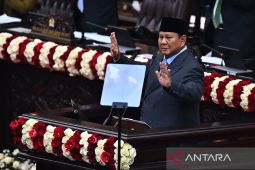
President Prabowo Subianto, in his Financial Note speech on Friday (August 14), said state spending in the 2027 RAPBN is designed at Rp4,097.2 trillion, while state revenue is targeted at Rp3,426.0 trillion.
The government has also targeted economic growth in the range of 5.8-6.5 percent.
"The state budget is not merely a financial document. It is our tool of struggle, a tool to protect the people, a tool to strengthen the nation, a tool to realize the ideals of independence in achieving a better life," Prabowo said in his address on the State Budget Draft (APBN) for the 2027 Fiscal Year, along with its Financial Note and Supporting Documents.
The budget is directed toward implementing the National Priority Work Program (PKPN), which covers food sovereignty, energy and water self-reliance, education, health, downstreaming and industrialization, infrastructure, housing, and disaster resilience, strengthening the people's economy and village development, as well as poverty reduction.
Two of these priorities, food security and energy self-reliance, form the frontline of national defense.
Land that sustains
For Indonesia as an agrarian nation, food is not merely a commodity but also a matter tied to the sustainability of people's lives.
The food self-sufficiency program remains a vision Prabowo has repeated in nearly every speech. The government has allocated Rp195.3 trillion for food security in the 2027 RAPBN, up 2.3 percent from the 2026 state budget outlook of Rp190.9 trillion.
The budget is allocated partly to boost food productivity through the development of 2.7 million hectares of rice-growing areas, the creation of 100 thousand hectares of new rice fields, the optimization of 200 thousand hectares of farmland, and pre-harvest agricultural equipment assistance covering 23,528 units for the food crops subsector.
The government is also channeling funds toward revitalizing 616 hectares of salt fields, developing 55,765 hectares of irrigation networks, building 14 dams still under construction, and upgrading facilities at 400 fishermen villages.
The food security budget is also used for food aid to address food insecurity for 5,000 people, as well as cheap food movement programs for 38 community groups.
The size of the budget reflects the government's effort to strengthen domestic food production while reducing dependence on imports.
Over the past year, Indonesia has achieved self-sufficiency in eight food commodities, namely rice, corn, large chili peppers, cayenne pepper, consumption sugar, chicken meat, chicken eggs, and shallots.
Energy self-reliance at grassroots
Besides food, the government has placed energy self-reliance among its priorities in the 2027 RAPBN.
In his speech, Prabowo pointed to the long-standing paradox of Indonesia's dependence on fossil energy and imported fuel oil, even with the country's vast renewable energy potential.
One of the government's future policy directions is accelerating electrification, especially through the development of solar power plants (PLTS).
Prabowo has set a target to develop 100 gigawatts (GW) of solar power capacity while accelerating the phase-out of diesel power plants. Calculations show that building 100 GW of solar capacity could save at least Rp73.9 trillion per year through lower electricity production costs.
For 2026, the government is targeting 30 GW of solar power development and the retirement of 13 GW of diesel power plants. Prabowo also said ideally every village would have a 1-megawatt solar power plant.
The government is also pushing the development of a national electric vehicle (EV) ecosystem, from providing EV incentives and building charging infrastructure to strengthening the battery supply chain.
These steps are seen as capable of reducing dependence on fossil-based fuel oil and easing the use of foreign exchange to meet domestic energy needs.
The government has allocated Rp272.95 trillion for energy subsidies in the 2027 RAPBN, used to keep the price of fuel oil and electricity down.
Prabowo said Indonesia has already begun achieving energy self-sufficiency.
This has been realized through the mandatory implementation of B50 biodiesel since July 1, 2026, a blend of 50 percent palm oil-based biodiesel. The B50 policy has fully halted diesel fuel imports and saved the state up to Rp170 trillion per year in foreign exchange.
By reducing dependence on imported fossil energy and increasing the use of domestic electricity, the government expects that the state budget will be shielded from volatility in global energy markets.
The plan has received a positive response from the Institute for Essential Services Reform (IESR). CEO of IESR Fabby Tumiwa welcomed the government's commitment to gradually reducing fuel oil subsidies.
He said the policy could reduce energy imports, improve urban air quality, and bolster the national electric vehicle industry.
"IESR welcomes the government's commitment to gradually reduce fuel oil subsidies through accelerating transport electrification and providing incentives for domestically produced electric motorcycles," Tumiwa said.
Fiscal resilience to protect purchasing power
Food security and energy self-reliance are part of the strategies to strengthen domestic economic resilience.
As domestic food and energy supplies grow stronger, volatility in global commodity prices is expected not to directly impact public purchasing power.
The government has targeted inflation in the range of 1.5-3.5 percent. In this context, food and energy security are expected to serve as buffers against volatility in global markets.
Even so, the success of this agenda will depend heavily on implementation on the ground, with oversight against budget misuse and ensuring every rupiah delivers real benefits to the public remaining key challenges to watch.
Through the allocation of hundreds of trillions of rupiah, the 2027 RAPBN is aimed not only to drive economic growth but also to serve as a safety anchor, ensuring households across the country can keep their kitchens running and villages throughout the archipelago are no longer left in the dark.
Related news: Indonesia achieves self-sufficiency in eight food commodities: Prabowo
Related news: Indonesia confident on food security outlook as farm output rises
Related news: Indonesia says food self-sufficiency won't close door to trade
Translator: Bayu, Kenzu
Editor: Azis Kurmala
Copyright © ANTARA 2026
KioskNews shows a cleaned-up reading view extracted from the publisher’s page — the original always lives on their site, not ours.