This Jewish movement was almost lost to the world, but has found a home in Australia
It’s a movement that was almost lost to the world because of the Holocaust.
But the Jewish Bund, born in Eastern Europe in the late 1890s, has its longest-standing branch in Australia. It stands for secular Jewish identity, support of Yiddish and Yiddish culture, progressive politics, cultural autonomy and workers’ rights, and has recently experienced a resurgence.
New York-based writer and artist Molly Crabapple explores the origins and evolution of the movement in her latest book, Here Where We Live Is Our Country: A History of the Jewish Bund. It made its debut at No.4 on the New York Times bestseller list.
As she heads to Australia for a speaking tour sponsored by the Jewish Council of Australia, Crabapple says the Holocaust meant many of those who subscribed to Bundist philosophy died. “I felt this huge responsibility to the ghosts that I was writing about to get their stories right,” she says.
“We are confronting a wave of global fascism, of ethno-nationalism, of borders drawn in blood and of economic collapse, and the Bund’s ideas of democratic socialism and solidarity across difference are our best chance of saving ourselves.”
David (Doodie) Ringelblum is president of the Jewish Labour Bund in Melbourne, many of whose members are direct descendants of the original Bundists, thanks to the large numbers of Polish Jews here who helped refugees emigrate after World War II. Melbourne is home to one of the few Yiddish schools in the world.
The Bund was a workers’ union set up in Lithuania in 1897 to protect the interests of the Jewish working class. “They worked very hard at re-creating a culturally autonomous world, so the Bund worked very hard to establish a Yiddish-focused, secular, progressive politics,” says Ringelblum.
His main criticism of Crabapple’s book is that it stops at 1948, even though the Bund has continued to exist and evolve since then. The Melbourne branch was not contacted by the author for her research.
Bundist philosophy comes from the Yiddish term doikayt, according to Ringelblum, which loosely translates to “here where we live”.
“Our focus is on cultural autonomy for all people wherever they live,” he says, likening the idea to multiculturalism, as espoused by Gough Whitlam in the 1970s.
It’s an interesting moment for such an idea, given the recent midterm elections in the United States and upcoming elections locally. “America truly, at the last moment, pulled itself back from the brink,” says Crabapple, adding that the results were a win for human rights.
“The campaign against Abdul El-Sayed was one of the most grotesquely racist I’ve ever seen. They sent mailers to people’s homes in Michigan saying that Abdul wanted to force women to wear burqas. Voters resoundingly rejected that because they saw that that sort of racism is what powerful people use when they want to keep their power by dividing ordinary working people and turning them against each other.”
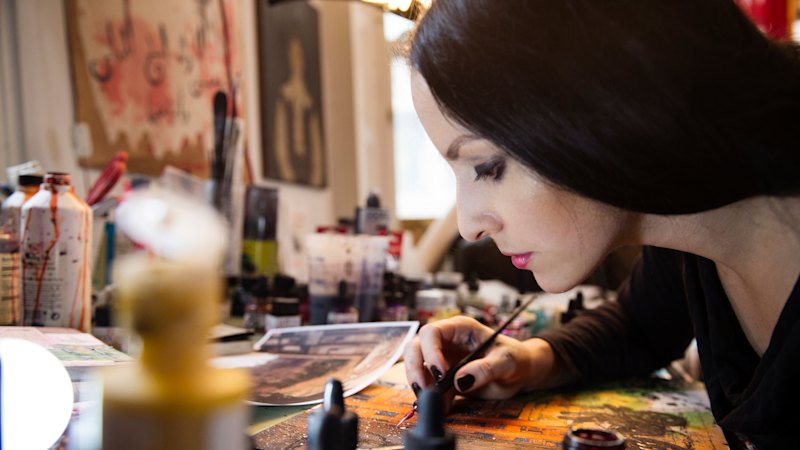
The 43-year-old artist has work in the Museum of Modern Art and freelances for Vice, The New Yorker, Rolling Stone and Vanity Fair. She has written two other books: her 2015 memoir Drawing Blood and, with Marwan Hisham, Brothers of the Gun: A Memoir of the Syrian War, published in 2018 and has two Emmys for her animations for The New York Times.
As division in the US and around the world has led to the rise of the far right, Crabapple cautions against the idea of ethno-states.
“I don’t believe there should be a white Christian America where people who aren’t white and Christian don’t have equal rights,” she says. “I don’t believe that there should be a Serbia where people who are Kosovars or Bosnians or anyone else don’t have equal rights.
“The European idea of ethno-nationalism, which came in vogue in the 19th century, is a terrible idea that has led to ethnic cleansing wherever it’s been practised. Whether it’s in Greece and Turkey, in the Balkans, or Poland and Ukraine … or in Israel-Palestine, ethno-nationalism is a terrible idea. I believe that states should be for all their citizens, where everyone is equal, regardless of race, religion or ethnicity. Full stop.”
Having reported on war in Syria, on Ukraine during the Russian invasion, and from refugee camps in Lebanon, Crabapple uses a distinctive visual art in her journalism; she started aged just four. “My mother taught me how to draw, and I think I would be drawing if I was on a desert island,” she says. “I cannot imagine a life where I’m not drawing all the time.”
Her love of art ties to Bundist philosophy, which involves commitment not just to political and economic change, but to improving life on all levels.
“Jewish socialists have a slogan that really resonates with me, which is ‘For a better and more beautiful world’,” Crabapple says. “It’s the idea of not just attempting to improve the world politically or economically, but to make life richer and more lovely as well. You know, the classic labour phrase: bread and roses. And so the Bund did not merely run candidates for office or create unions or have general strikes and protests, or defend their communities with a fist or guns. Though they did do all of that, they also created a beautiful alternate world, everything from kids’ movements, a women’s movement, hiking clubs, choirs, theatres and a secular Yiddish school system.”
“The Bundist newspapers didn’t just write about revolution and politics. They also translated avant-garde literature into Yiddish because they believed nothing was too good for the working class, and they transformed life on every level from the political and economic to the cultural, the literary.”
Molly Crabapple is in conversation in Melbourne on November 15 and 17 and Sydney on November 22.
The Booklist is a weekly newsletter for book lovers from Jason Steger. Get it delivered every Friday.
KioskNews shows a cleaned-up reading view extracted from the publisher’s page — the original always lives on their site, not ours.