God, guns and grievances: Alberta’s separatists make their case for independence
It’s barely 8 a.m. and Darcy Gerow is talking about tearing Alberta’s political system down to its very foundations.
Sign In or Create an Account
Gerow, a podcaster and former deputy leader of the Libertarian Party of Canada, is addressing a crowd of Alberta separatists in a low-ceilinged conference room a few minutes’ drive from the Calgary airport. In his speech, called “the anarcho-capitalist case for Alberta,” he advocates for a system of government by the same name, which would privatize all aspects of society.
“The long-term goal is the complete replacement of state monopoly,” Gerow said.
“The liberal experiment in Canada has run its course, and that’s why Alberta wants to separate. But an independent Alberta requires independent Albertans to follow the logic of private property and consent to its consistent end, which is a fully privatized civil society.”
While Gerow’s address proposed a decidedly more radical approach to forming a hypothetical new nation than others at this event, he is in good company. About 100 like-minded Alberta separatists — including a few of the most prominent voices in the pro-independence movement — are gathered in this small conference space to discuss the future of Alberta. That is: How the province should break free from Canada and establish itself as a free and independent nation.
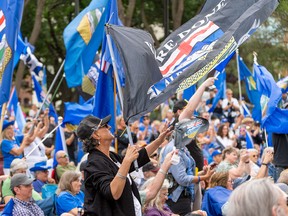
The attendees are a collection of various anti-establishment or libertarian-leaning pundits, politicians and activists. Advocates for free speech on campuses network with American gun rights lobbyists. Anti-vaccine activists share tables with small-government libertarians and “anarcho capitalists.” While each has his or her own specific issues of interest, their fundamental values are mostly in agreement. They are united under one common belief: that the Canada of today has fallen into a state of serious disrepair.
“Our political system is extremely broken,” Drew Barnes, a former United Conservative Party MLA, tells the gathering during a speech later in the day.
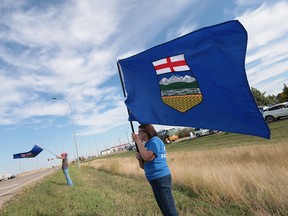
The event, held on an uncommonly cold September weekend, comes just weeks before a referendum on whether Alberta should consider triggering negotiations to leave the Canadian federation. On Oct. 19, Albertans will vote in a referendum with 10 questions on the ballot, one of which will ask them whether they want to commence the legal process to hold a binding referendum on separating from Canada.
Alberta’s separatists, some of whom have been credited with getting Premier Danielle Smith elected by swaying the United Conservative Party vote in her favour, have been pushing their case for Alberta going it alone.
Media coverage of the resentments that have fuelled Alberta separatism tend to focus on matters such as Ottawa’s restrictive energy policies or the province’s systematic underrepresentation in Parliament. Flying more under the radar, and visible here at this gathering, is a separatism intellectually rooted in the basic beliefs of small government, God’s supremacy and individual rights.
Barnes, who was ousted from former Alberta premier Jason Kenney’s caucus in 2021 for speaking out against the government’s COVID vaccine and other policies, tells the crowd about how he was elected to the Alberta legislature on a promise to uphold a few fundamental principles: “smaller government, lower taxes, stronger property rights and more choice,” he says.
“And then I saw my party, my colleagues, drift away from that because of a strong administrative state and a desire for power.”
In many ways, the views expressed here are no different than the more classical conservative beliefs of minimal government intervention and a tendency to favour local centres of government over centralized ones. Last month, Conservative Leader Pierre Poilievre, who has long said he opposes separation, made a case for Canada based on the idea that the federal government could, and must, be narrowed down in order to give provinces more control over their affairs.
“What Albertans are complaining about is not Canada,” he told a gathering of Conservative supporters in Edmonton. “It is the government policies that are actually inconsistent with how Canada was meant to work in the first place.”
Premier Smith, for her part, has also opposed separation, instead favouring a series of constitutional or other policy changes that would put more decision-making power in the hands of provinces.
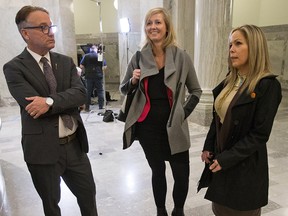
For Barnes, who previously represented the Cypress–Medicine Hat riding in the legislature, such efforts are prone to get intercepted by a Parliament that inherently favours non-Albertan interests. He said he aims to combat what he views as that institutional rot with a new federal political party that will run strictly in Alberta’s 37 electoral ridings. Called Alberta Now, the party would, according to Barnes, give the province new sway in Ottawa by explicitly representing the interests of Alberta in the House of Commons. Much like the Bloc Québécois represents Quebec, the theory goes, such a party could tilt the balance of power in favour of Alberta’s voters.
“I think we have to accept that in our current first-past-the-post Westminster system, it’s going to lead to two parties,” he told attendees. “So let’s figure out a way for libertarian values to work strongly in a conservative party.”
The strategy has been tried before: The Alberta Now party is reminiscent of the now-defunct Maverick Party, which ran candidates solely in Alberta and Saskatchewan ridings in the 2021 election. (The party won less than two per cent of the vote in both provinces.)
Barnes’s Alberta Now gambit follows the thinking of the more pragmatic wing of the wider separatist movement, which tends to prefer to advocate for the province’s interests within Canada’s existing political system.
The pragmatists — who often want to “send a message to Ottawa” rather than actually separate from the country — see the upcoming referendum more or less as a negotiating tactic. By showing their discontent with Ottawa’s political class, they see an opportunity to gain the leverage needed to enact various policies that would reverse what they see as the country’s inherent political bias toward Ontario and Quebec. With that, they believe they could establish a provincial police force; push for constitutional changes that protect gun owners, secure greater provincial control over immigration rates; and eliminate Canada’s equalization program, among other things.
Such separatist sympathizers see Canada’s power structure as inherently anti-Albertan and fundamentally broken, but believe it can be reformed through effective political pressure. The hardcore separatists who are gathered here, by comparison, want to rip it all down to the studs. Where the pragmatists see a Canada that is damaged, the hardcore set see it as downright diseased.
For the former Libertarian Party of Canada candidate Gerow, the only remedy is to build a new nation of Alberta on a constitutional foundation that maximally prioritizes civil liberties over collective rule.
“Secession is the right step, but it is only a piece of the puzzle,” Gerow told the crowd.
Sadly, when we look closely at the history of the human race, we find that liberty is rare and tyranny is the norm
Modern societies are doomed to fail because the states that govern them inevitably work to enforce their own levers of control, Gerow argues, leading to ever increasing centralization of power.
“Alberta’s grievances — the extraction of wealth, regulatory constraints and the erosion of provincial jurisdiction — are not mistakes specific to Canada,” he said.
The state, Gerow said, possesses a “monopoly on ultimate decision-making and the power to impose compulsory payment” on its citizens through taxes. Over time, judges, legislators and the executive branch become “agents of the same apparatus whose power the constitution is supposed to limit,” he said.
“Alberta separatists have many valid reasons to leave Canada, but at its core, it’s because a limited state is a utopian fantasy, and that’s why Confederation failed.”
Only by privatizing every element of the public domain, from national defence to the courts, can citizens resist centralized control and win back their autonomy, Gerow argued. Under such a governing structure, public agencies ought to be broken up and divided among property owners and net tax contributors, who would ultimately make decisions about regulation and taxation.
Most other attendees here wouldn’t likely argue for such a radical vision for preserving civil rights. But the room is unanimous in its belief that Canada has become a victim of relentless government overreach, led by a bloated government that has extended its influence into too many areas of public life.
The Calgary event, called Capitalism and Morality and hosted by Econ Americas, an investment advisory firm, is an offshoot of similar conferences that have been held in Vancouver for over a decade. Held in Calgary’s Croatian-Canadian Cultural Centre, it was designed as a platform for guests to share politically incorrect and freedom-oriented ideas in the spirit of debate. Much of the talks at this particular event revolved around Alberta separatism, but its chief organizer said the event is not explicitly separatist.
Tamara Lich, one of the key organizers behind the 2022 Freedom Convoy that protested the federal government’s lockdown measures, delivered a keynote speech at an exclusive dinner after she was handed a “Good Rebel Award.” According to a video posted online, Lich stuck mostly to speaking about her role in the Freedom Convoy and her legal battles and did not directly address separatism. She did not respond to an interview request.

Frances Widdowson, a former professor and campus free speech advocate, talked about the need for more intellectual freedom at universities. Bruce Pardy, a professor of law at Queen’s University, talked about the fundamental paradox of the state — that is, the inherent problem of how the state is both the thing that protects individual rights and the thing that restricts them. “You can’t be free with it, and you can’t be free without it,” he said.
Widdowson told National Post she is not a separatist herself — “I don’t think it makes a lot of sense to break into smaller units,” she said. Pardy is not actively involved in the separatist movement, but has often spoken publicly about how an independent Alberta could ensure freedom for its citizens.
The event doubles as a networking and business event. At booths adjoining the main conference room, vendors sell handcrafted soap made from beef tallow or leather-bound copies of classic literary works.
At one table, two women with a grassroots organization called Alberta Women For Independence give away free T-shirts and other swag emblazoned with the Alberta flag. The group aims to help get women more informed about, or involved in, the separation movement; a card on the table suggests that female supporters of the movement “transform your backyard into a space for open dialogue.”
Calgary-based Bow Valley Credit Union, a sponsor of the event, hands out leaflets describing some of the financial services it offers, including a chequing account that lets customers seamlessly convert their Canadian dollars into bitcoin.
Some of the attendees here bristle at the “libertarian” label, given that the ideology, which essentially prioritizes personal freedoms above all else, has fallen into disrepute in recent years. A few of them say they adhere instead to the ideas of paleoconservatism, or a traditional brand of American conservatism that prioritizes regional values, nationalism and Christian values.
Phil Hart, a Republican member of the Idaho State Senate, spoke to the audience about the need for Alberta, once separated, to write its own Bill of Rights that restate and deepen civil liberties. Like others here, he prefers a constitution that mimics the American nation “under God,” as it’s written in the U.S. Pledge of Allegiance.
“If your rights come from God, the government can’t take them away,” he said to a burst of applause. “I can’t take them away. Only God can take them away.”
Hart talks about a theory held by some, which is that the American founding fathers based the spirit of the constitution (as it applies to the judiciary, legislative and executive branches) on the biblical book of Isaiah. Chapter 33:22 reads: “For the Lord is our judge, the Lord is our lawgiver, the Lord is our king; it is He who will save us.”
If your rights come from God, the government can’t take them away
Indeed, much of the constitutional preferences that are discussed in the room during this event are distinctly American, emphasizing the first and second amendments, which protect free speech and the right to bear arms.
“In all of human history, only one factor has proven strong enough to resist this natural tendency towards endless government growth: The right to bear arms,” Jim Ostrowski, a lawyer and guns rights advocate based in New York state, said.
“Sadly, when we look closely at the history of the human race, we find that liberty is rare and tyranny is the norm.”
Another perspective uniting almost all people gathered here is the belief that the ideological left has grown into a cancer that undermines the foundations of western society.
“The left-wing pathology recognizes no limits to its own goals,” Clayton Reeder, a senior associate at Kelowna, B.C.-based investment banking firm RWT Capital, said in his speech. “There are always more lines to cross.”
That left-wing pathology has materialized in countless ways, the idea goes, from the open-border immigration policies that have weakened western identity to the institutionalized repression of free speech on university campuses.
In that way, Reeder said, culture warrior leftists are ultimately interested in destroying or undermining society rather than building it up. Because of this, it is a belief system that will not and cannot stop until only the rubble remains. And as it breaks down the pillars of society, it eventually begins to eat itself.
“In cosmological terms, this is chaos,” Reeder said. “In physics, it’s like entropy. In religious terms, it’s the waters of the flood. And that image — the waters of chaos unleashed — is rather applicable here.”
Reeder said that commentators on ancient biblical texts point out, for example, that the floods in the book of Genesis came after the society of the time had become so deeply corrupted that all societal boundaries had seemingly collapsed. The people had come unmoored from any moral law that bound them.
“But perhaps even more notable is what the serpent — the Nachash — said to Adam and Eve in the third chapter of the book of Genesis: ‘You shall be as gods. None shall be higher than you, and there should be no authority that binds you.’ So, perhaps this oneness and equality at the heart of leftism has this diabolical aspect that animates it,” Reeder said.
That sort of ideological rot — both ideologically and institutionally — is partly what prompted Fergus Hodgson, head of the Econ Americas, a financial consultancy based in Colorado, to host the event. It’s a problem that is as visible in Canada as any other western nation, he said, and will only continue to divide society.
“I’m concerned that the intellectual class of Canada is captured,” he said in an interview. “They’re basically all government funded, or they get preferential treatment through tax subsidies or carve-outs or what have you. And so, I wanted a forum where we could get the best of the people who are much more independent in their perspectives.”
Hodgson, who was born in New Zealand but holds Canadian citizenship through his mother, describes the Canadian Prairies as a largely ideologically aligned region firmly rooted in a “mixture of laissez-faire capitalism and paleoconservatism.”
“Fundamentally, both of those strands are at direct odds with centralization in Ottawa,” he said.
Albertans, who were until recently a pioneering lot of oilfield wildcatters and farmers settling harsh terrain, inherently have far more in common with, say, the buffalo hunters of the U.S. plains than with Laurentian Canada. Hodgson sees Alberta, Saskatchewan and rural British Columbia as being ideologically similar to U.S. states such as Montana, Idaho and Wyoming.
“My strong view is that the prairie and mountain state people are the most freedom-oriented people on the planet, and therefore there is a very peculiar and unique opportunity to build a nation freer than any other, freer than the United States, freer than Switzerland, freer than New Zealand,” he said.
(Hodgson said he is entirely opposed to the idea of Alberta as a “51st state,” and said he hasn’t met many other separatists who want to join the U.S.)
While Albertan separatists are united in their desire to leave, they are in much less agreement over what a new nation might be composed of. Many don’t imagine an Albertan nation with radically less government intervention, but instead see the goal as giving Alberta more leverage to work in its own interests.
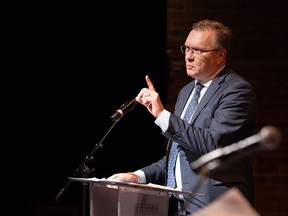
“I’m more of a pragmatist,” said Keith Wilson, the leader of pro-separatist advocacy group Let Alberta Decide.
“I understand the importance of having government to create certainty and to allow the market to function at an optimal level. I don’t subscribe to this extreme libertarianism that we can function without government.”
Wilson said he sees the Oct. 19 referendum as an “historic opportunity” that could finally give Alberta voters a more meaningful seat at the political table in Canada’s political system.
“We need to gain leverage to have discussions with the federal government and try to address some of the long-standing grievances,” he said. “So, I hope more and more people realize that and choose to vote for Option 2, even if they don’t support independence.”
The 10th question on the Oct. 19 ballot will ask voters if they want to stay in Canada (Option 1) or “commence the legal process” to hold a binding referendum on separation at a later date (Option 2).
Wilson, who didn’t attend the Calgary event, said that the separatist movement is indeed made up of various factions or people with differing interests, but said that is no different from the range of opinions he witnessed when he was the president of his student society at Douglas College, or when he advocated on behalf of Alberta ranchers in the 2010s. People in the separatist camp often want Wilson to prioritize specific issues, but typically they tend to have a unified goal in mind, he said.
“The common theme across the board is that Canada is no longer working for Alberta, and that Alberta can do better by redefining its constitutional relationship.”
Also absent from the event are Jeff Rath and Mitch Sylvestre, perhaps the two most prominent advocates for separation and the organizers behind a petition that effectively prompted the referendum.
Sylvestre told National Post that he favours “more local government” and smaller government wherever possible. The owner of a gun store, he is opposed to greater firearm controls but said he was perfectly satisfied with Canada’s gun policies before the Trudeau era. He favours unlocking more oil and gas development for economic reasons, but considers himself environmentally minded when it comes to keeping bodies of water clean or limiting artificial spraying on agricultural lands — “I’m about as green a guy as there is,” he said.
A Christian, Sylvestre said he also believes that rights are God-given rather than afforded by human-designed governments.
“As far as I’m concerned, if there’s nothing above government, then they’ll just take all the rights and freedoms away,” he said. “I think that the biblical values are the path, I really do.”
Rath did not respond to National Post’s request for comment. In recent weeks, he has become the target of lawsuits from several First Nations that the Alberta lawyer had represented in their land claims against the federal government. He’s being sued for more than $100 million.
A few weeks before the Oct. 19 referendum, it doesn’t look as though the separatists have much of a shot at breaking away from the federation in favour of a small government oasis. Polling shows support for separatism has dwindled in recent months, although it’s remained roughly around 20 per cent in favour of leaving, while support for Smith’s United Conservative Party, which announced the referendum, has fallen in favour of the provincial NDP.

Wilson acknowledges that some of the separatist movement has lost momentum as the Liberal government under Prime Minister Mark Carney has sought, for now, to appease Alberta’s grievances by promising to fast-track a new oil pipeline and ratcheting back various climate-oriented energy policies.
Laughing, he points out that the pro-independence side’s position is much like the Liberals under Justin Trudeau, who is without question the separatists’ most disliked bogeyman of all.
“We’re in about the same place as the Liberals were two weeks before the vote in the last federal election, and they pulled it off. So, my view is you have to approach these things as though you’re not winning.”
Danielle Smith, premier of Alberta
Smith has long said that she prefers “an independent Alberta within a united Canada,” and has urged voters to vote to stay in Canada. She has become more explicitly in favour of federalism as voting day nears, but has also sought to explain to non-Albertans why many in the province feel the need to separate.
As she put it in a recent forum hosted by former Reform Party leader Preston Manning: “When a proud, hardworking people feel their contribution is taken for granted and their livelihood is treated as something to be phased out, some begin to ask a painful question: “Does this country actually want us?”
Pierre Poilievre, Official Opposition leader of Canada
Poilievre’s Conservative Party has long held the position that opposes Alberta’s separation. In a recent speech urging Albertans to vote to remain in Canada, he made the case for why Alberta separatists are actually opposed to Ottawa’s continued overreach rather than to the nation of Canada itself.
“Simply put, the last decade the federal government has done terribly at the things that are actually its job: immigration, crime, military spending, borders, while intruding into things that are not its job: regulating our resources, going after hunting rifles which are private property, just to name a few examples.”
Thomas Lukaszuk, founder of Forever Canadian
Lukaszuk, the former deputy premier in Alberta’s Progressive Conservative government, has become a central voice of the federalist cause in the province. He has argued that separation is highly unpopular among the general population, and that the movement threatens to needlessly create uncertainty and drive away potential private investment. The former MLA launched his own advocacy group, Forever Canadian, to sway voters to reject the tenth referendum question on separation.
“A vast majority of Albertans, up to 80 per cent of Albertans, want nothing to do with separatism,” Lukaszuk said in an interview with Alberta Primetime last December. “They want both our federal government and provincial government to focus on what matters: affordability, health care, education. Not this silliness of separatism.”
Mark Carney, prime minister of Canada
Carney was elected to office on a promise to fight back against U.S. trade aggression, and the prime minister has made Alberta central to his efforts to diversify trade away from America. He has opposed separation, but has also tried to convince non-Albertans to be sympathetic to the province’s complaints. Speaking with reporters in June, Carney rejected claims that the Alberta referendum could be used as a way to send a message to Ottawa, and warned voters against presuming that separation from Canada would be a simple process.
“This is a real referendum,” he said. “It’s not a question about a question, (or) a free option. I saw first-hand what happened, what gets sold in these referenda. It’s: ‘everything’s going to be easy, you can keep your passport, you can keep the currency, you can stay in the country and leave it at the same time,’” he said, referencing Britain’s vote to leave the European Union during his time as Bank of England governor.
Jason Kenney, former premier of Alberta
Kenney has been one of the most vocal opponents of Alberta separation, and among the loudest critics of the movement’s leaders. In August, he teamed up with former Alberta premier Rachel Notley and the Canadian Chamber of Commerce on a campaign called Stronger Together, which sought to make a case for Canadian federalism.
“The national business community represented by the Canadian Chamber is an integrated network of hundreds of thousands of businesses of all sizes who know Alberta’s interests and theirs go hand in hand,” Kenney said in a statement announcing Stronger Together. “We’re ready to rally with facts and to make the case for a strong Alberta and a united Canada.”
Stephen Harper, former prime minister of Canada
Harper had long refrained from making many public statements about Alberta separation, but started explicitly oppose the pro-independence movement in the weeks before the referendum. The former Conservative prime minister took the unusual step of speaking at Prime Minister Mark Carney’s investment summit last month, and in a recent op-ed in the National Post, Harper said he didn’t see the upside of Alberta separating.
“I see no benefit and significant risk for Alberta to go down that path today. I believe Albertans’ energies are far better employed pushing for change in Ottawa and for the exercise of greater power by Alberta itself. Such efforts are far more likely to produce actual, positive results.”
Our website is the place for the latest breaking news, exclusive scoops, longreads and provocative commentary. Please bookmark nationalpost.com and sign up for our daily newsletter, Posted, here.
Join the Conversation
This website uses cookies to personalize your content (including ads), and allows us to analyze our traffic. Read more about cookies here. By continuing to use our site, you agree to our Terms of Use and Privacy Policy.
KioskNews shows a cleaned-up reading view extracted from the publisher’s page — the original always lives on their site, not ours.