Lower fees, more places in facilities for PWDs among first moves by disability task force
SINGAPORE - By 2028, families will pay less for disability services, as the Government lowers fees and increases means-tested subsidies.
More spaces will also be added to day activity centres and sheltered workshops by 2030.
Around 5,000 people with disabilities accessing community and residential disability services are expected to benefit from these changes by 2030.
Fee caps for all government-funded disability services will be introduced, with the amounts varying for different facilities.
For most families, subsidy rates will rise by at least 10 percentage points. These subsidies are means-tested, and apply to a wide range of disability services, including day activity centres, adult disability hostels and homes.
The income ceiling for households to qualify for these subsidies will also be raised. The maximum per capita monthly household income will increase from $4,800 to $6,000.
This will extend financial support to more middle-income households and covers about 80 per cent of households with people with disabilities (PWDs), said the Ministry of Social and Family Development (MSF).
These moves to make disability services more affordable are among the first set of recommendations by the Taskforce on Assurance for Families with Persons with Disabilities released on Sept 17. The task force was formed in December 2025 to review how support for the PWD community can be strengthened across life stages, and has held several engagement sessions with groups including families and service providers.
Senior Minister of State for Social and Family Development Goh Pei Ming, who leads the task force with four other political office holders, announced the moves at the sidelines of a visit to the TOUCH Centre for Independent Living at the Enabling Village in Lengkok Bahru.
Goh said affordability was one of the biggest concerns for caregivers, and some had expressed uncertainty about meeting their loved ones’ care needs over their lifetime.
“Over time, care costs can add up. Families hope to get assurances that support will continue to be affordable,” said Goh.
Another key move tackles a growing waiting list for day activity centres and sheltered workshops - facilities where adults with disabilities can be engaged in daily activities.
MSF will add another 1,300 day activity centre and sheltered workshop spaces by 2030, on top of the 1,000 additional places previously announced in 2024.
Goh said this “significant expansion” would bring the total number to about 5,800 places.
Families had told the task force that long wait times for such services can be stressful, he added.
Day activity centres are community-based facilities for those with disabilities who are aged 18 and above and cannot work, while sheltered workshops provide work skills training and job support for PWDs who can work, but are not yet ready or unable to take up open employment.
Full recommendations to come in October
Costs for disability services were last adjusted in July, when the Government increased subsidies for residential and community disability services by up to 15 per cent and 10 per cent respectively, and raised the household per capita income ceiling for subsidies from $3,600 to $4,800.
With the newest announcements, families of those with higher support needs will see their monthly fees after government subsidies for selected services drop by about 25 per cent to 80 per cent.
Lower-income households will pay no more than $10 per month for community-based services such as the day activity centres and Enabling Skills for Life Programme (ESLP), down from between $20 and $60 today.
The ESLP equips adult PWDs with independent living, communication, social-emotional functioning and vocational skills.
The Government will work with social service agencies over the next few years to expand capacity and carry out the adjustments to fees and subsidies, said MSF.
The inter-agency task force, which has looked into areas such as employment and lifelong learning for PWDs, will announce its full set of recommendations in early October.
Health product distributor Wu Ping’s son Sherman Jian, 24, has multiple disabilities and has attended TOUCH Centre for Independent Living since 2021. Any additional savings will give the middle-income family more room to plan for his future, said the 56-year-old.
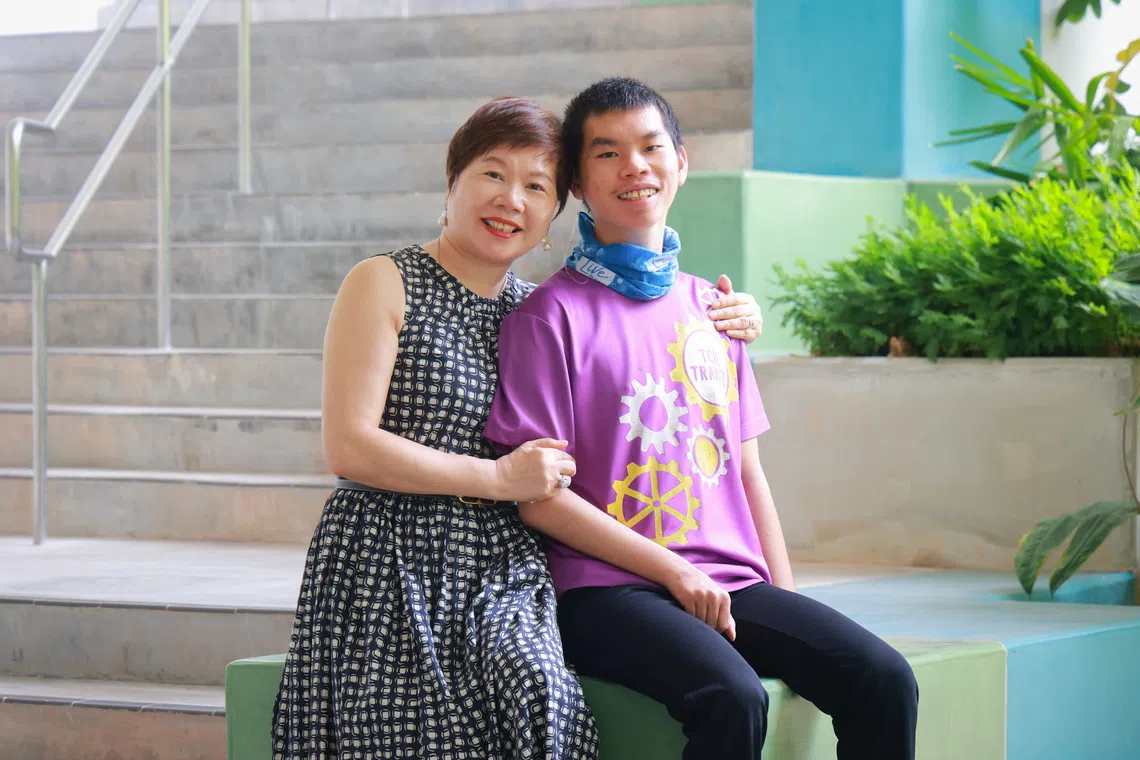
Wu Ping (left) and her son Sherman, who has an intellectual disability, deafness, cerebral palsy and epilepsy.
ST PHOTO: JASON QUAH
They currently pay $660 monthly for him to attend the day activity centre after government subsidies, down from $1,135 previously before the July adjustments. Their out-of-pocket costs are likely to fall further with the latest changes.
She said in Mandarin: “These subsidies make me feel that it’s not only the family and parents caring for the child... There are people walking with us on this journey.”
KioskNews shows a cleaned-up reading view extracted from the publisher’s page — the original always lives on their site, not ours.