When it comes to work, 60 is the new 40: Seniors are still clocking in, not cashing out
SINGAPORE – Said Mohamed’s life is deeply rooted in the Mandai Wildlife Reserve.
Not surprising, as he started working at the then Singapore Zoo at the age of 27 and spent the next 44 years proudly watching his “leafy children” stretch towards the sun, weather the elements and blossom into their full potential under his protective care.
One such “child” is the 50m-tall buah sentul, or cotton fruit tree, that sits at the entrance to the proboscis monkey exhibit at the wildlife reserve. He planted it as a seedling and nurtured it for the next 40 years.
“I also met and married my supervisor at the zoo,” said the 71-year-old, laughing.
Having spent almost a lifetime making sure the plants that now flourish in the five attractions at the wildlife reserve thrive, Said is not ready to give it all up and retire any time soon.
“Apart from having made good friends and a social network here to help keep me mentally alert, I also need to work to be able to support my son financially,” he said.
Said’s son, 37, has a disability and still attends a special school for adults. Said has also hired a domestic helper to manage his son’s daily needs.
While more than three in five seniors in Singapore continue punching the clock beyond their retirement age, citing social connection or mental stimulation as top reasons, a substantial proportion, like Said, work for financial reasons.
Even among Singapore’s high-income respondents, 48% said they needed additional income to cover daily living expenses and ensure long-term financial security.
These were the findings from a November 2025 survey conducted by Sun Life, an international financial services organisation, which looked at what it meant to age with confidence and the steps seniors were taking to make their vision of retirement a reality.
Called Retirement Reimagined: Asia’s Retirement Divide, the interviews were conducted online with a total of 3,006 people across Hong Kong, Indonesia, Malaysia, the Philippines, Singapore and Vietnam – with those from the island republic totalling 521.
A similar result turned up in a survey conducted around the same time, between September and October 2025, by the National Trades Union Congress (NTUC) with nearly 600 respondents across all age groups.
The NTUC study found that almost half, or 46%, of the respondents expressed a desire to work past the age of 70.
This willingness increased with age.
More than 66% of those aged 64 or above want to continue working past 70, compared with only 51% of those aged between 50 and 63.
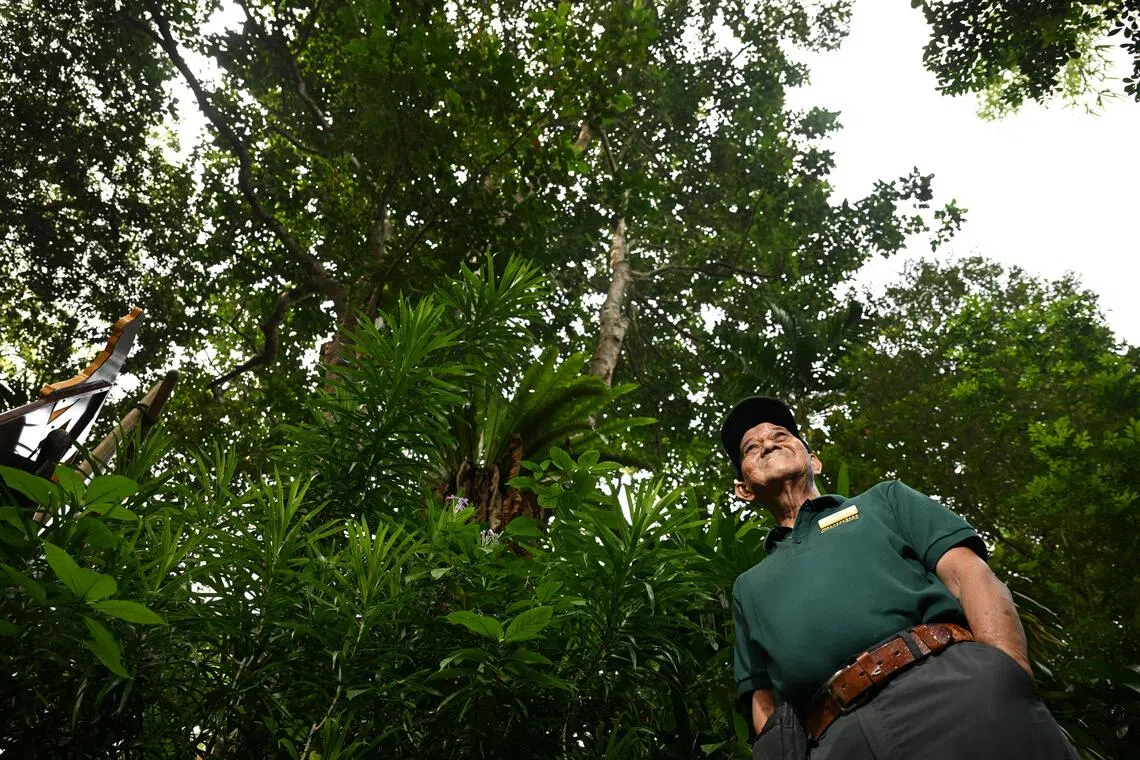
The 50m-tall buah sentul, or cotton fruit tree, that Said Mohamed planted and nurtured from a seedling now towers over the entrance to the proboscis monkey exhibit at the wildlife reserve.
ST PHOTO: AZMI ATHNI
Since July 2026, Singapore’s statutory retirement age has moved from age 63 to 64, and the re-employment age has also gone up to 69 from 68.
For someone approaching retirement, this means another year of earnings, more time to save, or an opportunity to move into a less demanding role.
And according to the Ministry of Manpower’s Labour Force in Singapore Advance Release 2025, between 2015 and 2025, the employment rate among workers aged 65 and above rose from 24.7% to 31.5%.
The NTUC survey found that maintaining mental and physical health by staying active was a top motivation, followed closely by the need for income to cover living expenses. These motivations are reflected in broader labour market data.
Based on the findings of the survey by his company, Sun Life Singapore chief executive Christopher Albrecht said: “What we are seeing is not a single retirement experience, but two very different realities. For those who are prepared, working longer can be a choice that offers flexibility and freedom. For others, it reflects financial pressure.
“Planning early, and planning holistically, is what determines which path people are on.”
Agreeing, Paulin Straughan, director of the Centre for Research on Successful Ageing at the Singapore Management University, said it is important to address the larger issue of senior engagement when it comes to those who have to work and those who wish to work.
Finding purpose in later-life work
Today’s older workers bring different expectations to the table.
Angelique Chan, the director of the Centre for Ageing Research & Education at Duke-NUS Medical School, said the whole discussion is about the fact that “60 is the new 40”.
“The current 65-year-olds, or even the 70-year-olds, are often healthier, better educated and more tech-savvy than the same cohort a generation ago. Our healthy life expectancy today is so high that we have actually pushed out the time in which we become disabled,” she said.
Straughan added: “Being a lot more educated, we want to remain socially relevant to apply our skills and play our part to make this world a better place.
“Living longer also makes many worry that retiring early may render us economically ill-prepared for retirement.
“Then there is also the fact that there are sometimes no grandchildren to play with or look after.”
That is why many people now view retirement less as a sudden, hard stop to working and more as a flexible transition that blends partial work, lifestyle and active mental engagement while allowing for ongoing personal growth and community.
Here, Chan said, the answer is to have employers adapt accordingly – flexible schedules, remote opportunities and part-time arrangements – to make it easier for experienced workers to contribute without burning out.
Agreeing, Straughan added: “Regardless of the triggers, employers must learn that if they want to do business in Singapore, they must restructure paid work and learn to purposefully and meaningfully engage older workers in their 50s to 70s.
“This means they have to recalibrate how they can design tasks that leverage older workers’ experiences and engage them on their own terms.”
Chan said: “What workers above 60 have is crystallised intelligence. This is a collection of facts, skills and information that they have accumulated over their lifetime through education and experience, and it is really something not to be discounted.
“You can’t teach it. It has to be lived. And if you start devaluing that, then you are going to have (young) workers who stay at a company for two years, three years, and they move on. Institutional memory becomes less and less, and with that, comes less and less loyalty to a company.”
This is perhaps why some companies prefer to retain staff beyond age 65 to preserve critical institutional knowledge, ease tight labour markets, and benefit from the strong performance and stability of mature workers.
Said’s critical experience in plant growing and care stood him in good stead when it came to passing on his knowledge to younger colleagues at the reserve.
Even Mandai Wildlife Group assistant vice-president for horticulture June Foo confidently told The Straits Times that Said was her mentor during the 20 years she had worked with him.
Like Said, Gleneagles Hospital assistant director of nursing Susan Kok, 70, saw her tenure extended beyond retirement age at the institution.
She has been working in the nursing profession since 1976, literally starting from the bottom.
“Old nurses never really go away,” Kok said, laughing.
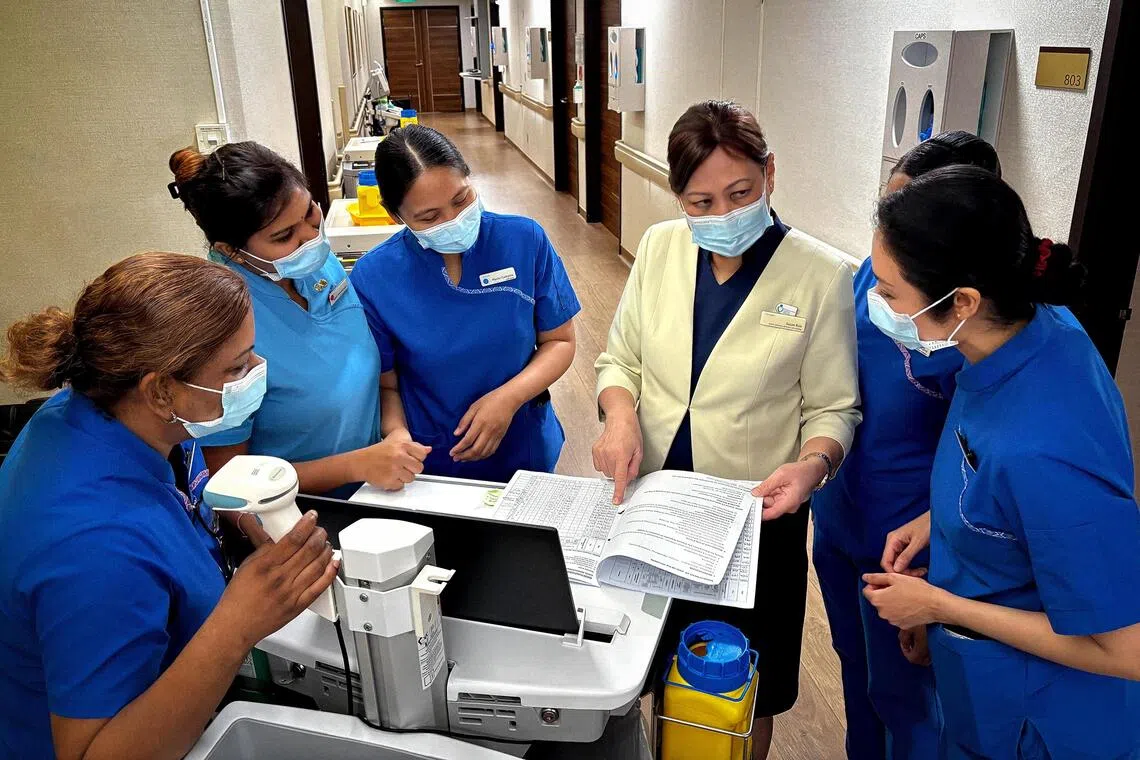
Susan Kok (centre), assistant director of nursing at Gleneagles Hospital, continues working beyond retirement age as she enjoys passing on her healthcare knowledge to younger colleagues.
ST PHOTO: JUDITH TAN
“Like how I was mentored by my older colleagues at the hospitals where I started, I now choose to stay to help groom the next generation of nurses by passing clinical knowledge and judgment, teaching them to overcome challenges and support planning and policies,” she said.
“Having worked 50 years in this field, managing patients and assisting the doctors, my life’s focus has remained here. Perhaps I would continue nursing as a volunteer in the community when I really retire.”
Pivoting to a new role
Unlike Kok, Phuah Gaik Kheng, 73, a former nurse manager at the Singapore General Hospital, left nursing but remained at the institution as one of its senior patient experience managers (SPEM).
“Being a nurse was my identity for 54 years. I first trained and worked in the UK for 11 years – in psychiatry, critical care and emergency medicine. Then I returned and carried on until I retired from SGH, where I was senior nurse manager in the emergency department (ED),” she said.
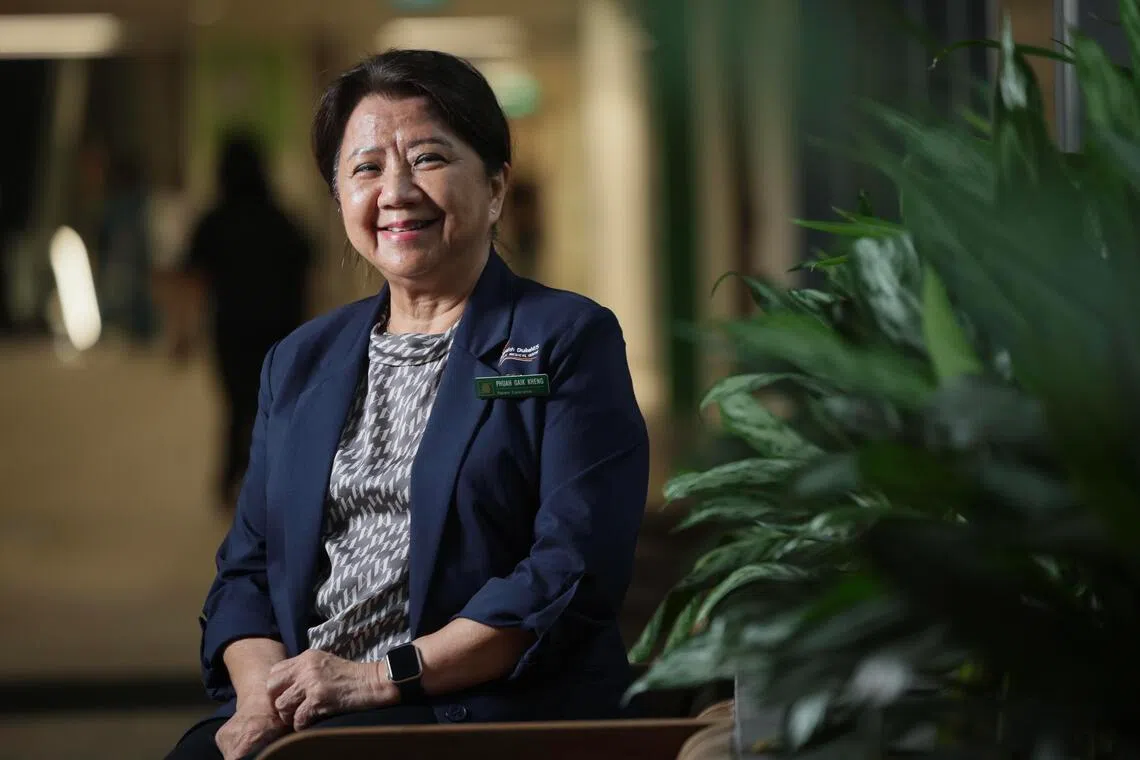
Former SGH nurse manager Phuah Gaik Kheng left the profession but remained at the institution as one of its senior patient experience managers.
ST PHOTO: GIN TAY
She became an SPEM in 2020 when she turned 67.
“I continued at ED, where emotions and tempers can run very high. It is also where staff are most at risk of facing abuse. As someone who has been on both sides, I can advocate for patients as well as for my healthcare colleagues,” Phuah said.
Phuah said her life experience helped especially when she was able to put herself in the shoes of others.
“Most of the time, the problem is simply from miscommunication, or a wrong choice of words. Even poor bedside manners, like spending more time on the screen than speaking to the patient, can set them off. Having been trained, I now help in changing mindsets at both ends,” she said.
Chan said pivoting to post-retirement usually meant switching to a completely new industry or launching a business. While it is increasingly common, recreating a career later in life introduces a unique set of “non-linear challenges”.
The older worker cannot be complacent.
Questions such as ‘Why do you want to do it?’ and ‘Can you do it?’ can hurt too.
Here, it is about people being able to learn and grow as they age, Chan said.
“However, ‘Can you do it?’ is more problematic. Here, the person would have to show the energy and enough education in the new area to be able to be convincing,” she said.
“In terms of meritocracy, it is not about how old you are, but whether you are passionate enough or if you have studied enough about the area and could think laterally. Then the odds are you will do well in the new position.”
Retention in the same profession has its issues as well, Chan said.
“The older nurse is revered for her experience and knowledge, but there also is the issue of keeping up with technology, with artificial intelligence. I have seen some instances where team members wonder why the older ones are not as savvy on social media.
“So, older people also have a responsibility to keep up. They do not have to be fantastic at it, but they need to keep up,” she said.
Sociologists often ask whether teams in the office should be made up of both older and young workers.
Chan said the answer is “yes”, as the seniors would bring to the table “institutional memory and crystallised intelligence”.
“Everyone in the team has different strengths. And if AI is important, we have younger people to take on that as their major load. Then the older person brings wisdom, calmness, experience and perhaps shortcuts – something that you cannot buy or teach,” she said.
Foo said Said still amazes his colleagues whenever they stroll through the reserve to make sure the shrubs and trees are doing fine.
“He would be telling us both the native and biological names of the plants and what they are good for as herbs to treat certain ailments.
“We would want to have Said around as long as we can keep him,” she said.
KioskNews shows a cleaned-up reading view extracted from the publisher’s page — the original always lives on their site, not ours.