Have our exercise books changed, or have our priorities changed?
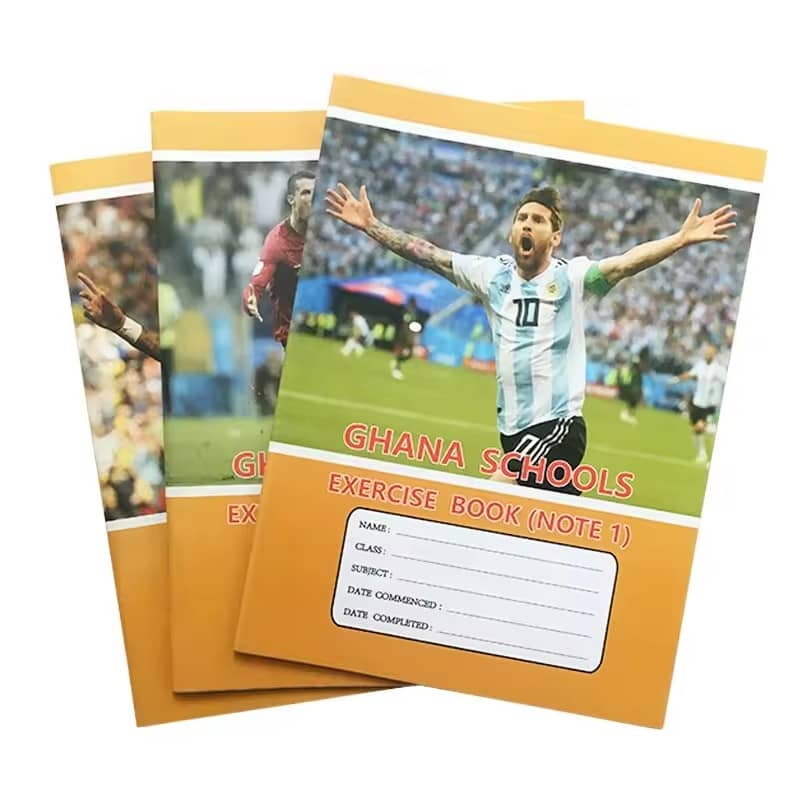
I've been thinking lately about the exercise books we used growing up. I wonder how many people have noticed the change too.
If you went to school in Ghana some years ago, you probably remember those exercise books with multiplication tables, country facts, and conversion charts at the back. You would also find the days of the week and the months of the year printed there. They were simple books, but they offered little reminders that could be useful in class and beyond.
Sometimes, while waiting for a lesson to begin, you might find yourself reading the multiplication table at the back of your book. You could check how many days were in a month or remind yourself of the order of the months. Nobody had to set an exercise for you. The information was simply there, and because you saw it often, you gradually became familiar with it.
These days, however, many exercise books look different. It is now common to see the faces of popular footballers, musicians, actors and other celebrities on their covers. And honestly, there is nothing wrong with that. Children enjoy colourful designs, and it is only natural that they would be excited to carry books featuring people they admire.
But it does make me wonder: must we choose between making an exercise book attractive and making it useful? Can't it have both?
Those small learning reminders may have seemed ordinary, but they probably helped more than we realised. Children learn in different ways, and sometimes they remember things simply because they come across them repeatedly. Jean Piaget's cognitive developmental theory reminds us that children actively make sense of the world around them. In that sense, having simple information such as multiplication tables, days and months that children can see regularly may give them another opportunity to practice and remember.
Another useful perspective comes from Lev Vygotsky's sociocultural theory. Vygotsky emphasised that children learn through interaction with other people and the culture around them. They learn from teachers, parents, classmates and even the everyday materials they use. An exercise book that includes simple facts, local languages, cultural information or short explanations could therefore become more than a place to write; it could also give children something to discuss with others and learn from.
I remember that learning did not always have to involve opening a textbook. Sometimes, all you had to do was turn your exercise book around. It was a small thing, but it made useful information part of your everyday school experience.
Then there is the question of the people we choose to put on the covers. Children often admire the famous people they see around them. Psychologist Albert Bandura's social learning theory helps explain this: children can learn by watching others and seeing them as examples. A footballer, musician or actor on a book cover may inspire a child in one way or another. There is nothing automatically wrong with that.
Still, it is worth asking why we do not see more Ghanaian footballers, musicians, actors, scientists, writers, teachers, inventors, athletes and other people who have contributed to society. Why must it be mostly foreign celebrities? Imagine a child carrying an exercise book with a Ghanaian scientist on the cover, or one featuring a local author or a local musician or an important figure from our history. That image might lead to a question: Who is this person, and what did they do?
That is one way ordinary things can introduce children to ideas they may not meet every day. The people and images around us can influence what we notice, talk about and admire. As children grow, they also learn about their society, its history and its values. This process, known as socialisation, happens not only at home and in the classroom but also through everyday experiences.
Urie Bronfenbrenner's ecological systems theory also helps us see why the small things in a child's environment matter. A child's development is shaped by the different settings they are part of, including home, school and the wider community. Exercise books are only one small part of that environment, of course, but they are used regularly in school and at home. What children repeatedly see in these everyday spaces can contribute to the ideas and conversations they encounter as they grow.
This does not mean we should stop featuring international celebrities. Children should be free to admire people from different parts of the world. But they should also have the chance to recognize and appreciate people from Ghana. Our own achievements and stories deserve a place too.
Even the pictures on a book cover can carry a message. A child may see a famous footballer and associate that person with talent, success or determination. In the same way, seeing a Ghanaian scientist, writer or national figure could remind a child that people from their own country can also do remarkable things. The idea is not that every child will respond to the image in the same way, but that it can create an opportunity to learn and have a conversation.
This also connects with symbolic interactionism, a sociological perspective that looks at how people create meaning from symbols in everyday life. To a child, a picture in an exercise book may be more than decoration. It may represent fame, hard work, talent or success. In the same way, a Ghanaian personality or historical figure on a book could help communicate that people and achievements from our own communities are worth noticing and celebrating.
Of course, exercise book manufacturers have their own reasons for choosing particular designs. They may be responding to what children like, what parents are willing to buy and what sells in the market. Designs change with time, and there is no reason to expect exercise books to look exactly as they did years ago.
Perhaps, though, there is room for a little balance. The popular faces children enjoy could remain on the front, while the back could carry multiplication tables, days of the week, months of the year or other useful facts. Some books could feature Ghanaian personalities, historical events, cultural information or interesting facts about the country. It does not have to be complicated, and it does not have to be the same design for every book.
I think this is a conversation worth having among parents, teachers, school authorities, manufacturers and anyone who cares about children's learning. An exercise book may look like a small part of a child's education, but think about how often it is used. It goes to school, comes home and is opened almost every day. If it can do a little more than provide space for writing, why not?
Perhaps the old exercise books were not better in every way. Maybe today's designs simply reflect the interests of a new generation. But change does not mean we have to leave every useful thing from the past behind. We can make room for new ideas while keeping the little things that helped us learn.
So, what do you think? Do you remember the multiplication tables, days and months printed at the back of your old exercise books? Did you find them useful, or did you hardly pay attention to them?
And for parents and teachers, would you like to see some of those features return? Should Ghanaian personalities and achievements have a bigger place on the books children use today? Or can we have colourful covers, inspiring faces and useful learning information all in one exercise book?
I would be interested to hear different views. Perhaps this is one of those small changes we have become so used to that we have never really stopped to discuss it.
KioskNews shows a cleaned-up reading view extracted from the publisher’s page — the original always lives on their site, not ours.