Food Sovereignty Ghana calls for national agroecology framework to strengthen food safety
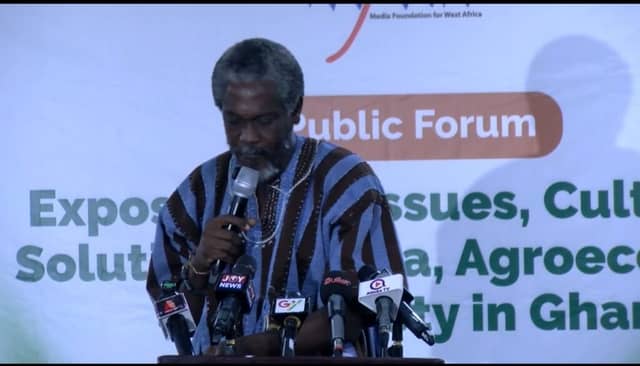
Food Sovereignty Ghana has called on government to establish a comprehensive national agroecology framework to guide agricultural policies, strengthen food safety and promote sustainable food production.
The organisation says the absence of a coherent framework, coupled with inadequate monitoring of farming practices, continues to expose consumers to potential risks associated with pesticide misuse and unsafe handling of agricultural chemicals.
Its Communication Director, Edwin Kweku Andoh Baffour, made the call at a public forum organised by the Media Foundation for West Africa (MFWA) at the Sunlodge Hotel in Accra on November 27, 2026.
Held under the theme “Exposing the Issues, Cultivating Solutions: Media, Agroecology and Food Safety in Ghana,” the forum brought together stakeholders to discuss challenges within Ghana’s food systems and the role of the media in promoting accountability and public awareness.
Mr Andoh Baffour said Ghana needed a coherent national agroecology framework with clearly defined priorities and measurable objectives.
“Ghana needs a coherent national agroecology framework that establishes clear priorities and measurable objectives. One that integrates agroecology into extension work, education and research and protects indigenous knowledge and biodiversity,” he stated.
He added that the framework must be developed through consultations with farmers, traditional authorities and researchers, stressing that agroecology should become part of Ghana’s mainstream agricultural transformation agenda.
On food safety, Mr Andoh Baffour called for stronger monitoring of farming practices, particularly the application and handling of pesticides.
“When it comes to food safety, I think we need something like traffic tech in our food system. We need much, much closer monitoring because Ghanaians have a right to food that is nutritious, a right to food that is affordable and safe,” he said.
He expressed concern about the misuse of pesticides and unsafe handling practices among some farmers, attributing the problem partly to inadequate education and inappropriate application of agricultural chemicals.
Citing examples from farming communities, he described how some farmers use their fingers to test pesticide mixtures and repurpose chemical containers as measuring cups.
“You’ll find farmers who use their fingers, like you saw in the video, to taste whether they’ve mixed it and it’s strong enough. And they’ll cut the container in half and use it as cups,” he said.
Mr Andoh Baffour warned that washing such containers may not eliminate chemical residues, potentially exposing farmers and consumers to harmful substances.
Speaking on behalf of the Executive Director of the Media Foundation for West Africa, the Director of Freedom of Expression and Digital Rights, Dora Boama Mawuto, also called for greater attention to agroecology as part of efforts to promote healthier and more sustainable food systems.
“It’s about time we paid attention to sustainable and healthier practices such as agroecology,” she said.
Ms Mawuto explained that agroecology promotes farming systems that work with nature rather than against it, drawing on ecological principles and traditional knowledge to build productive, resilient and environmentally sustainable agricultural systems.
She highlighted practices such as crop rotation, intercropping, composting, mulching and biological pest control as approaches that can improve soil health, conserve biodiversity and reduce farmers’ dependence on synthetic chemical inputs.
The discussions at the forum highlighted the need for stronger agricultural policies, improved oversight of food production and sustained media attention to promote food safety and sustainable agriculture in Ghana.
Stakeholders say coordinated efforts among government, farmers, researchers, civil society and the media will be critical to ensuring safer food production and more sustainable agricultural practices.
KioskNews shows a cleaned-up reading view extracted from the publisher’s page — the original always lives on their site, not ours.