Hall of Famers v bunch of gamers: the Dodgers’ exit proves money can’t buy everything
Milwaukee Brewers manager Pat Murphy had just watched his club dismantle Los Angeles for a fourth straight National League Championship Series game. Standing with his team in the Dodger Stadium clubhouse, he was ready to celebrate. But before popping his champagne and setting off a stream of celebratory suds, Murphy had a message.
“They got a bunch of Hall of Famers. We got a bunch of gamers.”
Murphy had nailed the Dodgers to the wall, ending the season of a juggernaut who came into 2026 with eyes on becoming the first NL team to win three straight World Series titles.
He also nailed the postgame speech.
The Dodgers are dead, and instead, it’s Milwaukee who made history, becoming the first team to avenge an NLCS sweep by returning the favor against that very same team, the very next season.
Making history, it seems, is a theme with these Brewers, who racked up a franchise-best 103 wins during the regular season, and have now dethroned a team who seemed a shoo-in to become baseball’s first true dynasty since the millennium.
Milwaukee transformed LA into a team of ghosts, and no more so than in Game 4. With the desperate Dodgers bidding to wake up the echoes with a 4-0 lead, the Brewers went to work. And again, it was Jake Bauers who broke LA’s back. In Game 2, Bauers tortured Dodgers ace Yoshinobu Yamamoto with an epic 12-pitch walk that sparked a key rally. In Game 3, there was an epic 11-pitch at-bat, this time against two-time Cy Young Award winner Blake Snell, concluding with a franchise-defining home run. In the fourth inning of Game 4, Bauers struck a double against starter Tyler Glasnow, cutting the Dodgers’ lead in half. An inning later, Bauers – the journeyman infielder who paused his retirement and returned this season because he needed health insurance for his soon-to-be newborn – drew a bases-loaded walk to tie the game. Garrett Mitchell’s sixth-inning solo home run gave Milwaukee a lead that would hold up. An old-school, three-inning save by Aaron Ashby was the chef’s kiss.
Now Milwaukee will head to their first World Series since 1982. There will be plenty of time to ply the Brew Crew with pixelated plaudits as they await their American League opponents, the Tampa Bay Rays or Cleveland Guardians. First, though, comes the funeral.
The tight, young, dynamic and fundamentally sound Brewers made Los Angeles’s best look old, flat and incapable. And while it all seems somewhat sudden, perhaps the writing was on the wall all along.
The Dodgers, the team who have everything, lack for nothing and have more money than Davy Crockett, won 100 games this season, but were just 38-37 against teams above .500 and hit into an MLB-worst 128 double-plays. In ways, they looked more like another expensive but deeply flawed coastal superpower: the New York Yankees. The Bronx bombs also beat up on lesser opponents all season long while struggling against higher-end teams. It’s no coincidence that both teams are now out; baseball has a way of weeding out the suckers, even in what some believe is a “crap shoot” of a postseason.
Perhaps the most shocking spectacle was the undoing of the sport’s most prolific figure, Shohei Ohtani. The best two-way player in baseball, inside his category of one, showed signs of breaking down in the latter portion of the season. First injuries forced him to stop pitching. Then he went homerless from late August until Thursday. Ohtani said it was only his ability, not injuries, holding him back, but he was dropped to sixth in the batting order for Game 3, and that doesn’t happen to an elite player in his prime unless there are issues. In the seventh inning of Game 4, with Kiké Hernández 90ft away from tying the game at five, Ohtani waved at an Ashby slider that was closer to Fresno than the Dodger Stadium home plate. Ohtani, the four-time MVP, wasn’t alone. Former MVP Mookie Betts hit light; former MVP Freddy Freeman hit even lighter. The lineup, collectively, hit for a .590 OPS in the series, while the pitching was uneven at best.
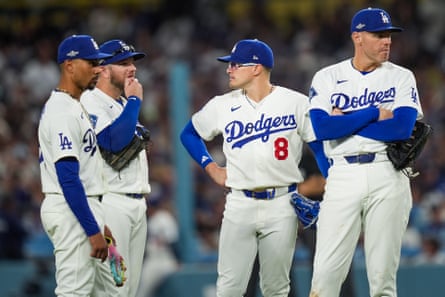
After the game, manager Dave Roberts, who was out-skippered by Murphy all series, told Fox that “the great thing about what we do is, you can try as much as you want, want it as bad and there’s nothing you can do about it. There’s nothing guaranteed.”
And that, it seems, gets to the heart of where we are with the Dodgers and where we may be with baseball: nothing, at all, is guaranteed. Not even after signing Kyle Tucker and Edwin Díaz in the offseason for a combined $309m. Not even after trading for Cy Young Award winner Tariq Skubal at the deadline. And not after writing $340m worth of checks. The Dodgers’ payroll is more than the combined payroll of the Rays, the Guardians, and the Brewers, the club that sent home “the team that destroyed baseball”.
And so the Dodgers, always in the headlines, leave us with all sorts of questions. The most straightforward: how will they respond and retool? The bigger questions: can critics say they destroyed baseball when the Brewers and their 19th-ranked payroll just destroyed them? Is baseball, a game that involves both skill and luck and always keeps us guessing, really some kind of utopian paradise where paupers can actually compete for prizes against princes? Are high payrolls and all-star laden rosters the most important metrics when it comes to who can compete for a title? How much can a smart, deliberate team brass make up for small budgets? In other words: who can find the gamers, when they can’t afford the Hall of Famers?
KioskNews shows a cleaned-up reading view extracted from the publisher’s page — the original always lives on their site, not ours.