Concorde lands in Hong Kong’s Kai Tak for the first time in 1976 – from the SCMP archive
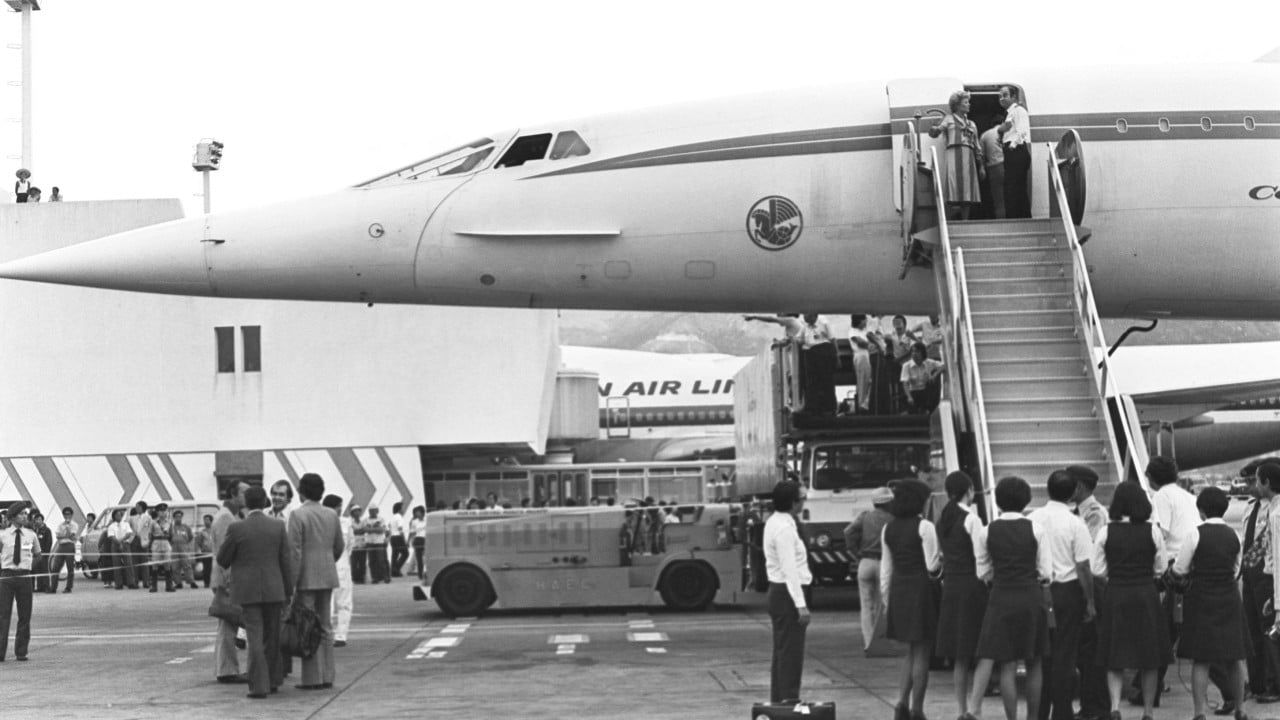
The supersonic age hit Hongkong yesterday (November 5, 1976) – not with a bang, as many expected, but with a whisper.
Concorde, the Anglo-French airliner, arrived from Manila on a demonstration flight with Mrs Imelda Marcos, wife of the Philippine President, as special guest.
While the aircraft stopped over before returning to the Philippines, the First Lady and her party found time to do some shopping.
Other passengers included guests and officials of the French Aerospatiale Company, which manufactured the plane jointly with the British Aircraft Corporation.
Mrs Jehan Sadat, wife of the Egyptian President who is visiting Manila, had been invited to join Concorde’s first trip to Hongkong but she was unable to go because of her tight official schedule.
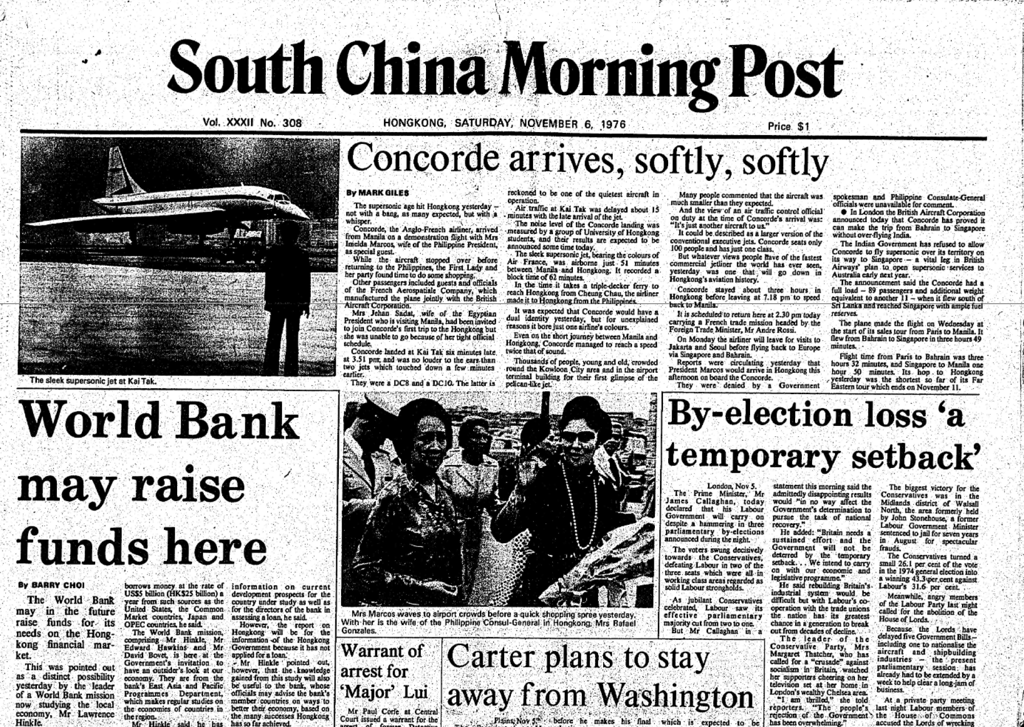
Concorde landed at Kai Tak six minutes late at 3.51pm, and was no louder to the ears than two jets which touched down a few minutes earlier.
They were a DC8 and a DC10. The latter is reckoned to be one of the quietest aircraft in operation.
Air traffic at Kai Tak was delayed about 15 minutes with the late arrival of the jet.
The noise level of the Concorde landing was measured by a group of University of Hongkong students, and their results are expected to be announced some time today.
The sleek supersonic jet, bearing the colours of Air France, was airborne just 51 minutes between Manila and Hongkong. It recorded a block time of 62 minutes.
In the time it takes a triple-decker ferry to reach Hongkong from Cheung Chau, the airliner made it to Hongkong from the Philippines.
It was expected that Concorde would have a dual identity yesterday, but for unexplained reasons it bore just one airline’s colours.
Even on the short journey between Manila and Hongkong, Concorde managed to reach a speed twice that of sound.
Thousands of people, young and old, crowded round the Kowloon City area and in the airport terminal building for their first glimpse of the pelican-like jet.
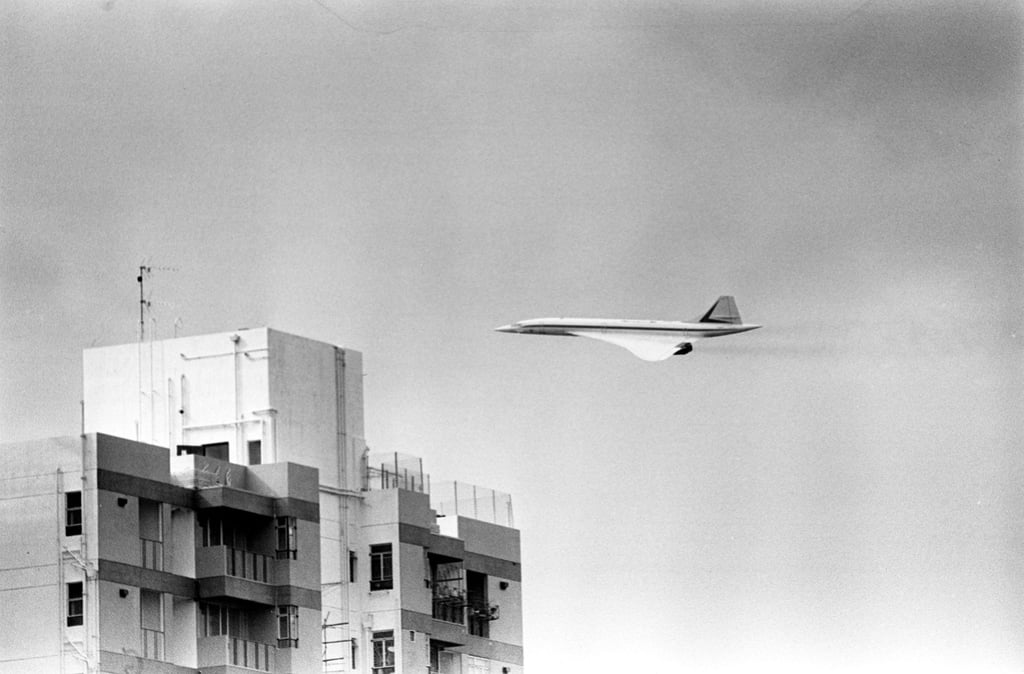
Many people commented that the aircraft was much smaller than they expected.
And the view of an air traffic control official on duty at the time of Concorde’s arrival was: “It’s just another aircraft to us.”
It could be described as a larger version of the conventional executive jets. Concorde seats only 100 people and has just one class.
But whatever views people have of the fastest commercial jetliner the world has ever seen, yesterday was one that will go down in Hongkong’s aviation history.
Concorde stayed about three hours in Hongkong before leaving at 7.18pm to speed back to Manila.
It is scheduled to return here at 2.30pm today carrying a French trade mission headed by the Foreign Trade Minister, Mr Andre Rossi.
On Monday the airliner will leave for visits to Jakarta and Seoul before flying back to Europe via Singapore and Bahrain.
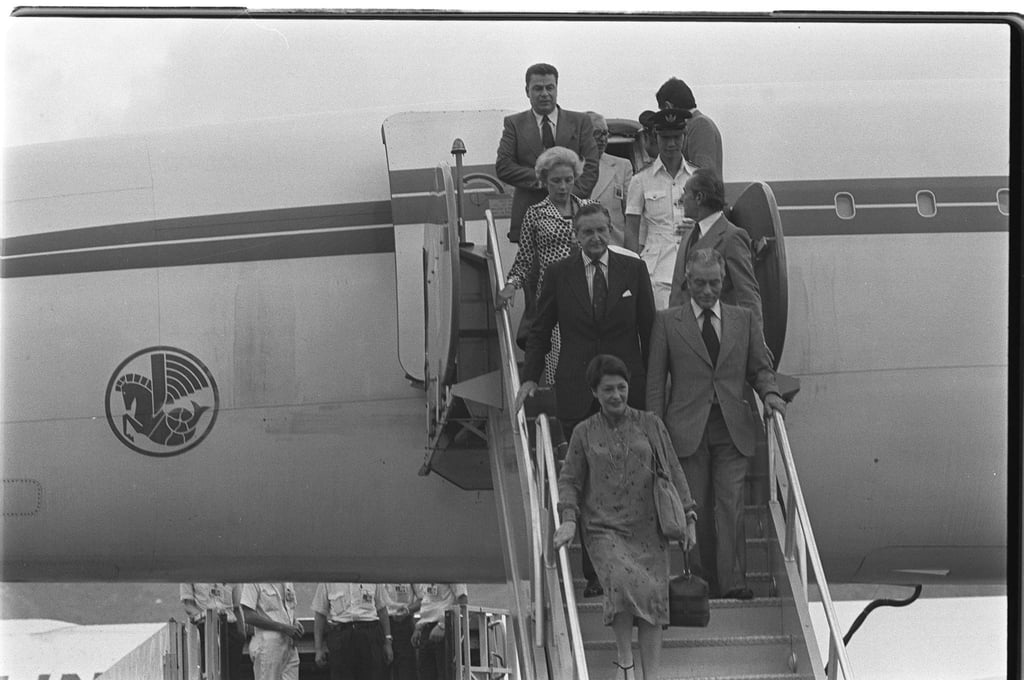
Reports were circulating yesterday that President Marcos would arrive in Hongkong this afternoon on board the Concorde.
They were denied by a Government spokesman and Philippine Consulate-General officials were unavailable for comment.
In London the British Aircraft Corporation announced today that Concorde has proved it can make the trip from Bahrain to Singapore without over-flying India.
The Indian Government has refused to allow Concorde to fly supersonic over its territory on its way to Singapore – a vital leg in British Airways’ plan to open supersonic services to Australia early next year.
The announcement said the Concorde had a full load – 89 passengers and additional weight equivalent to another 11 – when it flew south of Sri Lanka and reached Singapore with ample fuel reserves.
The plane made the flight on Wednesday at the start of its sales tour from Paris to Manila. It flew from Bahrain to Singapore in three hours 49 minutes.
Flight time from Paris to Bahrain was three hours 32 minutes, and Singapore to Manila one hour 50 minutes. Its hop to Hongkong yesterday was the shortest so far of its Far Eastern tour which ends on November 11.
KioskNews shows a cleaned-up reading view extracted from the publisher’s page — the original always lives on their site, not ours.