‘If people start practising asset allocation, they will view volatility as opportunity’: ICICI Prudential AMC Executive Director, CIO
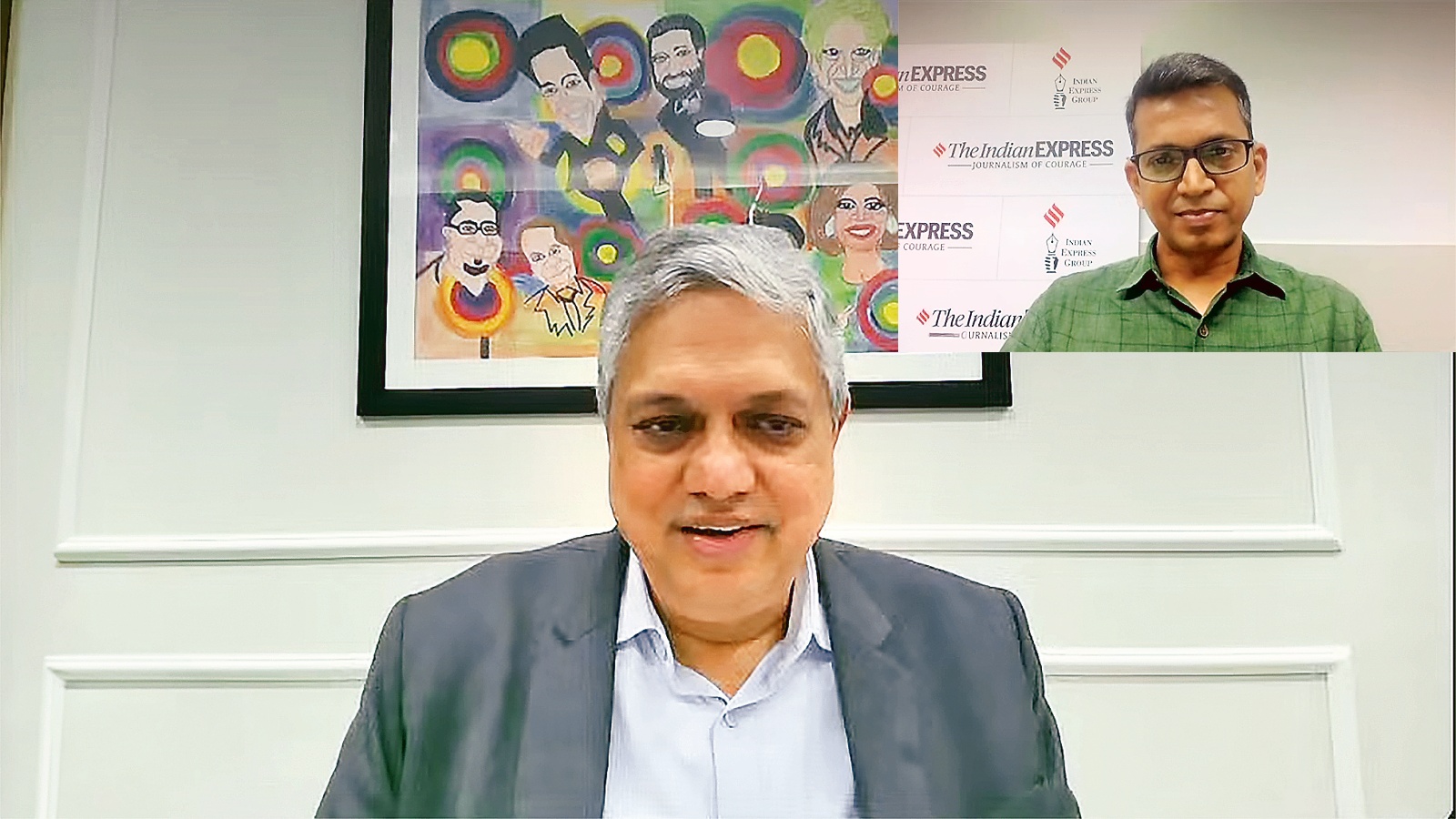
Before its recent surge, the Sensex had traded around the 73,000 mark for around three years. Sankaran Naren, Executive Director and Chief Investment Officer at ICICI Prudential AMC, spoke to Sandeep Singh, National Bureau Chief at The Indian Express, on October 27, about what was holding the markets back and how people should plan their investments. Edited excerpts:
Three years back, the markets were overvalued. That could be part of the explanation. But there are multiple reasons.
First, is the geopolitical problem — war in Ukraine and the Gulf, and record high crude oil prices. Second, artificial intelligence-related growth has been very high in some countries: US, South Korea, Taiwan, Japan, etc. The growth rate there has been much higher than the growth rate that India can ever give. People have moved to these markets, particularly in the last two years.
And the third reason is that after March 2023, once the money started coming into equity mutual funds, three sets of investors started to sell. One is Indian promoters who have been launching IPO after IPO because they know that the markets are overvalued. The second is private equity companies which had invested pre-2023, which had realised that you can sell these stocks to Indian investors at a good price. And the third was multinationals who had set up businesses in India over the last 20, 30, 40 years. They realised that they should list in India because here you get valuations much higher than in your home country. Despite the huge amount of money that we collected, all that money primarily went into these three sets of people’s pockets. And that is why markets have not delivered returns.
Weakening rupee, volatile oil prices, rising interest rates, slowing growth: What is your biggest worry?
I am worried about the impact of AI on India, whether it will be negative or positive. It is the most important long-term view because at some point of time the war will end and when the war ends, oil will come down. At some point of time, people will not have IPOs. But AI can be a structural trend. And no one knows what the long-term impact of AI will be. People believe that fund managers can correctly guess the long-term impact, but we also don’t know.
There is a talk of India becoming a $20-trillion economy say two decades from now. Are the grounds ready for that?
In the services sector, there are no other countries which are competing with us. In manufacturing, there are multiple countries that are competing, including Vietnam and Thailand. To win in manufacturing is not as easy as winning in services. Is India working to become better every year over the previous year? Yes. But the competition is intense.
I think we need to create manufacturing employment on a very large scale. And that is the solution for growth to increase. And I’m sure that the government is well aware of this issue and will focus on it. But it is not as easy to create a global manufacturing hub in every area as it has been to create a global services hub.
Story continues below this ad
https://www.facebook.com/watch/live/?ref=watch_permalink&v=2024699198233575
Assuming that the US-Iran war ends, which sectors should investors look at to maximise their returns?
I think banking clearly will benefit a lot because the sector has been hurt by inflation and the rupee has been depreciating. Oil marketing companies should certainly benefit because they are the people who are bearing the brunt of the higher oil prices. If you look at areas like aviation for example, they are going to be benefited. But overall, we have started rate hikes and they may continue if oil is like this. But if the war ends and oil crashes, the requirement for the Reserve Bank of India to keep hiking interest rates also goes down. But we require a good fall in oil. A good fall in oil actually lubricates all parts of the economy, not just a few areas.
These are external factors. On the domestic front, what gives you comfort and what is challenging?
The current account deficit is under control, fiscal deficit is under control. Credit growth is booming. The automotive industry has been booming over the last year. Power demand has been booming.
Some of the challenges include a subpar monsoon. And there is always the worry that El Niño will create more problems.
Story continues below this ad
There are things that any country can do… the RBI realised that it is important to get insurance deposits. So, they floated an FCNR scheme and collected $127 billion of deposits. That takes care of all near-term foreign exchange issues. Having said that, the problem of the war, and the problem of what AI leads to in the future, will remain.
Amid these challenges, does asset allocation become much more important, given we don’t know how things are going to shape, and how long the challenges will continue given the nature of them being external rather than internal?
Indians have got this love for equity at this point of time. And equity is inherently not a riskless asset class. That’s why if people start practising asset allocation, they will view volatility as an opportunity and not worry so much. But, if you are only invested in equity or you take positions in derivative markets on leverage, then you are very worried about everything that is happening.
Many investors have 15-20 schemes in their portfolio. Can you simplify and tell us three classes of schemes that investors must possess at all times?
I am of the view that if you create three categories — balanced advantage, balanced hybrid, and flexi cap — you would have covered substantially. Then you don’t need to worry day-to-day about what’s happening in the market. You just keep investing in these categories and keep saving and keeping put money in these three categories because our broad approach is very clear.
Can you take our readers through these categories briefly?
Balanced advantage is a very simple model: As the market goes up, you keep selling, and as the market goes down, you keep buying. So in 2023-24 when the market was more overvalued, it had less exposure to equity and higher exposure to debt and arbitrage. Today, because equity has become more fairly valued, it has a higher exposure to equity and a lower exposure to arbitrage and debt. If you look at balanced hybrids, it’s even more simple. It says you can invest between 40% and 60% in debt, and 40% and 60% in equity. It is the quintessential asset allocation product where you’re choosing two products, and both the products have to be between 40% and 60%.
Story continues below this ad
The third category is called “flexi” cap because you can invest in all kinds of things. You can invest in large cap, mid cap, small cap, micro cap and, therefore, you are entirely investing in the entire equity market. So we call it the most unconstrained fund.
For people who need gold, I would say multi-asset is the fourth category.
KioskNews shows a cleaned-up reading view extracted from the publisher’s page — the original always lives on their site, not ours.