Fallback to First Choice: Why Chinese Parents Are Rethinking Vocational Schools
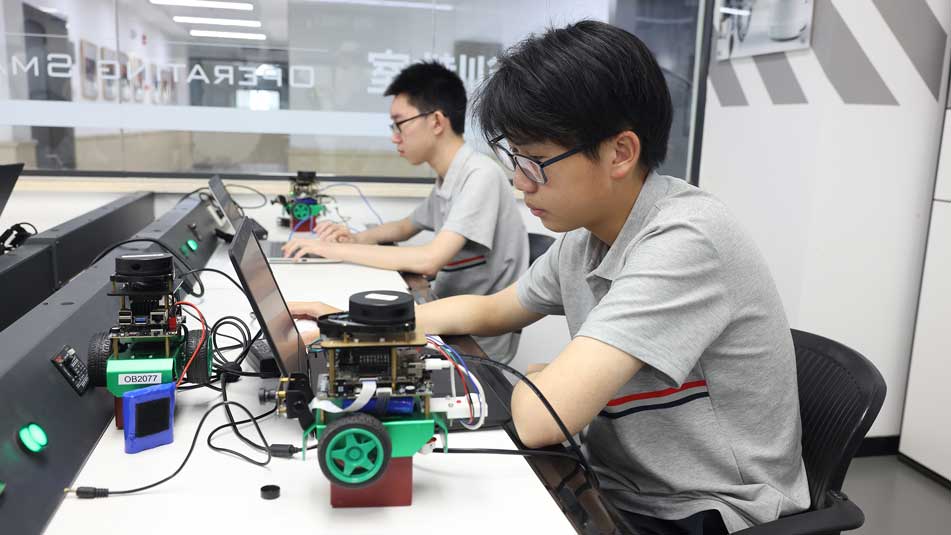
Coming from a Shanghai family with a strong academic background, Yang Fan had always felt studying at university was his destiny. The only problem was, he was flunking middle school.
“He’d make the same mistake with a character the entire semester. I just couldn’t get him to do it right,” says his mother, Zhao Xuan, who could only look on in frustration as Yang struggled with his homework night after night. “Given how much it was taking for him to get through middle school, I felt high school would crush him.”
Last summer, with the conventional academic pathway looking a bad fit for their 15-year-old son, Zhao and her husband began to consider China’s integrated secondary vocational-to-undergraduate articulation program. Launched as a 2014 pilot in Shanghai, the initiative sees students spend up to three years at a vocational school before transitioning to a partner university to complete a related four-year bachelor’s degree program.
Over the past 12 years, the number of participating educational institutions has rapidly expanded, now covering at least seven provincial regions, and applications have soared.
Shanghai alone has established 91 majors across 38 vocational schools and 18 universities, enrolling about 20,000 students and producing six cohorts of graduates. Planned enrollment this year was 2,756, up from just 120 in 2014 and a 17.5% increase from 2025.
Programs cover diverse fields including robotics, accounting, digital media arts, big data engineering, logistics, environmental design, hospitality management, cultural heritage restoration, smart manufacturing, performing arts, sound recording, information security, and materials science.
The trend reflects a sea change in attitudes toward vocational education in China. Technical skills training has long been stigmatized as “low status” and a “fallback option,” but as the country’s workforce undergoes a massive restructuring driven by an aging population, advancements in artificial intelligence, and an economic slowdown, more people feel it now makes students more employable compared to those with purely academic backgrounds.
In real terms, most students in the integrated program say their experiences are far less stressful than those of their peers at traditional Chinese high schools, and that they are encouraged to focus more on their personal strengths rather than sticking to a one-size-fits-all curriculum.
However, because most applicants are only in their mid-teens, it’s often parents who make the final decision, with research suggesting that more-passive children have only a vague idea of, or interest in, what might lie ahead.
The path less traveled
It was only when Zhao learned that the prestigious Shanghai Maritime University (SMU) would join the integrated secondary vocational-to-undergraduate articulation program in 2026 that she was sure the pathway was a “realistic match” for Yang.
Soon, Zhao and her husband, who holds a Ph.D., had researched the job prospects of various degree holders and consulted with their son, who was willing to give vocational school a try. For him, it was an opportunity to follow his growing interest in mechanics and spend time on activities he’d been forced to drop in middle school, such as table tennis and learning to play guitar.
In the 2026 zhongkao, the national high school entrance exam, Yang scored highly enough to earn a place this fall in the mechanical design, manufacturing, and automation major run jointly by Shanghai Harbour School and SMU.
With the increase in applications, programs have been setting higher admission thresholds. More than 80% increased their cut-off in 2026, and over half by 20 to 30 points. To secure a place in either of the two majors run in partnership with SMU, students must score at least 690 points out of a maximum 750.
In the final year of middle school, “we really pushed ourselves to the limit,” says Zhao, though she dismisses the idea that her son’s zhongkao score was a reflection of any academic acumen. “We got lucky. The exam was on the easy side.”
Kuang Ying, a professor specializing in vocational education at Shanghai’s East China Normal University, points out that students and parents today have far more information about the integrated program compared to when it started.
“People weren’t familiar with these programs, and many working-class families lacked the information they needed to make a reasoned decision back then,” she says.
Pan Yuxiao, who grew up in Shanghai’s northern Chongming District, was among the first students to enroll in the pilot in 2014. He’d wanted to continue his studies at a high school closer to the city center, but his zhongkao score was too low.
By chance, he came across a brochure about the integrated program. “There was hardly any information back then. The teachers didn’t know about it, and neither did the parents,” recalls Pan, who eventually enrolled in the mechanical engineering major offered by Shanghai Industrial Technology School and Shanghai Polytechnic University (SSPU).
Kuang believes that not only has awareness of such courses substantially improved since the inaugural cohort but parents’ priorities have also changed. “Now people are looking for a more certain future,” she explains. Families are no longer solely fixated on school rankings and prestige; they are taking a more honest look at their child’s academic standing relative to their peers and what they can realistically achieve. This allows them to make more informed, pragmatic choices tailored to a child’s abilities and circumstances, she adds.
The reason many have chosen the integrated program over a standard high school, then and now, is simple: It virtually guarantees a spot on a bachelor’s degree course. However, for some, mental health is another major factor.
Wu Yulu, a sophomore student at SSPU, scored 640 in the 2022 zhongkao, enough to get into a selective local high school in Shanghai. But she doubts she would ever have made it to college through the traditional route. “I just wouldn’t have had the stamina for it,” she says.
The pressure of middle school took its toll on Wu. In her first year, she would work on her homework late into the night and often woke up at her desk. When her grades began to drop, she took a leave of absence due to stress.
A 2022 report by the China Youth and Children Research Center based on interviews of 24,758 students in 10 provinces found that 23% of middle school students were at risk of depression, while 31% showed signs of anxiety.
When Wu returned to middle school the following fall, she had lots of material to catch up on but had learned to “let myself off the hook.” It was around then that she heard about the integrated vocational-to-undergraduate major in taxation that led to a bachelor’s from SSUP.
For Wu and her parents, it seemed a fitting path forward. “I wouldn’t have to wear myself out,” she says. As the program was still relatively unknown in 2022, she was one of only two students in her class who applied.
Same but different
As in Yang’s case, Jia Xinyi’s parents first suggested she join an integrated program, recommending she study early years education. This was 2017, and China had just relaxed its one-child policy. Her family predicted a baby boom and reasoned that Jia could land a stable job at a kindergarten, yet she had little interest in the subject.
When it came time to decide, Jia was torn. “No one could guarantee how things would turn out, but the integrated pathway offered a clearer route,” she says. She eventually settled on a major in materials science and engineering because a relative already worked in the field.
Once enrolled at Shanghai Material Engineering School, Jia found the daily schedule fairly typical: four morning classes, another four after lunch, and 30- to 90-minute study sessions in the evening. Chinese, mathematics, and English formed a core part of the curriculum for all three years, with students using standard textbooks. However, she feels the homework was far more manageable than at regular high schools.
Wu agrees. She says the learning atmosphere at her vocational school was relatively relaxed; she was no longer plagued by the workload-induced sleep deprivation she’d experienced in middle school.
However, on top of core academic subjects, vocational school students also take practical classes in their chosen field.
While preparing for a vocational qualification exam, Jia learned to conduct chemical analyses of construction materials, received skills training in cement production, and was given a factory tour. Pan says his teachers at Shanghai Industrial Technology School introduced him to 3D printing technologies and a five-axis machine center, an advanced cutting tool.
Professional skills competitions also offer a different dimension. Wu took the opportunity to enter contests in intelligent finance and taxation, and won awards for several videos she made after teaching herself how to use editing software. These achievements helped her come to terms with her tough middle school years and showed her that she could shine through her strengths.
In most provinces, students on the integrated pathway take a transition exam after three years.
Wu recalls that the test was undemanding. For the academic section, the pass mark was 180 points out of 300, while the only vocational requirement was that candidates reach 70% of the class average. “The pass rate was very high,” she notes, adding that only one student in her year had failed.
Parental guidance
Twelve years in, the integrated program is still a work in progress. Local education officials commonly visit participating schools to solicit student feedback on the teaching quality and the curriculum. Jia recalls that some of her classmates called for more class hours in physics and chemistry, as well as better-qualified teachers.
However, for her, the major challenge was what came next. While studying for her bachelor’s at the Shanghai Institute of Technology, Jia discovered that she needed to take the kaoyan, China’s national postgraduate entrance exam, to progress to one of the university’s master’s programs. To prepare, she had to start from scratch in several foundational academic subjects because her vocational school had devoted so little time to them. She believes this has since been addressed in training plans for subsequent cohorts.
Meanwhile, education experts are concerned by the fact that it’s typically parents pushing their children to choose the integrated program, rather than driven by personal interest.
According to an education industry magazine article written this June by a finance tutor at Shanghai Economic Management School, surveys show that roughly 80% of students on the integrated program had primarily followed their parents’ wishes in applying, “placing themselves in a passive stance” and leading to a “lack of initiative.”
Pan notes that several of his vocational school classmates had “no interest in their major and felt that their potential was being wasted.” Whenever Jia posted about her studies on social media, she also noticed that the vast majority of comments and questions were from parents.
Kuang believes few adolescents have the ability to think clearly about decisions with such far-reaching consequences. “Middle school students are often bewildered when it comes to making choices. Even high school graduates are,” she says, adding that China’s education system doesn’t provide children with enough formal career guidance or expose them to different professions early.
It’s been five years since Pan’s inaugural 40-strong cohort graduated from university. He estimates that only 25% to 33% of his classmates work in fields related to their majors. He initially found a job working with machinery after graduation but has since switched to the medical industry.
Jia is completing a postgraduate internship in environmental, health, and safety management, far removed from her academic focus of materials science. She believes it’s highly unlikely she’ll end up working in her field of study.
Switching track
As China’s real economy develops and the central government places greater emphasis on skilled professionals, Kuang says the integrated program’s growing popularity is inevitable. “Technical skills will become one of the major pathways to success,” she predicts.
Since 2014, the public has gained a better understanding of how the integrated program differs from conventional vocational education. Schools are committing quality resources and assigning their most capable teachers. “These positives give Chinese parents greater confidence in choosing this once-stigmatized pathway,” Kuang adds.
In Pan’s view, much of what students learn in high school is irrelevant to real life, while those who choose the integrated route are making a conscious decision to use their time and energy wisely.
Jia adds that parents are having to consider alternatives because the days when graduating from a prestigious university guaranteed a secure job are gone. However, she still worries that some see the integrated vocational route as a “back door” to a bachelor’s degree.
Yang started at Shanghai Harbour School this fall and hopes to take part in many extracurricular activities and competitions. On registration day, the incoming cohort was encouraged to pursue independent learning, which Zhao was glad to hear.
“We don’t want our child spending his time in a passive learning environment, simply being dragged along by others,” she says. “Choosing the integrated pathway doesn’t mean taking the easy way out. It means stepping onto a different track, one that still demands hard work but puts my son in the driver’s seat.”
(Due to privacy concerns, Yang Fan, Zhao Xuan, Pan Yuxiao, and Jia Xinyi are pseudonyms.)
Reported by Chen Lei, Wang Zhaoxue, and Zhang Zhenyao.
A version of this article originally appeared in The Paper. It has been translated and edited for brevity and clarity, and is republished here with permission.
Translator: Chen Yue; editors: Wang Juyi and Hao Qibao.
(Header image: Students during a practical training class at Shanghai Information Technology School, Aug. 13, 2026. VCG)
KioskNews shows a cleaned-up reading view extracted from the publisher’s page — the original always lives on their site, not ours.