2026 Elections: Election fraud risk rises as voting draws closer
By Fion Khan / Staff writer, with CNA


With the nine-in-one local elections to be held next month, the public should be vigilant against four prevalent types of scams, as fraud rings capitalize on election fever to target voters and businesses, the Criminal Investigation Bureau said yesterday.
The four types of scams are fake giveaways of campaign merchandise, investment fraud involving campaign billboard advertisements, impersonation of candidates and fraudulent political donations, the bureau said in a news release, based on reports received on the 165 anti-fraud hotline.
The first and most common election-related scam involves fake giveaways of campaign merchandise, it said.
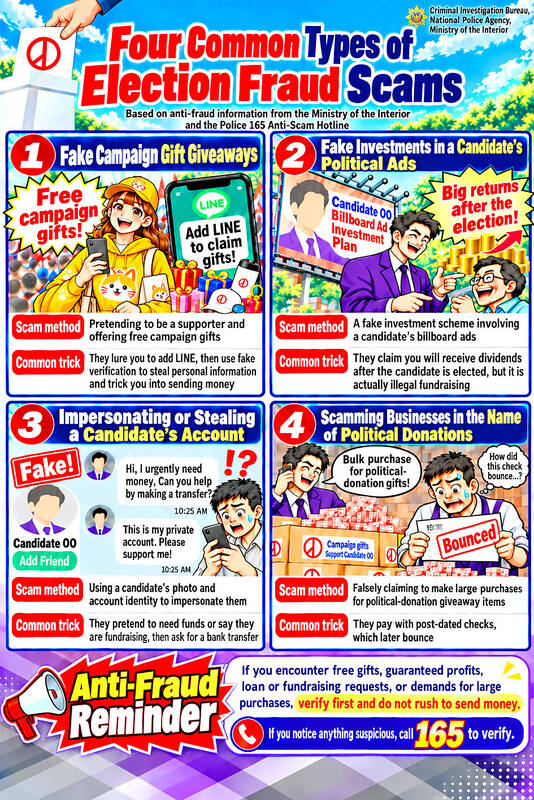
An infographic warning against election-related scams.
Photo courtesy of the Criminal Investigation Bureau
Scammers often pose as merchandise vendors or supporters on social media, offering free campaign items or exchanges among supporters, it said.
Once victims leave comments, they are directed to join Line accounts where scammers request “real-name verification” or “cash-flow verification,” it said.
They would be instructed to use their online banking apps to operate cardless ATM withdrawal services, allowing the scammers to steal their money, it said.
In one case during the Double Ten National Day holiday, a supporter came across a post on Threads offering surplus campaign merchandise, it said.
After clicking a fraudulent link provided by the scammer and following instructions on a fake mobile banking system, the victim gave away over their national ID number, online banking withdrawal code and password, allowing the scammer to withdraw NT$340,000 (US$10,514) from the account within 40 minutes, it said.
The second type of scam involves supposed investments in campaign billboard advertisements, it said.
Scammers claim investors would receive substantial returns once a candidate is elected, or claim to offer insider investment channels with guaranteed profits, it said.
Victims are duped into sending money out of a desire to support the candidate while expecting financial gains, it said.
The third type involves impersonating candidates or public officials on social media, it said.
Scammers first identify staunch supporters on candidate fan pages before impersonating candidates or incumbent officials to send private messages, it said.
Fraud rings claim to be using private accounts and ask supporters to transfer money or provide loans, citing election expenses or the need to raise funds discreetly, it said.
The fourth type involves defrauding businesses under the pretext of political donations, it said.
Scammers place large product orders purportedly to serve as in-kind political donations, paying with post-dated checks, it said, adding that once the merchandise is delivered, the checks bounce.
The bureau urged businesses and the public not to hand over money or goods without first meeting the political figure or campaign team in person and confirming the details.
While the scam tactics are not new and the number of cases reported so far is not high, the public should be vigilant during the final month of the campaign, it said.
People who receive unfamiliar links should verify whether they lead to official Web sites, it said.
If customer service representatives ask them to use online banking apps for real-name or transaction verification, they should immediately halt the process, it said.
Anyone with doubts can call the 165 anti-fraud hotline for assistance, it said.
KioskNews shows a cleaned-up reading view extracted from the publisher’s page — the original always lives on their site, not ours.