Democracy v the machine: the birth of the digital age and the warnings that were ignored
One of the stranger things about this dizzying, headlong moment in time is that it doesn’t have much of a past. Everything is about the future of this, the future of that: the future of work, the future of humanity, the future of the planet. It’s as if everyone is screaming (some ecstatically, most terror-stricken): robots are taking over the world! Meanwhile, you can’t put down your phone, unplug, delete your AI apps, tell Zoom to piss off; it feels as if you are racing toward something, and can’t stop, or look back, or think straight.
But of course this weird moment in history does have a past. It comes from somewhere. It wasn’t inevitable. Things could have turned out differently. They still can. And if you look back, one thing you’ll see is that a lot of people saw this all coming. They foresaw our present when it was still the future. They thought it might turn out fabulously, a computer utopia. And they worried it might turn out disastrously. Above all, they issued warning after warning about the rise of what I call the artificial state, the replacement of the liberal democratic nation-state, the consent of the governed, with the rule of people by machines. They warned of a future in which democratic deliberation would be replaced by prediction by calculation, the public sphere would be supplanted by data-driven commerce, and drones would take the place of the demos. Why didn’t anyone listen?
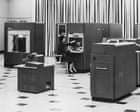
Between the 1950s and the 1980s, computers got smaller, faster, cheaper and more powerful; computer languages became more sophisticated; and electronic data, once a molehill, became a mountain. As data processing and general-purpose computers moved from the military to industry, business and medicine, sizeable chunks of public life became automated, driven by computers, calculations, networks and algorithms that did the political work of rallying support, running campaigns, communicating with constituents and crafting policy, especially in the world’s wealthiest nations.
The adoption and diffusion of such technologies led to wild-eyed speculation about their possible social and political consequences, a discussion that, characteristically, ricocheted between dreams of a technological utopia and fears of an artificial state.
In 1981, for instance, the Japanese sociologist Yoneji Masuda, a theorist of what he called “information society”, predicted the arrival of either a computopia that would bring about the eradication of all distinctions of class and nation and “a symbiosis in which man and nature can live together in harmony”, or a compudystopia that he called an “automated state”: government by machine. Yet the two possible futures had much in common, since the path toward either had already led humans “to neglect the need for coexistence with nature, while our impact on nature has grown immeasurably”.
A turning point in the story of the automated state had come in 1958, when a team of American researchers and ad men built a machine that they claimed could both predict and influence voting behaviour. That year, a landmark conference on the “mechanisation of thought processes” took place at the National Physical Laboratory in Teddington, near London. Speakers included French, Israeli, Russian and Hungarian scientists, and they talked of a future in which computers would one day compose music, resolve legal disputes, control air traffic, conduct surgery and, in the administration of government, replace not only clerks but executives.
In New York, Edward L Greenfield, the head of a Madison Avenue advertising firm, drafted a proposal for what would become known as a People Machine. Greenfield proposed to compile hundreds of thousands of punch cards – election returns and public opinion surveys and census data – to build an “information bank” that could sort voters by types and their opinions by issues. “There is nothing mysterious about this on the surface, the input to the machine being the information about real individuals obtained in surveys”, Greenfield and the MIT political scientist Ithiel de Sola Pool wrote in 1958. But “once this information is inside the high speed storage facilities of the machine, it is a different world”. The machine would operate as a “macroscope” that could simulate the whole of the US electorate.
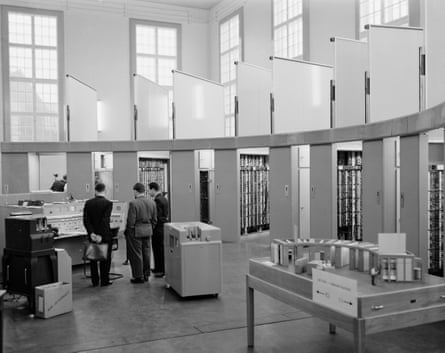
The next year, Greenfield and Pool and IBM’s Alex Bernstein formed a company called the Simulmatics Corporation. By “simulmatics”, they meant the automated simulation of human intelligence. They believed they had invented “the A-bomb of the social sciences”.
Their first client was the Democratic National Committee. In 1959, the DNC hired Simulmatics to run simulations on an artificial electorate and tell the party’s nominee what to say, to whom, and when. Not everyone was enthusiastic. “I shudder at the implication for public leadership of the notion … that a man shouldn’t say something until it is cleared with the machine,” wrote the historian Arthur Schlesinger.
After John F Kennedy won the nomination, his campaign hired Simulmatics to run predictions on an IBM 704. When Kennedy won, many in the press attributed the victory to Simulmatics’ People Machine. As the New York Herald Tribune put it, “a big, bulky monster called a ‘Simulmatics’” had been Kennedy’s “secret weapon”.
Simulmatics went on to new campaigns, heralded by the press. But the People Machine turned out to have been ahead of its time. In 1970 Simulmatics went bankrupt, unable to find enough paying clients for its services. The problem wasn’t the computers, or the model. The problem was an insufficiency of data. When Bernstein met with book and magazine publishers and film distributors in hopes of selling a market simulation of book sales, magazine subscribers and ticket sales – the kind of microtargeting done decades later by companies such as Amazon and Netflix – he reported that there was no way to build a model for any of these industries.
Simulmatics’ only real successes were in politics, where the company could rely on large caches of data: censuses, election returns and public opinion surveys. But in this sector, the company’s work raised considerable alarm. It also inspired prophecies of political doom, including two dystopian novels. One was published in 1964: The 480, a political thriller in which a barely disguised “Simulations Enterprises” meddles with a US presidential election. It was written by Eugene Burdick, who’d been asked to join the company but had declined, for reasons that became clear in The 480, in which he described Simulmatics as part of a sinister political landscape.
The new underworld is made up of innocent and well-intentioned people who work with slide rules and calculating machines and computers which can retain an almost infinite number of bits of information as well as sort, categorise, and reproduce this information at the press of a button. Most of these people are highly educated, many of them are PhDs, and none that I have met have malignant political designs on the American public. They may, however, radically reconstruct the American political system, build a new politics, and even modify revered and venerable American institutions – facts of which they are blissfully innocent.
Burdick died in 1965, but his concerns about an automated state were bubbling up all over the place. In 1966, in The Myth of the Machine, the American critic Lewis Mumford lamented the rise of “cybernetic intelligence”, warning that under its “automatic operation … man will become a passive, purposeless, machine-conditioned animal whose proper functions, as technicians now interpret man’s role, will either be fed into the machine or strictly limited and controlled for the benefit of depersonalised, collective organisations”.
Mumford described technological determinism – the idea that machines determine the course of history and represent a march of progress – as “a radical misinterpretation of the whole course of human development”. This mistaken belief, he wrote in The New Yorker the next year, had to be abandoned “if we are to get an adequate grip on our mechanised culture before we lose both our consciousness of human purpose and our confidence in being able to control our own creations”.
No one really ever paused to get that grip. Instead, data collection became crucial to industries that began accumulating, as stored computer files, everything from credit card transactions to car rentals to library checkout records, which made possible the kinds of predictions that Simulmatics Corp had only been able to dream of. With so much data, computers – increasingly linked together – stood poised to become far more than simple question-and-answer devices.
While all this was going on – the accumulation of data, refinements in computer architecture and the use of computers not only to calculate but also to communicate – the best thinkers of the age wondered what it might mean for humanity: computopia, or the automated state? The answer appeared to depend, in large part, on what these technologies might mean for humans’ capacity to understand the world. As ever, the nature of government would depend on the nature of knowledge. “Organised knowledge puts an immense amount of power in the hands of people who take the trouble to master it,” as a director of medicine and science at the Rockefeller Foundation put it.
Meanwhile, the nature and form of knowledge was changing. In 1965, the brilliant engineer JCR Licklider, the man most appropriately credited with inventing the internet, wrote Libraries of the Future, in which he considered the many disadvantages of books. “Surveying a million books on 10,000 shelves,” he said, is a nightmare. “When information is stored in books, there is no practical way to transfer the information from the store to the user without physically moving the book or the reader or both.” But convert books into data that can be read by a computer and you can move data from storage to the user, and to any number of users, much more easily.
Using the contents of all the books held in the Library of Congress as a proxy for the sum total of human knowledge, Licklider calculated its size in 1960 and estimated that it was doubling every year. Using these numbers, the sum total of human knowledge, as data, would be about a dozen petabytes in the year 2020. No one really knows how big the internet was in 2020, but some people said it was dozens of zettabytes. If they were right, Licklider was way off. In any event, the library of human knowledge seemed, suddenly, breathtakingly vast.
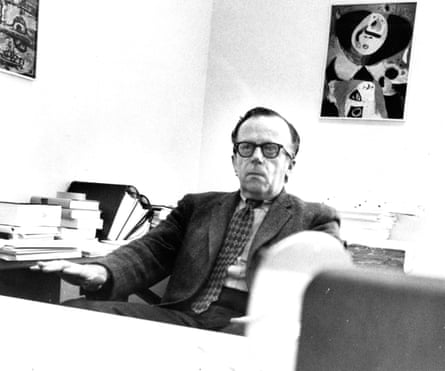
Would the libraries of the future be available to everyone? And what about the libraries of the present: the troves of data in the possession of governments? In the US, a proposal to establish a National Data Center, meant to provide, for electronic data, what the Library of Congress provided for books and the National Archives for manuscripts, was abandoned due to privacy concerns. (Critics dubbed the proposed National Data Center the “snooping machine”.)
Licklider proved an excellent futurist. In 1963, he’d sent a memo to colleagues at the Advanced Research Projects Agency (Arpa), proposing “to develop a capability for integrated network operation”, what would become first Arpanet and, eventually, the internet.
Licklider’s vantage on this project, and his involvement in most of the cutting-edge research done in the 1960s, gave him exceptional clarity about the future. In April 1968, in an essay for the magazine Science and Technology, Licklider and the psychologist Robert W Taylor predicted that “in a few years, men will be able to communicate more effectively through a machine than face to face”. They also predicted the emergence of “online interactive communities” that would change how people engage with each other: “Life will be happier for the online individual because the people with whom one interacts most strongly will be selected more by commonality of interests and goals than by accidents of proximity.”
Simulmatics Corporation’s co-founder Ithiel de Sola Pool also contributed an essay to that issue, in which he predicted that developments such as personalised newspapers would lead to an era of hyperindividualism. “A reader starts by asking for a digest of the news,” Pool imagined. “He can ask for details on any story that interests him.”
Pool believed the hyperpersonalisation of news would transform politics. “In the 21st century, the sort of critic who now attacks conformity in society may be complaining of an atomised society,” Pool predicted. “Modern technology, he’ll assert, has destroyed our common cultural base and has left us living in a little world of his own.”
He was not wrong. “In the coming atomised society, the information the citizen gets will arise from his own specific concerns,” he wrote, and “when everyone can select his own fund of information, the political problem of gathering an effective body of support behind a particular rational issue or candidate will become very different and very much more difficult”.
More common in the 1960s and 70s than Pool’s predictions of an atomised society under an automated state – or at least louder, and more attention-getting – were predictions of computer-driven socialist revolution or democratic liberation as types of computopias. In Chile between 1971 and 1973, during the rule of the democratically elected Salvador Allende, cyberneticists developed Project Cybersyn, a network whose chief purpose was to manage Chile’s socialist economy. Political reality intervened: the entire project was abandoned after Augusto Pinochet took power in a coup in 1973.
Elsewhere, optimism only grew. “Ready or not, computers are coming to the people,” Stewart Brand predicted in Rolling Stone in December 1972. The personal computer, Brand predicted, would bring “power to the people”. Brand, an LSD advocate, had studied at Stanford, and he described the arrival of Arpanet as the best news “since psychedelics”.
Computopianism found many adherents. Writing in 1975, the Israeli-American sociologist Amitai Etzioni and his co-authors predicted that the computer revolution would bring a return to “the form of democracy found in the ancient Greek city-state, the kibbutz and the New England town meeting, which gave every citizen the opportunity to directly participate in the political process”. Historian Daniel Boorstin, the librarian of Congress, predicted in 1978 that the new ties of communication would create new ties of community, a development he called the “republic of technology”.
Yet there were, as ever, sceptics. Joseph Weizenbaum, an MIT engineer who in 1966 had developed Eliza, the first of what would come to be called a chatbot, objected to the development of artificial intelligence as leading, inevitably, to the automation of the functions of the state. Writing in 1976, he described as “obscene” any project that proposed “to substitute a computer system for a human function that involves interpersonal respect, understanding and love”. He also warned against research that would one day result in “a fully automated battlefield”, and, as he wrote bitterly, months after the US evacuation from Saigon: “I see no reason to advise my students to lend their talents to that aim.”

Licklider was himself too careful a thinker to subscribe to either prediction: computopia or an automated state. In 1969, he predicted that by the year 2000 “an international network of digital computer communication networks” – he called it the multinet – would serve “as the main and essential medium of informational interaction for governments, institutions, corporations and individuals”, replacing everything from the telephone and the postal system to shops and banks.
Licklider was somewhat less confident about what the multinet would mean for politics. He knew that “interactive politics would function well only to the extent that the citizens were informed” and warned of the possibility of “new vistas for dirty tricks”, including “clandestine artificial intelligence programs, searching through the databases, altering files, fabricating records and erasing their own audit trails”. Nevertheless, Licklider echoed Brand when he concluded that “computer power to the people is essential to the realisation of a future in which most citizens are informed about, and interested and involved in, the process of government”. Yet society seemed to be moving in a different direction, towards an automated state rather than one in which citizens became more active participants.
after newsletter promotion
As the 1970s came to an end, consultants employed by Ronald Reagan’s presidential campaign invented their own People Machine, a computerised political information system. A reporter explained that it worked like a massive chessboard on which the Reagan campaign could try out possible scenarios: “If the unions scare half their members about Reagan’s labour record, should he step up his attacks on Carter or try to rebut their specific claims? Or, if John Anderson’s vote begins to drop, should Reagan add a campaign stop in Connecticut, or can he afford to cancel one?”
In 1980, it helped carry Reagan to victory. The language of an “information society” yielded to the language of an “information revolution”. In 1982, Time named “the computer” man (machine) of the year. “The computer will smash the pyramid” of wealth and render all people equal, one giddy forecaster promised in 1984.
Yet the metaphor of revolution was ill-considered, the political theorist Langdon Winner argued, because revolutionaries have answers to questions such as whether their movement seeks “to uphold a valid ideal of human freedom” and “Does it aspire to a system of democratic rule?” and “Will there be frequent, open elections?” By contrast, “the computer revolution is conspicuously silent about its own ends”. And, as Winner saw it, little evidence supported any of these computopian predictions. So far, “current developments in the information age suggest an increase in power by those who already had a great deal of power, an enhanced centralisation of control by those already prepared for control, an augmentation of wealth by the already wealthy.” He was shouting into a void.
“Scarcely a new invention comes along that someone doesn’t proclaim it as the salvation of a free society,” Winner remarked. There seemed no better example than the 1984 television advert for Apple’s new Macintosh personal computer. “Today we celebrate the first glorious anniversary of the information purification … a garden of pure ideology,” intoned a thunderous voice, as masses of humans, hairless and looking like androids marched in lockstep, and sat in rows to watch Big Brother on a giant computer monitor. They were dressed in grey uniforms, as if they lived under fascism. “On January 24, Apple Computer will introduce Macintosh,” the ad continued. Apple was suggesting that only its personal computer could prevent the rise of a totalitarian state machine. “And you’ll see why 1984 won’t be like 1984.”
Yet there were already signs that networking computers could lead to or contribute to social decay. Usenet, an online bulletin board, opened in 1980 on what was sometimes called the “poor man’s Arpanet”, a dial-up network linking universities and research centres. It offered users the ability to join newsgroups, and it included a reply function. Usernames could be anonymous. “Together immateriality and anonymity were an invitation to test social limits and boundaries,” the University of Winnipeg scholar Jason Hannan wrote. “Liberated from the personal repercussions and consequences of life offline, some newsgroup users discovered a sordid pleasure in transgression for its own sake.”
Sometime in the 1980s, this practice came to be called “trolling”. Viral hate dates to the 1980s as well. The American neo-Nazi George Dietz opened a bookstore in West Virginia in 1974 and began publishing a small subscription magazine called Liberty Bell. In 1983 he announced that he’d been “working, for the past two weeks, until four to five o’clock in the morning, trying to learn ‘computerese’ so that Yours Truly may talk to that monster in ITS language and on ITS own terms.” He soon after launched the first white supremacy bulletin board, Liberty Bell Network, on an Apple IIe personal computer.
His efforts were quickly followed by the launch, in 1984, of more bulletin boards, including the Aryan Nations Liberty Net, Aryan Nations/Ku Klux Klan Computer Net and White Aryan Resistance. Members of these groups also brought their style and their ideas into discussion groups on America Online and CompuServe. As the internet became the world wide web, these efforts disappeared, replaced, in the 1990s, by websites and, a decade later, by social media platforms.
Newcomers tended to break the existing conventions of the very early internet era by trolling, by instigating and participating in flame wars (an early term for bitter online arguments), and by being, generally, obnoxious. Old hands grew alarmed. “When i went into cyberspace i went into it thinking that it was a place like any other place and that it would be a human interaction like any other human interaction,” wrote Carmen Hermosillo, known by the username “humdog” in 1994, but “i was wrong when i thought that … it is a black hole; it absorbs energy and personality and then re-presents it as spectacle.”
Alarmed cyberspace veterans tried to coach newcomers in “netiquette”, as in a set of guidelines written by Sally Hambridge of Intel in 1995. “A good rule of thumb: be conservative in what you send and liberal in what you receive. You should not send heated messages (we call these ‘flames’) even if you are provoked.” Another rule concerned email, online chatting and online messages: “Remember that the recipient is a human being whose culture, language and humour have different points of reference from your own. Remember that date formats, measurements and idioms may not travel well. Be especially careful with sarcasm.”
The hope that the internet would obey rules existed at one end of a spectrum; at the other end was the more widely held enthusiasm for the idea that the internet would be a place without rules. Acolytes of Brand saw it as a mystical counterculture utopia called Cyberia, where, as the media theorist Douglas Rushkoff wrote in 1994, the “shamanic experience” of psychedelic drugs would be joined with the “cybernetic experience” of a networked personal computer to usher in a “new dimensional plane”.
Neoliberals and libertarians had different ideas: computers would – somehow – solve the inequalities of wealth and income and attendant political instability that characterised advanced capitalism in an age of globalisation. In the 1990s, Democrats promised that “thanks to the near-miraculous capabilities of microelectronics, we are vanquishing scarcity”. In 1993, Wired magazine reported that “life in cyberspace seems to be shaping up exactly like Thomas Jefferson would have wanted: founded on the primacy of individual liberty and a commitment to pluralism, diversity and community”.
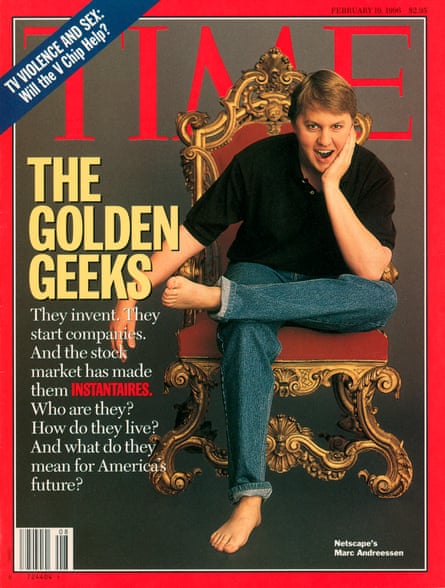
Meanwhile, the public, understandably, had very little idea what to expect of the coming transformation. In 1994, on the Today show, Bryant Gumbel asked, “What is internet, anyway?” More people knew the answer to that question in 1995, after the entrepreneur and computer scientist Jim Clark and Marc Andreessen, a 24-year-old coder from Wisconsin, launched Netscape Navigator, a browser, and earned $58m on the first day its stock was publicly traded. Overnight, Andreessen became, as the New York Times reported, “the newest member of Silicon Valley’s instant millionaires club”. That sale set off the tech company gold rush known as the dotcom boom. A year later, Andreessen was on the cover of Time, barefoot and in blue jeans, sitting on a golden throne, laughing.
Across the second half of the 20th century, liberal democracy made possible the rise of the artificial state. It didn’t make it inevitable. The digital revolution didn’t have to play out the way it did in the realm of politics and government; it played out the way it did because of the failure of liberal democracy to limit corporate power over politics and government, its failure to heed decades of warnings about the dangers of an automated state.
Techno-libertarianism, which married the technocracy crusade of the 1930s – an anti-democracy movement led, in the US, by Elon Musk’s grandfather – to the computopianism of the 1980s, was born in the 1990s. Beginning in the previous decade, Silicon Valley had fallen under the spell of the libertarian Ayn Rand. Rand had been a cult figure of the far right since the publication in 1943 of her novel The Fountainhead, and she became even better known after the 1957 publication of Atlas Shrugged. Rand embraced radical individualism and saw a very narrow role for the state in human affairs, arguing that every individual ought to be completely free to pursue personal gain through heroic, self-interested achievement. “I’m challenging the moral code of altruism, the precept that man must live for others”, she said in 1959. “I say that man is entitled to his own happiness and that he must achieve it for himself.”
Some people in Silicon Valley even named their children Ayn and Rand and their companies after characters from her books. Steve Jobs considered Atlas Shrugged his “guide in life”. Under Rand’s influence, some leading Silicon Valley investors and inventors stopped believing in both democracy and the liberal nation-state, subscribing instead to a hybrid Brandian/Randian vision of a world requiring no controls but a keyboard, a mouse and a stock exchange.
In the 1990s, this vision became messianic. Tech companies started talking about their mission, and their mission was always magnificently, impossibly, extravagantly world-changing: transforming the future of work, connecting all of humanity, making the world a better place, saving the planet.

Under the influence of Rand, the internet became what conservatives and techno-libertarians wanted it to become. In 1995, when Newt Gingrich came to power in Congress as speaker of the house, under the banner of a Contract with America, one of his first moves was to close the federal government’s Office of Technology Assessment, which had been formed in 1972. The office hadn’t been especially powerful, but its mandate included assessing the implications of any new technology supported by the federal government. Its closure gave Gingrich a free hand in directing any policy relating to the opening of the internet in accordance with the tenets of techno-libertarianism.
One of the contract’s earliest manifestos appeared – online – in 1996, John Perry Barlow’s A Declaration of the Independence of Cyberspace: “Governments of the industrial world, you weary giants of flesh and steel, I come from cyberspace, the new home of Mind. On behalf of the future, I ask you of the past to leave us alone,” Barlow wrote. “You are not welcome among us. You have no sovereignty where we gather … You have no moral right to rule us nor do you possess any methods of enforcement we have true reason to fear … Cyberspace does not lie within your borders.”
Libertarian futurists weren’t the only people proposing new rules for cyberspace; they just happened to be the people who ended up making the rules. In 1995, Michael Hauben, a computer science student at Columbia University and an active user of Usenet (he coined the term “netizen”), drafted a Proposed Declaration of the Rights of Netizens. He saw himself as a leader of what he described as “the fight to keep the net an uncommercialised public commons”.
Hauben’s declaration, co-authored with his mother, listed rights that included “universal access at no or low cost, freedom of electronic expression to promote the exchange of knowledge without fear of reprisal,” and “universal and equal access to knowledge and information”, as well as “protection of the public purpose from those who would use it for their private and money-making purposes”. Much of the idea that the internet could be a democratising force can be traced to Hauben’s writings, including his 1997 essay The Computer as a Democratizer.
Douglas Adams, the author of the 1970s satirical science fiction series The Hitchhiker’s Guide to the Galaxy, had a vision for the internet, too. In 1996, he founded a company called The Digital Village – appointing himself chief fantasist – with the idea of building a web platform, h2g2, that, echoing his series, would be an “online guide to Life, the Universe, and Everything”. In 2001, both Adams and Hauben died, the former of a heart attack and the latter, at the age of 29, after an accident. Their frameworks for free and equal access to an internet structured by public interest, not commercial interest, died with them.
But by then, the techno-libertarians had already won. In 1996, Bill Clinton signed the bipartisan Telecommunications Act, which delivered exactly what everyone from Newt Gingrich to John Perry Barlow wanted: an almost entirely unregulated internet. Four years later, Wired announced with characteristic, computopian swagger, “We are as a nation, better educated, more tolerant and better connected because of – not in spite of – the convergence of the internet and public life.” No such era of tolerance arrived.
Adapted from The Rise and Fall of the Artificial State by Jill Lepore, published by Allen Lane on 25 August. To support the Guardian, order your copy at guardianbookshop.com
KioskNews shows a cleaned-up reading view extracted from the publisher’s page — the original always lives on their site, not ours.