Trump, Xi and Putin agree to reduce nuclear risks: Why the Shenzhen declaration matters
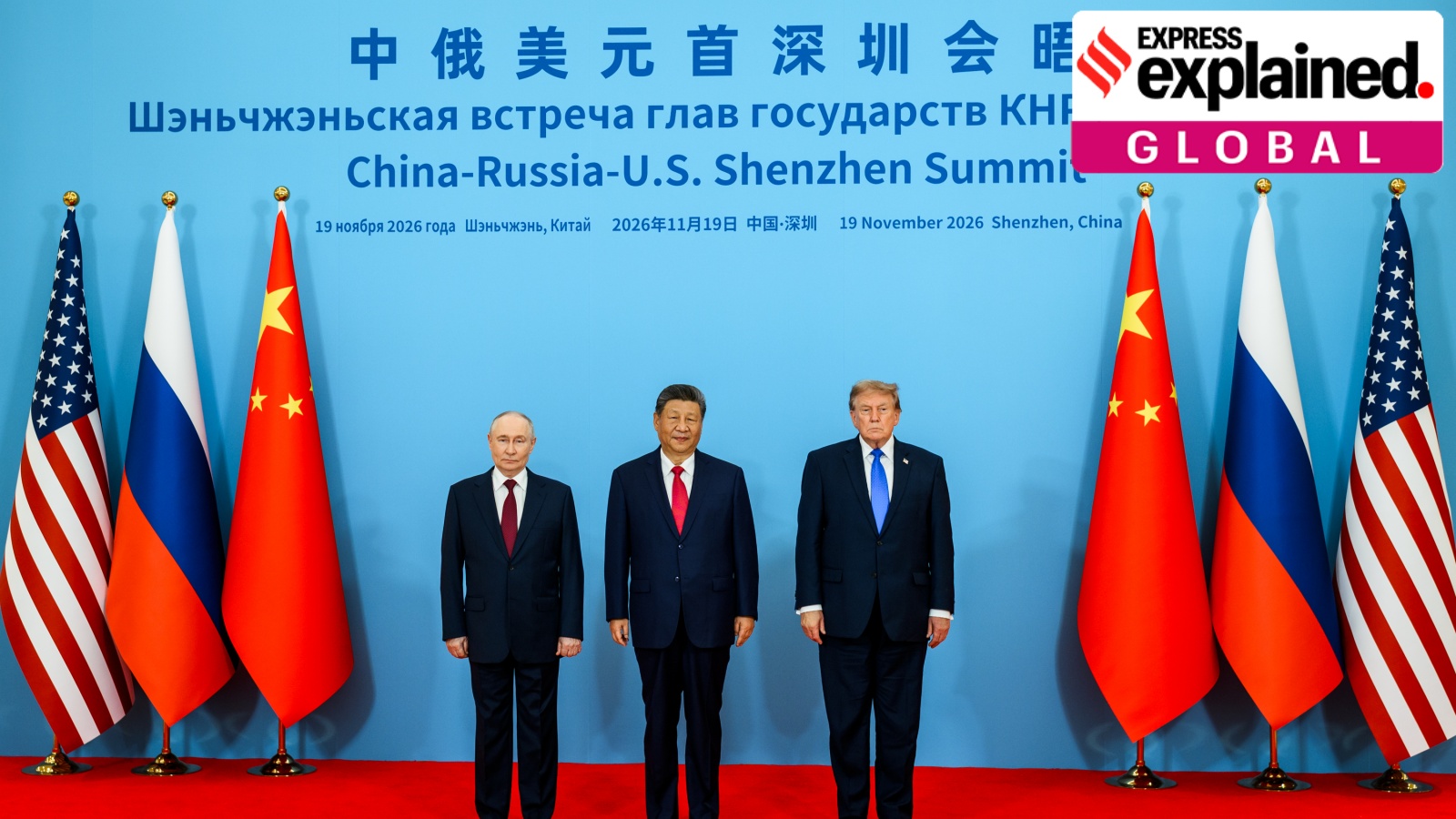
On November 19, 2026, US President Donald Trump, Chinese President Xi Jinping and Russian President Vladimir Putin met for a trilateral summit in Shenzhen, China. The first of its kind, the talks took place on the sidelines of the Asia-Pacific Economic Cooperation (APEC) summit and included a discussion about the nuclear question.
The three issued a joint peace declaration following the talks, committing to upholding stability and security tthrough four points, including one addressing nuclear risks. Why was this significant? We explain.
The fourth point of the declaration states that the three leaders agreed that nuclear war cannot be won and must never be fought. Furthermore, the three countries agreed to conduct a dialogue on reducing nuclear risks and preventing weapons proliferation.
In 2022, China, Russia, France, the UK, and the US— the five permanent members of the UN Security Council (P5)— adopted a similar maxim. The Shenzhen agreement is a political commitment rather than a binding political treaty. It specifies no caps or ceilings on warheads, sets no timeline for disarmament, and contains no ratification clauses.
The official transcript of the meeting released by the Kremlin notes, however, that President Trump acknowledged that, “it’s not an easy thing to do, to give them up,” referring to nuclear weapons. He also stressed the importance of cooperation in preventing nuclear proliferation, including in the case of Iran.
Why is the nuclear question being raised again?
The threat of nuclear war has been recognised since the 20th century, with a series of arms-control agreements seeking to reduce the risks over the decades.
Nine months before to the Shenzhen summit, however, the 2010 Treaty on Measures for the Further Reduction and Limitation of Strategic Offensive Arms (New START) officially expired on February 5, 2026. This treaty was a legally binding limit on US and Russian nuclear forces and came into effect in 2011, replacing the 1991 START 1 Treaty.
Story continues below this ad
New START also provided for transparency and verification in the procurement process through up to 18 short-notice inspections per year along with regular consultation meetings and notifications.
In 2021, Moscow and Washington extended New START by another five years. Russia’s war on Ukraine, which began in 2022, further hampered arms-control efforts, and Russia suspended its participation in the treaty in 2023. The expiration of New START followed other setbacks to the arms-control framework, including the US withdrawal from a 1972 missile treaty and Russia’s 2023 revocation of its ratification from the Comprehensive Nuclear-Test-Ban-Treaty (1996).
Does Trump have a role in this resurgence?
Donald Trump has made nuclear arms reduction a recurring part of his foreign policy agenda.
During his first term (2017-2021), his administration held discussions with Moscow on a possible successor to existing arms-control arrangements. Washington also sought to bring China into these negotiations, although Beijing declined to participate.
Story continues below this ad
The question has returned to the forefront in Trump’s second term.
Throughout 2025, Trump spoke about the possibility of negotiating a nuclear arms reduction agreement involving the US, Russia and China. He argued that the three countries were spending considerable sums on nuclear weapons and that reducing these expenditures could serve their mutual interests.
The immediate turning point, however, came with the expiration of New START on February 5, 2026. On the same day, Trump called for negotiations towards a “new, improved, and modernized Treaty,” rather than simply extending the existing arrangement. His administration subsequently indicated that it wanted multilateral nuclear arms-control discussions involving both Moscow and Beijing.
This is significant because the existing arms-control architecture has been largely bilateral, built around agreements between Washington and Moscow. Bringing China into the process would mean addressing a third nuclear power whose arsenal has been expanding and which has historically resisted joining US-Russia arms-control negotiations.
Story continues below this ad
According to a 2024 US Department of Defence assessment, China could possess more than 1,000 operational nuclear warheads by 2030. This expansion has complicated Washington’s calculations: any future agreement that limits only American and Russian arsenals would leave China’s growing capabilities outside its framework.
The Shenzhen declaration, therefore, can be seen against this backdrop. It provides a diplomatic opening for discussions among the world’s three largest nuclear powers.
For now, the agreement signals an acknowledgement by the three powers that nuclear risks cannot be addressed in isolation. Whether they can translate this shared position into enforceable commitments is another question.
Does this mean the nuclear balance is changing?
The urgency of the issue is also reflected in the changing global nuclear balance.
Story continues below this ad
According to the Stockholm International Peace Research Institute (SIPRI) Yearbook 2026, published on June 8, the world’s nine nuclear-armed states possessed an estimated 12,187 nuclear warheads as of January 2026. Of these, 9,745 were part of military stockpiles available for potential use, while 4,012 were deployed with operational forces. An estimated 2,100-2,200 warheads were maintained on high operational alert.
Three points are of particular interest.
First, China is expanding its nuclear arsenal faster than any other nuclear-armed state. SIPRI estimates its stockpile at 620 warheads, up from 600 in 2025. Its expansion of missile silos and development of dual-capable delivery systems have raised concerns in Washington about the prospect of China emerging as a third major nuclear power
Second, Russia and the US continue to account for the overwhelming majority of the world’s nuclear weapons. Together, they possess approximately 8,100 warheads in their military stockpiles. Russia has also revised its nuclear doctrine. The deployment of Russian nuclear-capable systems in Belarus has added another dimension to European security concerns.
Story continues below this ad
Third, the expiration of New START has removed the last remaining treaty-based limits on the strategic nuclear arsenals of Washington and Moscow. Without its verification and data-exchange mechanisms, both countries face greater uncertainty about each other’s capabilities and intentions. The US could also consider expanding its deployed arsenal by placing additional warheads on existing delivery systems.
The numerical disparity between the three countries remains substantial: SIPRI estimates China’s military stockpile at 620 warheads, compared with 3,700 for the US and 4,400 for Russia. Beijing has historically resisted joining arms-control negotiations on the grounds that its arsenal is considerably smaller than those of the other two powers.
KioskNews shows a cleaned-up reading view extracted from the publisher’s page — the original always lives on their site, not ours.