The story of Hotel Mocambo, Mexico’s original luxury beach resort
When it comes to tourism in Mexico, one of the most popular options for international visitors is to spend a few nights at a majestic beach resort. From Cancún to Los Cabos, Mexico has established itself as a premier destination for world-class beach getaways, with Mexico’s Ministry of Tourism reporting that nearly half of Mexico’s visitors opt for ritzy coastal areas — where sprawling luxurious properties abound.
The shift toward Mexico’s coastline
The numbers show just how vital Mexico’s top-tier beaches are to its national tourism economy: Despite an overall lower number of visitors this year and a massive blow from U.S. airlines this summer, Cancún still leads the nation in international flight arrivals, accounting for 45% of Mexico’s airport activity as of June, with 4,844,588 reported flight arrivals.
Besides Mexico City, Guadalajara and Monterrey, which are among the 10 most active airports in Mexico, every other visit is largely due to Mexico’s beaches. This year, Los Cabos, Puerto Vallarta, Tulum, Cozumel and Mazatlán have generated the most airport traffic, respectively, with roughly 66% of Mexico’s inbound flights touching down near those beaches.
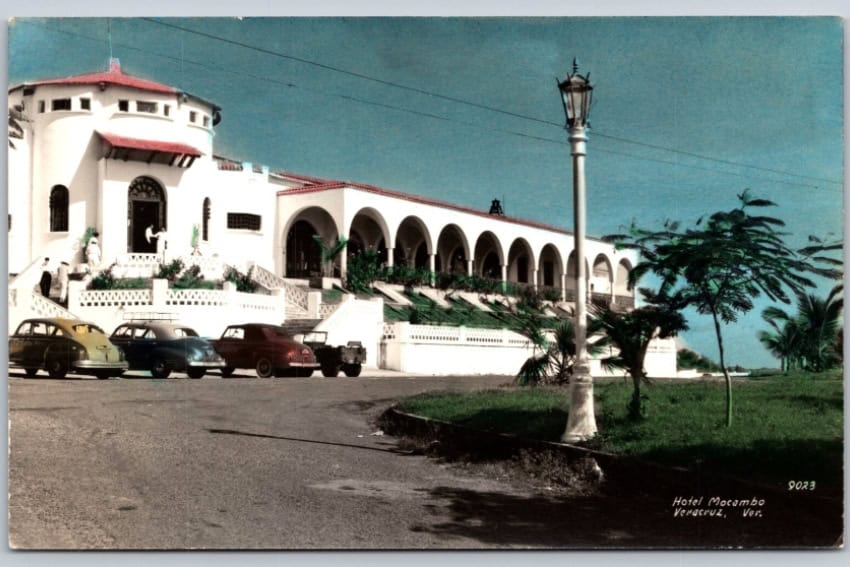
And yet, Mexico’s identity as a destination for opulent beach resorts originated in a region that is nowadays overlooked, particularly by international visitors. But if you know where to look, a time-travel beach experience awaits along the Gulf Coast, with its own kind of grandeur and charm.
Hotel Mocambo: Mexico’s first grand luxury resort
It’s impossible to overstate the historical significance of Veracruz and its port city, where the Spanish colonization of continental Latin America began in 1519. Over centuries, many of the country’s earliest contributions can be traced back to its Gulf Coast origins, including coffee, jalapeños, vanilla and more.
Add to that list: Mexico’s first grand luxury beach resort.
A flavorful, vanilla-scented hideout awaits along Mexico’s Gulf Coast

In 1938, Hotel Mocambo — named after Playa Mocambo, the beach where the hotel was built, and which originally derived from an Afro-Portuguese word denoting the region’s legacy as a refuge for escaped African slaves — began construction, making it among the earliest (if not the first) major beachfront resort in all of Mexico.
A midcentury haven for Mexican stars and cinema
During its heyday, Hotel Mocambo became a national treasure, with famous Mexican actors, musicians and celebrities — including Agustín Lara, Chavela Vargas and Pedro Infante — becoming regulars throughout the midcentury.
In 1943, “María Eugenia,” starring the iconic Mexican actress María Félix (and featuring a cameo from popular Veracruz singer Toña la Negra, who also personally frequented the hotel in those days), was filmed at Mocambo, demarcating the Golden Age of Mexican cinema.
Mocambo began as a 15-room property with a palm tree-studded view of the coastline to be enjoyed from extensive outdoor terrazas, grand staircases, arched hallways and open-air patios. A large outdoor pool and nearby barroom with high ceilings and jacuzzis can be found on separate levels, with a staircase that connects everything and inevitably descends to the beach.
Spanish influence and architectural expansion
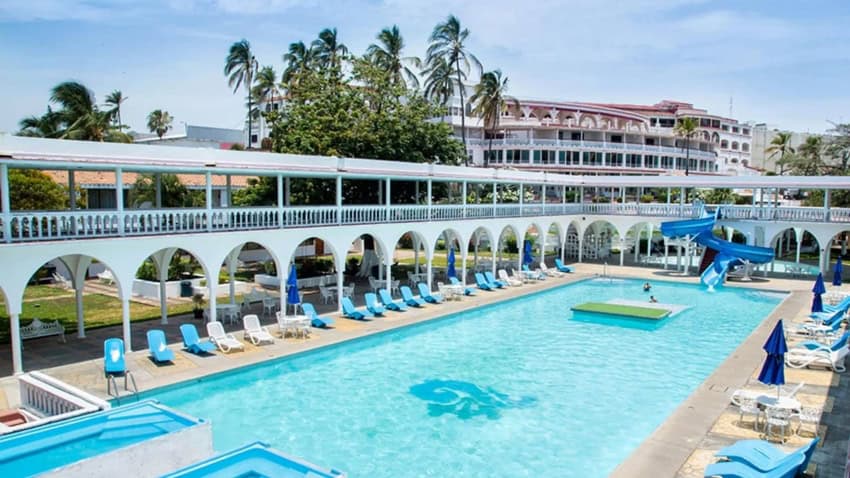
The hotel’s walkways are breezy and bedecked with a combination of maritime decorations and Moorish structural features designed by Jesús Martí Martín, an avant-garde architect who was exiled from Madrid, Spain, after the Spanish Civil War. Martín was commissioned by Gov. Miguel Alemán Valdés to lead the hotel’s design atop the highest coastal hill in Boca del Río — the city just south of the port of Veracruz, which sits on the Jamapa River along the Gulf of Mexico — around the time that other beach hotels were starting to sprout up in the Pacific states of Guerrero and Sonora.
Under the governorship of Alemán Valdés, who would go on to become Mexico’s president, Hotel Mocambo aimed to become the first grand-scale beach resort attraction in all of Mexico.
And for a time, it was.
Just two years after opening, the hotel’s first expansion was overseen by another Spanish architect, Enrique Segarra. At one point, the hotel grew to include 110 rooms, though today that number has dwindled to 70 (for context, Mexico’s grandest beach resorts can now exceed more than 2,000 rooms).
Though it is no longer the nexus of Mexican aristocracy that it once was, Mocambo remains an important historical fixture in Mexico’s development as an attractive beach resort destination.
Preserving the legacy of Mexico’s Golden Age
Before Mocambo and the subsequent rise of beach resorts all over Mexico, the country’s most opulent buildings and high-end tourist attractions were centered in Mexico’s cosmopolitan inland cities. Not until Mocambo in Veracruz — and the rise of Acapulco shortly after — did Mexico gain extreme popularity for its prime coastal real estate and beach resort culture.
How a colorful novel changed the course of tourism in Los Cabos
Ironically, or perhaps symbolically, the once-tranquil escape of Mocambo is now surrounded by modern buildings, major avenues, parking lots and the nonstop bustle of Mexico’s largest port city on the Gulf Coast. One of the neighboring buildings is a recently built high-rise apartment that juxtaposes interestingly with the dilapidated glory of Hotel Mocambo. And the state’s largest and most glamorous mall is within a short walking distance, as modernity has crept up to overtake Mocambo’s place.
Although the paint is faded and signs of decay are apparent in its grand facades, the resort is still worthy of a visit — simply for the pleasure of reliving Mexico’s Golden Age origins of beachside luxury.
Alan Chazaro is the author of “These Spaceships Weren’t Built For Us” (Tia Chucha Press, 2026), “Notes from the Eastern Span of the Bay Bridge” (Ghost City Press, 2021), “Piñata Theory” (Black Lawrence Press, 2020), and “This Is Not a Frank Ocean Cover Album” (Black Lawrence Press, 2019). He is a graduate of June Jordan’s Poetry for the People program at UC Berkeley and was selected as a Lawrence Ferlinghetti Poetry Fellow at the University of San Francisco. His work can be found in NPR, The Guardian, SLAM, GQ, L.A. Times, and more. He is currently based in Veracruz.
KioskNews shows a cleaned-up reading view extracted from the publisher’s page — the original always lives on their site, not ours.