Sakaja to Kamukunji Police: Why Were Eastleigh Building Suspects Released on Sh50,000 Bail Without Going to Court?
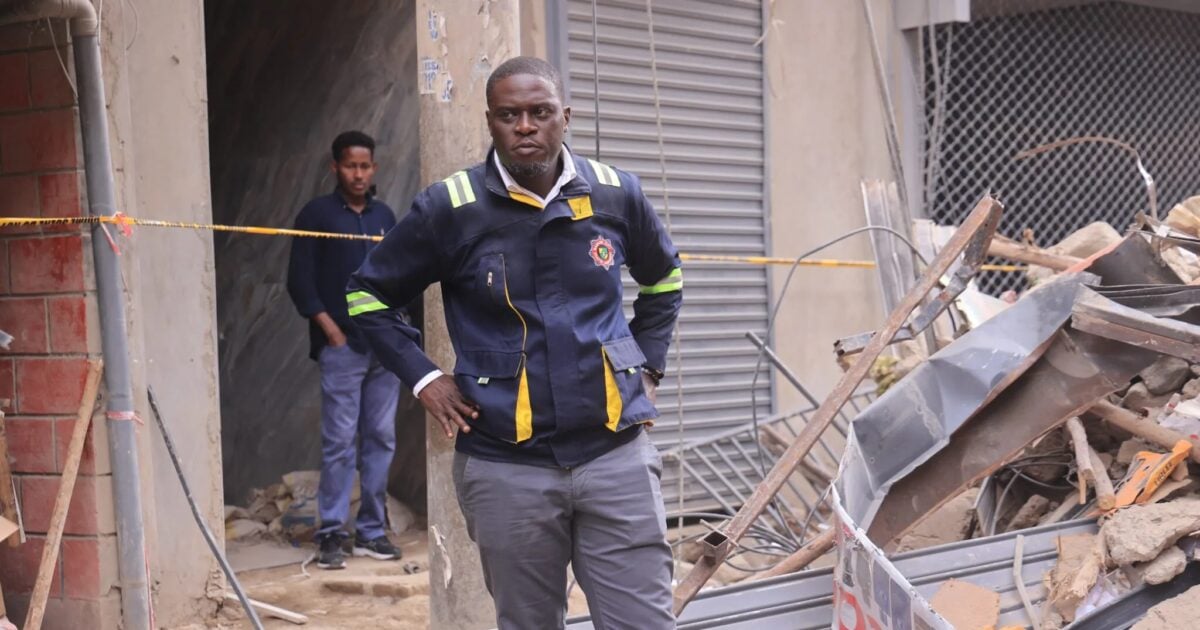
NAIROBI, Kenya, Oct 25 — Nairobi Governor Sakaja Johnson has demanded an explanation from Kamukunji Police Station over the reported release of suspects arrested in connection with the Eastleigh building that later collapsed, questioning why they were allegedly released on a cash bail of Sh50,000 without being presented in court.
Sakaja said Nairobi City County had taken enforcement action against those involved after establishing that the County had approved a change of user for the property but had not approved the architectural plans required to authorise construction.
The Governor said County officers arrested the suspects and handed them over to Kamukunji Police Station because county governments no longer exercise the prosecutorial powers they previously held.
“We enforced the law and arrested those involved. However, because we do not have prosecutorial powers, the suspects were handed over to Kamukunji Police Station. They were reportedly released on a cash bail of Sh50,000 without being taken to court,” Sakaja said.
“We want the police to explain why the suspects were released without being presented in court and why construction was allowed to continue. These are serious questions that must be answered.”
A police occurrence book entry from Kamukunji Police Station indicates that 14 suspects were booked into custody on June 17, 2026, over alleged offences relating to contravention of city planning laws.
The entry, recorded under OB No. 98/17/06/2026, names the suspects and states that they were booked by Nairobi City County officers before being placed in police cells.
A separate Kenya Police Service record indicates that 10 suspects were subsequently released on a cash bail of Sh50,000. The entry, recorded at 9.44pm, states that the release was carried out on the instructions of the Officer Commanding Station (OCS), identified in the record as C.I. Onyapidi, through Corporal Awadh.
The suspects named in the release entry are Najib Mustafa, Farah Omar Ahmed, Ahmed Noor Mohamed, Mubashir Hassan, Issak Tahlil Hussein, Ali Haji Abubakar, Abdullahi Abdi Abdullahi, Masinde Julius Muchombo, George Munigir Dinga and Abdi Mohamed Hamed.
The record references receipt number 2039434 and states that the suspects left the station without complaints. However, the documents do not, on their own, establish the specific charges against the suspects, the legal basis for the bail arrangement or whether they were subsequently presented in court.
The discrepancy between the 14 suspects recorded as booked into custody and the 10 named in the release entry also raises questions about the subsequent status of the other suspects.
A June 2025 enforcement notice adds another dimension to the questions surrounding the property and the enforcement of planning regulations.
The notice, issued by Nairobi City County over alleged construction works undertaken without the required development permission, cited the Physical and Land Use Planning Act, 2019, and county by-laws.
It directed the recipient to stop the works and remove the development described as illegal, warning that the County could undertake the required action and recover the costs if the directives were not followed.
The notice also provided for an appeal to the County Physical and Land Use Planning Liaison Committee.
The document raises questions about whether the developer complied with the notice and what enforcement action followed. However, further verification is required to establish conclusively the property’s identity, the precise circumstances surrounding the notice and whether its directives were enforced.
The notice’s connection to the Eastleigh building that collapsed has not been independently established by the document alone.
The Governor’s concerns have placed the spotlight on the handling of building enforcement cases and the relationship between county authorities responsible for development control and national agencies responsible for criminal investigations and prosecutions.
Sakaja clarified that approval to change a property’s use from private to commercial-cum-residential does not amount to approval of architectural plans authorising construction.
He said the County approved the change of user but did not approve the architectural plans, yet construction proceeded.
“If the building had been approved for construction, I would have named the officers who approved it so that action could be taken against them,” he said.
The Governor also criticised the circulation of documents allegedly being presented as evidence that the building had received full approval, insisting that the documents must be examined in the context of what was actually authorised.
“It is wrong for politicians to circulate misleading or purportedly fake documents to deceive Kenyans on such a serious matter as the Eastleigh building collapse. Human lives are at stake, and this is not an issue to be exploited for political gain,” Sakaja said.
He urged political leaders to exercise responsibility and allow facts and investigations to guide public discussion of the tragedy.
The dispute has renewed the debate over whether county governments should regain prosecutorial authority for offences arising from their regulatory functions.
Sakaja argues that the current arrangement creates a gap between enforcement and prosecution, leaving counties dependent on other agencies after taking action against alleged offenders.
Under his proposal, appropriately authorised county prosecutors would be able to pursue qualifying county offences through the courts, subject to the law and the constitutional authority of the Director of Public Prosecutions.
The Governor said county prosecutors previously had a better understanding of technical offences involving planning, construction and other county regulations, enabling them to handle such cases more directly.
“We want to be able not only to enforce regulations and make arrests, but also to take offenders to court and prosecute them. When counties had prosecutorial powers, we had prosecutors who understood the nature and seriousness of county offences and could ensure that appropriate legal action was taken,” he said.
Restoring the powers, he argued, would strengthen accountability by helping county authorities follow cases through the justice system rather than stopping at enforcement and the handover of suspects.
Sakaja said he had written to the Director of Public Prosecutions outlining the case for restoring the powers and was awaiting a response.
The Governor has also called on professional bodies representing architects, engineers, quantity surveyors and builders to investigate alleged cases in which registered professionals’ names and credentials are used to obtain construction approvals, only for them to be removed from project sites and replaced by foremen.
He urged the professional bodies to work closely with the County, report such cases promptly and take appropriate disciplinary action against members found to have breached professional standards.
The call comes amid renewed scrutiny of the responsibilities of developers, construction professionals and public officials in ensuring that buildings comply with approved plans and safety requirements.
The Governor maintained that accountability must extend to everyone whose actions or omissions may have contributed to the circumstances surrounding the collapse.
The reported release of suspects, the status of the building approvals, the earlier enforcement notice and the circumstances under which construction continued remain key issues requiring clarification from the relevant authorities.
Kamukunji Police Station’s explanation for the reported release, including the circumstances surrounding the Sh50,000 cash bail and whether the suspects were subsequently required to attend court, is central to the concerns raised by the Governor.
Investigations will be crucial in establishing individual responsibility and determining whether any developer, professional, public official or other party violated the law.
KioskNews shows a cleaned-up reading view extracted from the publisher’s page — the original always lives on their site, not ours.