Is Iran reaching the tipping point soon ? no one knows but history can be revealing — Phar Kim Beng
SEPTEMBER 7 — There are moments in geopolitics when the decisive weapon is neither a missile nor a tank, but the price and movement of a barrel of oil.
Iran may be approaching such a moment. Or it may not. No serious analyst can know precisely when a state reaches its economic and political breaking point.
But history suggests that oil-producing states ignore the arithmetic of energy revenues at their peril.
On September 13, 1985, Saudi oil minister Ahmed Zaki Yamani signalled a fundamental shift in Saudi oil policy.
Riyadh would no longer sacrifice its own production indefinitely to defend prices. Saudi output subsequently increased and oil prices plunged.
The consequences travelled far beyond the Gulf.
One of the biggest casualties was the Soviet Union.
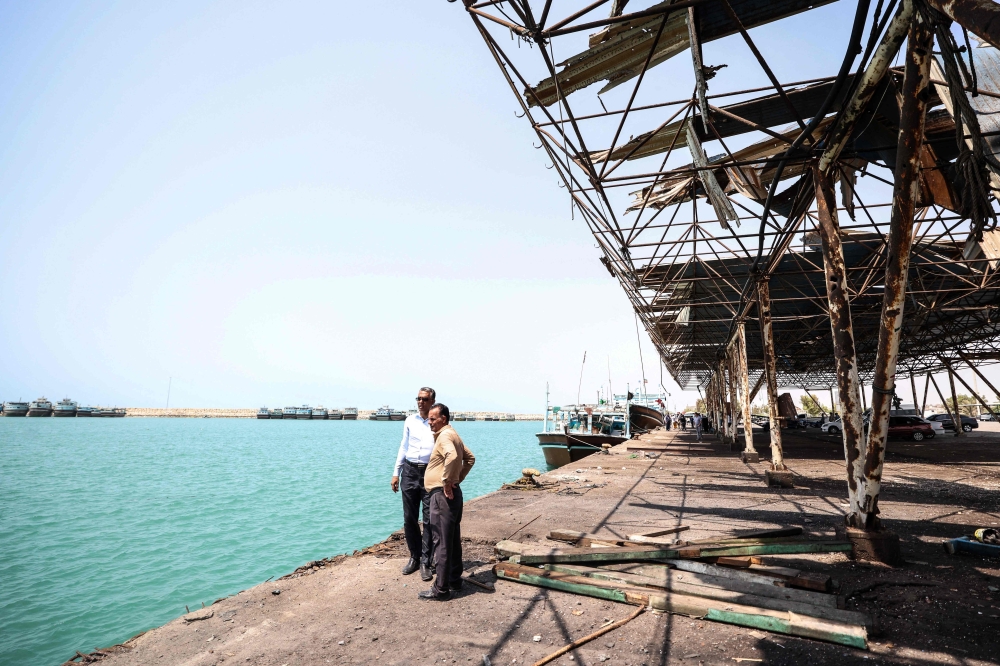
Men gather at the damaged port and storage and warehousing facilities following a US military strike earlier in the week on Kuhestak, Sirik County, in Iran's southern Hormozgan province on September 6, 2026. A deadly US strike hit a wedding celebration on the night of September 2, 2026, in the coastal town of Kuhestak along Strait of Hormuz in southern Iran, with the Iranian authorities saying it killed at least four people, including a child, and wounded 68 others attending the wedding. The United States announced attacks against targets belonging to Iran's Revolutionary Guards. Iran has been at war since February 28, when the United States and Israel launched a surprise bombing campaign that killed its supreme leader. — AFP pic
Yegor Gaidar, who later became acting Russian prime minister, argued that the resulting loss of hard-currency earnings was so severe that the Soviet system could no longer sustain itself.
He provocatively dated the beginning of the Soviet Union’s terminal crisis not to the revolutions of 1989 or the collapse of 1991, but to the oil shock beginning in 1985, argued a source in Newsweek.
Iran today is obviously not the Soviet Union of the 1980s.
Its political system is different. Its economy is different. Its population is different.
Tehran has also demonstrated repeatedly that it possesses considerable capacity to endure sanctions, isolation and external pressure.
Nevertheless, the historical comparison illuminates a basic strategic truth.
States require revenue.
Revolutionary ideology cannot indefinitely substitute for foreign exchange.
Missiles and drones cannot replace government income.
Strategic defiance cannot by itself finance food imports, infrastructure, salaries, subsidies, industrial production and national defence.
And Iran needs oil revenue badly.
This is where the Strait of Hormuz becomes paradoxical.
For decades, Iran’s ability to threaten the Strait has been one of its most formidable instruments of deterrence. Hormuz is among the most important maritime chokepoints on Earth.
In 2025, approximately 20 million barrels per day of crude oil and petroleum products passed through it, amounting to roughly a quarter of global seaborne oil trade. About 80 per cent was destined for Asia.
But a weapon can eventually begin injuring the hand holding it.
Iran’s disruption of Hormuz raises global energy prices and imposes costs on adversaries.
Yet Iran itself ultimately depends on maritime access to sell much of the commodity from which it earns desperately needed foreign currency.
The strategic equation has therefore begun to change.
Recent shipping data indicate that Iran has gone approximately seven weeks without meaningful crude exports through Hormuz.
Iranian crude loadings reportedly fell from roughly 2 million barrels per day in March to around 240,000 barrels per day in August.
That is potentially devastating arithmetic.
Iran can withstand considerable hardship. It has survived decades of sanctions.
It has developed elaborate trading networks and alternative financial arrangements. China remains crucial to Iran’s economic survival. It buys up to 90 percent of its exports as and when Iran can get it out.
But resilience should not be confused with immunity.
Oil revenue provides foreign currency. Foreign currency pays for imports. Imports support production and consumption.
When these mechanisms become severely constrained, governments eventually confront increasingly painful choices.
Iran therefore faces an extraordinary contradiction.
It wants to demonstrate that it can disrupt Hormuz.
Yet increasingly it needs Hormuz to function normally.
The longer the Strait remains unstable, the greater the possibility that Iran’s principal geopolitical lever becomes an economic liability.
This does not mean Tehran should capitulate to Washington. Nor does it mean the United States can assume that economic pressure will automatically produce political surrender.
History contains numerous examples of countries enduring extraordinary deprivation when national survival and sovereignty are perceived to be at stake.
Indeed, excessive pressure can produce the opposite effect: nationalism, radicalisation and further military escalation.
The wiser objective should therefore be normalisation rather than humiliation.
Iran needs to sell more oil.
The Gulf states need predictable shipping.
China, India, Japan, South Korea and Asean need energy security.
The United States needs to prevent another inflationary energy shock.
The global economy needs Hormuz to cease functioning as the trigger of perpetual crisis.
There is consequently a potential convergence of interests hidden beneath the confrontation.
Normalising the Strait could become the first practical building block towards a broader diplomatic settlement.
Tehran could guarantee freedom of navigation. Washington could correspondingly begin negotiating mechanisms that permit legitimate Iranian oil exports under an agreed framework.
Regional states, particularly Oman, could help construct and guarantee the arrangements.
Such diplomacy would not resolve every dispute involving Iran. It would not immediately settle disagreements over nuclear enrichment, missiles, sanctions or regional security.
But diplomacy does not have to solve everything simultaneously.
Sometimes the first requirement is simply to stop the economic bleeding.
For Iran, that increasingly means restoring its capacity to earn oil revenue.
The 1985 Soviet comparison should therefore be treated as a warning rather than a prediction.
The Soviet Union did not collapse simply because oil prices fell. Its economic structure was already deeply troubled.
Political stagnation, institutional weaknesses, technological deficiencies, fiscal pressures and the costs of maintaining a superpower military apparatus compounded one another.
Oil accelerated pressures already embedded within the system.
The question is whether Iran is approaching a similar convergence of pressures.
No one knows.
And that uncertainty itself should encourage diplomacy.
Waiting to discover the precise economic tipping point of a country of nearly 90 million people situated at the centre of the Persian Gulf would be an extraordinarily dangerous experiment.
A destabilised Iran would not automatically produce a peaceful Middle East. It could generate refugee movements, sectarian tensions, disrupted energy markets, uncontrolled military escalation and potentially a struggle over political authority inside one of West Asia’s most consequential states.
For Asean, this is hardly distant geopolitics.
The International Energy Agency estimates that about 80 per cent of the oil passing through Hormuz is destined for Asia.
Every prolonged disruption therefore reaches Asian economies through fuel prices, transportation costs, electricity generation, manufacturing expenses and ultimately household inflation.
Malaysia and Asean consequently have every reason to support diplomacy that restores predictable passage through Hormuz.
Iran’s strategic dilemma is becoming increasingly stark.
It can continue demonstrating that it possesses the power to disrupt one of the world’s most important waterways.
Or it can recognise that the same waterway is indispensable to its own economic recovery.
Iran needs more oil revenue.
To obtain it sustainably, tankers must move, buyers must return, insurance risks must decline and commercial confidence must recover.
That requires the Strait of Hormuz to become normal again.
Iran may or may not be approaching a tipping point.
No one knows.
But history suggests that governments dependent on energy revenues should never wait until the treasury itself answers the question.
* Phar Kim Beng, PhD is the Professor of Asean Studies at International Islamic University of Malaysia and Director of Institute of International and Asean Studies (IINTAS).
** This is the personal opinion of the writers or publication and does not necessarily represent the views of Malay Mail.
KioskNews shows a cleaned-up reading view extracted from the publisher’s page — the original always lives on their site, not ours.