Netflix's Narnia Backlash Explained, From Major Book Change To Meryl Streep's Aslan

Once head of Screen Rant's Star Wars coverage and co-lead of Superheroes, Tom Bacon now works with the movies and books teams. He's a lifelong fan of the fantasy and sci-fi genres, and loves franchises such as Doctor Who and Marvel. You can find him on Twitter @TomABacon, on LinkedIn @tabacon, or on Muckrack under tombacon.
Tom has a wide range of interests, and he continues to serve his university as a volunteer chaplain. He's heavily involved with his local church, and anyone who checks him out on Twitter will swiftly learn he's into British politics too.
Greta Gerwig's Narnia: The Magician's Nephew has stirred up quite a backlash on social media, with the first look at Netflix's Narnia dropping a lot of surprises. Published between 1950 and 1956, C.S. Lewis' The Chronicles of Narnia is a much-loved children's portal fantasy. The series began with The Lion, the Witch and the Wardrobe, with Lewis returning to Narnia to tell stories ranging from its creation to the end of the world. They're deeply allegorical (a reason Lewis' friend J.R.R. Tolkien disliked Narnia), which means they're often treated as almost sacred.
Greta Gerwig's Narnia adaptation promises to give us a very different take on the children's classics. For one thing, she's choosing to tell the stories in timeline order rather than publication order; most adaptations have begun with The Lion, the Witch and the Wardrobe, but she's starting with the creation of Narnia in The Magician's Nephew. Controversy has been rumbling since casting decisions were announced, but it's now exploded into furious debate after a first look. Here's all you need to know about the backlash (so far).
Greta Gerwig Has Cast Meryl Streep as Aslan

The backlash began in April 2025, when there were reports that Gerwig had approached Meryl Streep to voice Aslan. Gerwig has now confirmed Streep is indeed the new Aslan. Defending the casting choice to Empire, she explained it was a real challenge to choose the right actor:
I wanted someone who was profound but not pretentious, who had gravitas but not morose self-seriousness. Someone who could communicate depth and pathos as well as joy and delight. I wanted someone who was older than 70, so there was a wisdom of experience, but who also had the capacity of fresh wonder, like a child. And also to be one of the greatest actors to ever do it. That list is not a long one.
Gender-swaps are always controversial things, and this is awkwardly close to being one. The typical debate is about honoring the original, where Aslan is most definitely portrayed as male. In this case, though, Gerwig has (perhaps unwittingly) stumbled into a genuine theological debate about whether female pronounces can and should be used to refer to God as well as male ones. Aslan is, after all, a pretty in-your-face allegory for Jesus, right down to a death and resurrection in The Lion, the Witch and the Wardrobe.
As well as a fantasy writer, Lewis was a popular theologian who often dove into the theological controversies of his day. In God in the Dock, he acknowledged the simplicity of the argument for gender-inclusive language; "Why not? Since God is in fact not a biological being and has no sex, what can it matter whether we say He or She, Father or Mother, Son or Daughter?" But Lewis rejected this argument, simply because he believed this was not a mere matter of language.
But Christians think that God Himself has taught us how to speak of Him. To say that it does not matter is to say that all the masculine imagery is not inspired, is merely human in origin, or else that, though inspired, it is quite arbitrary or unessential... Without drawing upon religion, we know from our poetical experience that image and apprehension cleave closer together than common sense is here prepared to admit; that a child who has been taught to pray to a Mother in heaven would have a religious life radically different from that of a Christian child. And as image and apprehension are in an organic unity, so, for a Christian, are human body and human soul.
Gerwig's Narnia is hardly the first film to wade into these theological waters; back in 2017, The Shack was controversial for using female actors to portray God the Father ("Papa") and the Holy Spirit. But those portrayals were based on the novel by William Young, which deliberately used female portrayals to disarm readers' expectations. In this case, Lewis' own theology suggests he would be much more reluctant to gender-swap a character who's a clear allegory for Jesus.
Gerwig's Aslan Looks Like A Very Different Lion
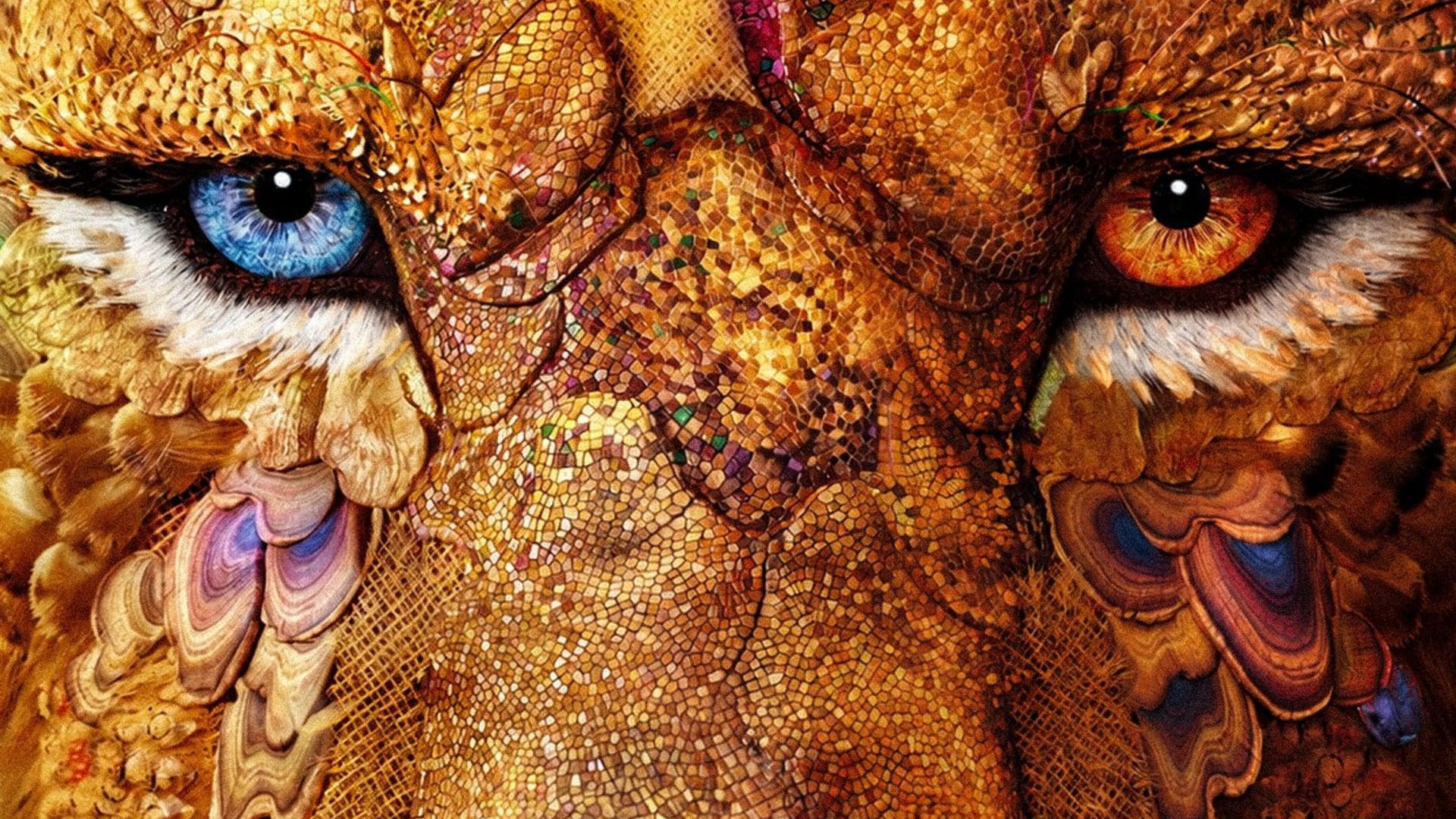
Gerwig's decision to cast Streep makes a lot more sense, though, in light of the first image of Aslan. This version of Aslan is influenced more by David Bowie than traditional portrayals of Aslan; he has multicolored eyes, feathers, and a red-striped face. Lewis chose a lion for Aslan because of a common Biblical name for Jesus ("the lion of the tribe of Judah"), but Gerwig's seems reminiscent of visions of angels in Biblical books like Daniel and Ezekiel.
Fundamentally, Gerwig is deliberately trying to give Aslan a very different "feel." This isn't Aslan as you've seen him before, a CGI lion roaring as he creates the world; he's designed to look like he's somehow beyond any created thing, as though lions are just the faint image of what he really is. It's a distinctive approach, very much fresh and original, but it's easy to see why some viewers are shaken by it. They grew up with Aslan, and the idea of changing how Aslan "feels" on such a fundamental level disturbs them.
Gerwig's Narnia Draws On David Bowie As Much As Narnia
Gerwig's Narnia doesn't just draw inspiration from Lewis; she considers it inspired just as much the music of David Bowie and The Who. "David Bowie saved my life," she told Empire. "Paul McCartney saved my life. Jimmy Page, Robert Plant. When I heard their music, I had this deep sense of [thinking], 'You're gonna be OK.'" Lewis wasn't hostile to popular culture, and may well have been fascinated with Bowie's use of mythology, but there would definitely have been a tension had the two overlapped enough for him to comment.
Empire's first images show just how important the Bowie influence really is; they include a glimpse of Emma Mackey as Jadis, a witch-queen from one world unwittingly transported to Narnia. Gerwig's adaptation is definitely taking very different approach, because The Magician's Nephew describes her as a towering woman dressed in royal robes. Understandably, this change has inspired some discussion online.
Gerwig's The Magician's Nephew Totally Changes Narnia's Timeline

It's easy to see why Narnia: The Magician's Nephew has been so controversial. In most cases, though, it's possible to figure out why changes have been made — even if not everybody is convinced. The problem, though, is that there's one last major change to the book: so far, every glimpse of the set seems to suggest this adaptation is set in the 1950s. Lewis' original version was set in the early 1900s, so this is quite a significant adjustment.
The timeline is also very important. The Magician's Nephew features a boy named Diggory, who grows up to be an adult professor in The Lion, the Witch and the Wardrobe. That story is explicitly set during the Second World War, because its child stars have been evacuated from London during the Blitz. If Gerwig's The Magician's Nephew is set in the 1950s, then her version of The Lion, the Witch and the Wardrobe would probably be sometime around the 1990s. The whole timeline has been changed.
Gerwig hasn't addressed this. In truth, viewers probably won't know why she's made it (let alone whether it works or not) until after The Lion, the Witch and the Wardrobe is made, so this particular point of contention will only be resolved should a sequel happen. As expensive as Netflix's Narnia reboot may be, don't expect Gerwig's Narnia to become any less controversial anytime soon.
Narnia: The Magician's Nephew will be released in theaters on Friday, February 12, 2027, and on Netflix on April 2.
- Release Date
- February 12, 2027
- Director
- Greta Gerwig
- Writers
- Greta Gerwig, C.S. Lewis
- Producers
- Mark Gordon, Amy Pascal, Rachel O'Connor
Cast
-
Jadis / The White Witch
-
Aslan (voice)
-
Carey Mulligan
Mabel Kirke
-

David McKenna
Digory Kirke
KioskNews shows a cleaned-up reading view extracted from the publisher’s page — the original always lives on their site, not ours.