The 10 Best Monster Movies in Film History

William likes watching movies and writing about those movies. Anything else is minutae.
Sign in to your Collider account
For October, the month when monsters are at their most prevalent, plastered all over cereal boxes and as a healthy portion of the Halloween costumes worn by kids, there's no better time to watch some monster movies. Not just any monster movies either. While we might all have our own personal favorites or guilty pleasures featuring cheap, cheesy monsters like The Blob or Basket Case, there's no beating the best beasts around. The kings of the monsters, the princes of darkness and the most deadly predators known to man.
Whether they come from underground or outer space, are man-made or come from nature, the best monsters don't share any one origin. They come from silent classics, cult films and modern blockbusters and are brought to life with stop-motion, make-up effects, animatronics and CGI. These are the best monsters in film history, and they come from the best monster movies in film history.
'Nosferatu' (1922)

Vampires are some of our oldest monsters, going all the way back to folk tales told over campfires. They've continued to evolve in novels and in films, each of them adding their own new wrinkles to the mythology. Some cinematic vampires are less monstrous and more romantic, like Edward in Twilight or many renditions of Count Dracula. To find one of the most monstrous depictions of a vampire, you have to go back to one of the earliest film's with F.W. Murnau's Nosferatu. The iconic design of Count Orlok, along with the performance by Max Schreck, has influenced legions of ferocious cinematic vampires, in remakes and beyond.
Unofficially adapted from Bram Stoker's Dracula, the film follows the basic plot of that seminal vampire novel but makes plenty of changes, including introducing the concept of sunlight being fatal, which has since been adopted into most vampire media. Even though it's unlikely to scare most modern horror film fans, the film still features some haunting visuals and is dripping with atmosphere. Most of all, Count Orlok is still one of the most unnerving portrayals of the most famous vampire.
'Frankenstein' (1931)

If we're going to talk about vampires, we might as well extend a rotted hand to all the general undead as well. Ghouls, revenants or zombies. Whatever you call them, they're the starring attraction in many a monster movie. The modern zombie dominates here with sheer numbers, but by their nature, can tend to blend together. Night of the Living Dead, Re-Animator and Shaun of the Dead all stand out, but as a truly unique member of the undead, Frankenstein stands head and neckbolts above all others. James Whale's iconic adaptation of the Mary Shelley novel is a true horror classic, and Boris Karloff's monster has become even more definitive than Count Orlok.
Removing the framing device of the novel, as well as a good chunk of the creature's story and development, the film reduces Karloff to grunts and moans to convey his emotions, but damned if he doesn't give an award-worthy physical performance. Without a single word, he's able to make the monster both threatening and pitiable. He's the ultimate sympathetic monster, and one of the few of the Universal Monsters who makes you root for him when the villagers start lighting their torches and grabbing their pitchforks. Frankenstein isn't evil, he was just reanimated that way.
'King Kong' (1933)

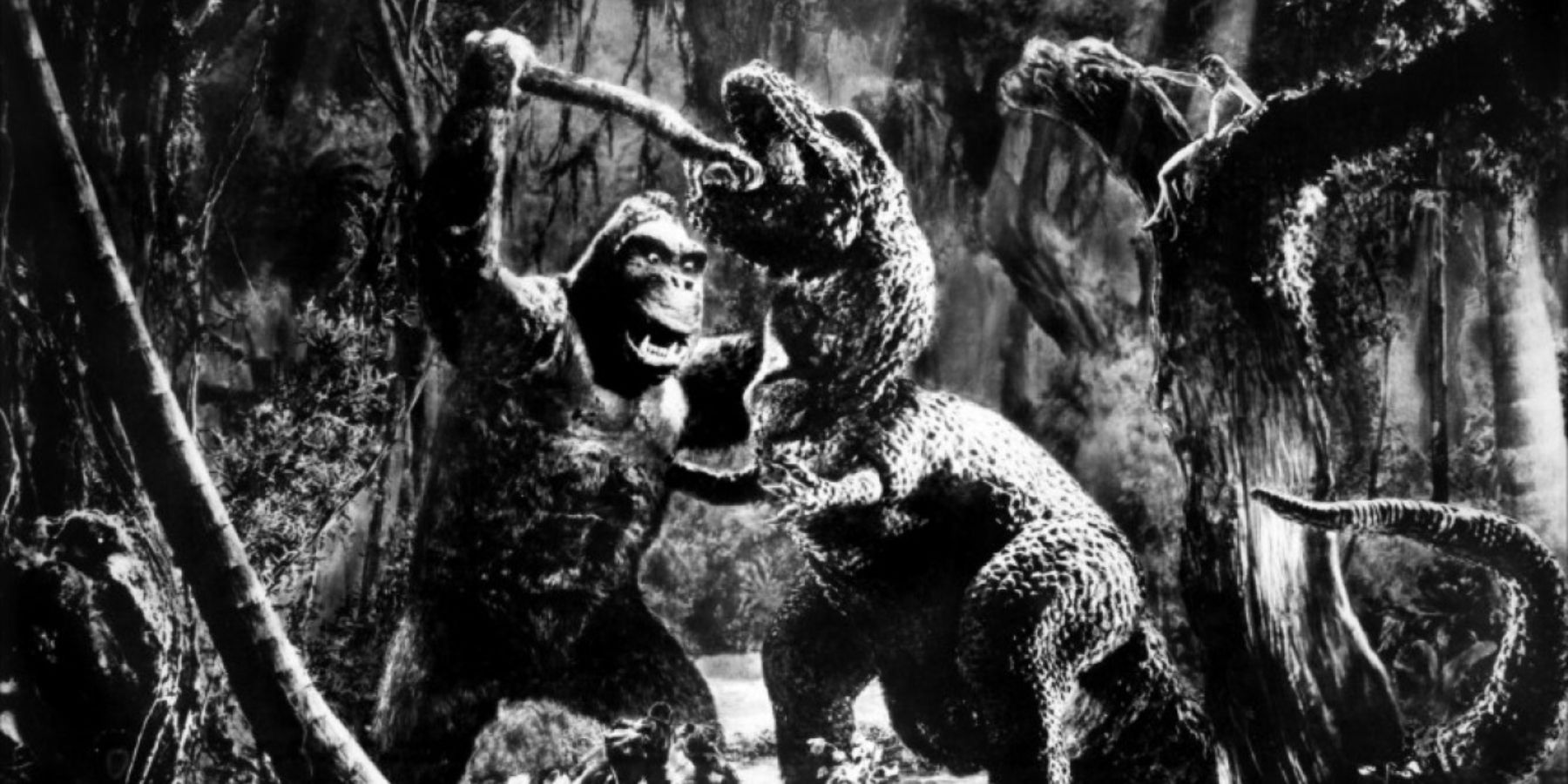
Frankenstein is far from the only monster who didn't deserve such harsh treatment at the hands of man. Just as he was unwillingly brought back to life, so was King Kong taken from his home and treated like an attraction. You can hardly blame the guy for breaking loose, grabbing Fay Wray and climbing to the top of the Empire State Building. He's had a rough go of it. The legendary ape was brought to life by the legendary Willis O'Brien for the Merian C. Cooper and Ernest B. Schoedsack adventure classic. O'Brien, who would later mentor monster-making legend Ray Harryhausen, imbues Kong with humanity, making him more than just a monster.
Almost every scene in King Kong is iconic, from the first sighting of Skull Island, to Kong's reveal behind a gigantic door, to his rumble in the jungle with a Tyrannosaurus Rex. While the depiction of many of the human characters hasn't aged well, Kong's greatness has only grown. He inspired generations of giant monster movies and prehistoric terrors. There is no Jurassic Park without King Kong, and there's no complete list of the greatest monster movies without him either.
'Godzilla' (1954)

The most iconic kaiju to be inspired by Kong is the one who also stole his title to become King of the Monsters. It's the absolutely atomic Godzilla. Though he's grown to become a cultural icon in Japan and experienced massive worldwide popularity, the original film featuring Godzilla is a much darker origin story. As a representation of nuclear destruction, the character carried heavy weight for Japanese audiences, coming into theaters less than ten years after the bombings of Hiroshima and Nagasaki. In America, the film was edited to reduce those themes, and actor Raymond Burr was inserted as an audience surrogate, but the original film still has tremendous power.
Godzilla is an ancient creature, awoken from his slumber by hydrogen bomb testing, and unleashed upon the world at large stomping his way through islands on his way to the Japanese mainland. The destruction in the film was meant to evoke the destruction wrought by World War II. While the model work may look quaint by today's standards, it's still got a sometimes chilling effect, as does the tragic ending. Even though that ending would be undone almost immediately for the sequel and Godzilla would quickly get recast as a hero, there's something special to when he gets to be the monster.
'Jaws' (1975)

Some monsters need not be of supernatural, scientific or legendary origin. Nature provides plenty of predators that scare us to death. While the reality is that humans pose a far greater threat to any animal species than they do to us, the opposite can be monstrously entertaining. Insects, birds, dogs, wolves, bears, snakes and alligators have all been the stars of their own monster movies, but the greatest of all is the great white shark that terrorized Amity Island in Steven Spielberg's Jaws. The director may be the best at creating a sense of wonder about the world, but he's also got a knack for making it seem utterly terrifying.
Beginning with Duel, Spielberg demonstrated an innate ability to imbue a sense of inherent evil within a character. In that case, it was a semi-truck. For Jaws, the young filmmaker does it with a shark that begins to chomp on island locals, making life a living hell for Roy Scheider's Chief Brody. The mechanical shark used in Jaws notoriously malfunctioned in the salt water, leaving Spielberg with no other option but to find ways to suggest the presence of the shark without actually showing it. That was a blessing in disguise, since the film's shots from the shark's perspective, accompanied by John Williams' iconic score, instill far more dread than any animatronic ever could. It's that dread that makes Jaws Spielberg's best monster movie.
Collider Exclusive · 8 Questions · 2 Minutes What Is Your Biggest Horror Nightmare? Elm Street · Chucky · Scream · The Conjuring
Four horror franchises. Four completely different ways of scaring you. One waits until you fall asleep. One makes sure nobody believes you. One is already in your group of friends. And one is in the house with your family. Answer eight quick questions about how you actually watch horror, and find out which nightmare was built for you.
😴Elm Street(Freddy Krueger)
🧸Chucky(Child's Play)
📞Scream(Ghostface)
🕯️The Conjuring(The Warren Files)
01
Which horror scene makes you cover your eyes? Four classic images. One of them is worse than the others for you.
02
You are home alone and you hear a noise. First thought? Everybody has one. It arrives before you have decided anything.
03
Which horror movie rule would you break first? Everybody thinks they would survive. Almost nobody actually does.
04
Something genuinely frightening happens. What do you do? Not in a film. In your actual living room, tonight.
05
How do you actually watch a horror film? Be honest about this one. Nobody is checking.
06
Somebody offers you serious money. Which do you still refuse? The amount does not matter. There is one on this list you are not doing.
07
Which feeling stays with you a week after the film? Good horror does not stop when the credits do.
08
Something wakes you at 3am. What is the worst possibility? Eight questions in, this is the one that decides your nightmare.
The Lights Just Went Out Your Nightmare Is…
Four franchises, four completely different ways of getting underneath your skin. This is the one built out of your particular fear, why it works so well on you, and what it would leave behind.
Elm Street
Your nightmare does not wait outside the door. It waits for you to close your eyes, which you are going to have to do eventually, because nobody has ever won that particular argument.
- Freddy is horror's cruellest idea: a threat that lives in the one place you cannot guard, cannot lock, and cannot avoid forever.
- You are the one who is fine during the film and wide awake at two in the morning. Your own head is where this does its damage.
- These films understood exhaustion as a horror engine. The kids on Elm Street do not lose because they are weak. They lose because they are tired.
- You can lock every door in the house. You still have to sleep.
Chucky
Your nightmare is not really the doll. It is the face of the person you tell, and the way they decide, very kindly, that you have imagined all of it.
- Chucky works precisely because he is absurd. That is the trap: the more accurately you describe him, the less anybody is going to believe you.
- You are the one shouting at the screen because the characters are not listening. You know that feeling from real life too.
- The franchise is at its best when the adults in the room are the real obstacle, and you have met those adults.
- By the time somebody finally believes you, you will have handled most of it on your own.
Scream
Your nightmare has your number, knows your name, and has almost certainly been inside your house before. The worst part is that you already know them.
- Scream is the only one of these where the killer takes the mask off and turns out to be somebody who was at the party.
- You are the person who calls the twist out loud before it lands. You watch people the same way you watch films.
- The franchise made the rules of horror part of the plot, which means the survivors are the ones paying attention. You would be paying attention.
- Everybody is a suspect, including the person who just offered to walk you home.
The Conjuring
Your nightmare is not really about you. It is about the people asleep down the hall, and the feeling that whatever is here is not interested in leaving.
- The Conjuring films are domestic horror. The house, the family, the perfectly ordinary room that quietly stops feeling ordinary.
- Your instinct is to get everybody into one room. Your fear is protective rather than personal, which is rarer than it sounds.
- This is the one franchise where belief is the weapon. The people who come through it are the ones who are not alone and refuse to be.
- Whatever is here did not come for you. It came for the household, and you are the one standing in the hallway.
'Alien' (1979)

Extraterrestrials have been popular movie monsters for decades. After audiences' fear began to drain for the classic gothic monsters, aliens arrived alongside their atomic monster contemporaries to inject it right back in. They still represent a fear of the "other" that was exploited by filmmakers for box office success in all sorts of invasion movies and space horror. In the early days, the effectiveness of the effects left a lot of fear to the imagination, but there's no need to imagine any horror in Ridley Scott's Alien. It took a B-movie premise and amped it up with A-level designs and the most terrifying E.T. ever put on film, making it the ultimate experience in grueling space horror.
The film began life as an egg of an idea by writer Dan O'Bannon, looking for a healthy host, which it found at 20th Century Fox, who were in search of their next sci-fi hit after Star Wars. After getting implanted in the studio with a bigger budget to feed off, the film took on the traits of its hosts, which included producers Walter Hill and David Giler, who gave the script a blue-collar makeover, creature designer H.R. Giger, whom O'Bannon had brought in based his biomechanical nightmare artwork, and Scott, whose brought a keen sense of visuals and dread. Add in a talented cast of established character actors and new talent, and Alien chestbursted out into the world as a pure creation of cosmic horror.
'An American Werewolf in London' (1981)

Alien was at the precipice of the practical effects boom that would define the monster movies of the 80s. With a new generation of creature effects artists, filmmakers could unleash all kinds of new nightmares on screen. For many, this meant returning to the classic monsters of their youth and giving them a full-blooded rebirth. Vampires became gnarly nomads in Kathryn Bigelow's Near Dark, The Fly became a tortured, decomposing Jeff Goldblum, and lycanthropes became quadripedal killers in John Landis' An American Werewolf in London.
Inspired by an experience he had watching a bizarre funeral in Yugoslavia, Landis wrote An American Werewolf in London to be a modern take on a classic monster. The characters in the movie are well aware of werewolf lore thanks to movies like The Wolf Man, the tropes of which are all subverted in the story. Most memorably, the film depicts the transformation into a werewolf with excruciating detail. It's a painful process made all the more palpable by the effects designed by the legendary Rick Baker, who won the inaugural Academy Award for make-up effects for his efforts.
'The Thing' (1982)

If it weren't for Baker and An American Werewolf in London, more people might have been praising the werewolf effects in Joe Dante's The Howling, which came out the same year. Those effects were the work of Baker's apprentice, Rob Bottin, who would become even more infamous the following year. Director John Carpenter was returning to one of his favorite monster movies of his youth, The Thing from Another World, and needed a new version of the monster that would redefine terror. The Thing is a pillar of practical effects, but more than that, it's Carpenter's masterpiece, going beyond mere monster movie scares to tap into a pessimistic paranoia that's still potent and petrifying.
Instead of a straight remake of the Howard Hawks-produced original, the film uses the original source material, the novella Who Goes There? by John W. Campbell Jr., as its basis. That's where Bottin's effects came in, since the invading alien that crash lands in Antarctica in the novella is a shapeshifter who can imitate any living creature. The Thing is no man in a suit, like Alien. It's a constantly shifting, nightmare creature made up of teeth, tentacles and any other appendage it can grow. The gruesomeness of the effects, and the film's bleak tone, made it hard for critics and audiences to deal with in 1982. Only three years after Alien, they were ready for something more hopeful, like Spielberg's E.T. the Extra-Terrestrial, which had released only two weeks earlier.
'Tremors' (1990)

By the end of the 80s, a dozen new creature effects had been established to meet the demand for movie monsters. Digital effects were still in their nascency, and were still more than a decade away from completely taking over. This meant when the filmmakers behind Tremors, a 50s monster movie upgraded for 1990, needed someone to create the film's subterranean terrors, they turned to the newly formed Amalgamated Dynamics. Founded by Alec Gillis and Tom Woodruff Jr., who had worked under Stan Winston on films like Aliens, the effects house was ready to leave their own mark on monster movies with some giant desert worms.
As written by S.S. Wilson and Brent Maddock, and directed by Ron Underwood, Tremors brings a healthy sense of humor to its B-movie premise of ancient worm monsters, later dubbed Graboids, that begin to terrorize the residents of a small desert town in Nevada. Led by Kevin Bacon, the cast is all game for finding plenty of laughs in the film, but the monsters themselves are no joke. Brought to life with a variety of techniques, including hand puppets, miniatures and full-size animatronics, the Graboids are some of the most underrated of all movie monsters, just as the movie itself was. A box office bomb, Tremors became a hit on home video, leading to multiple direct-to-video sequels that have carried on its monster movie legacy.
'The Mummy' (1999)

Vampires, zombies, werewolves, kaiju, aliens and giant worms. The only monster missing is a mummy. While the Universal original starring Boris Karloff may have established the bandaged baddie, and its many sequels cemented his image as a slow, shambling member of the dry undead, it's the 1999 remake which resurrected him for audiences that's become the standard. Stephen Sommers' The Mummy may be more of an Indiana Jones adventure movie, but its monster is still front and center, brought to life with a variety of techniques of which CGI is the most prevalent. Digital monsters may not have the same visceral effect as their practical cousins, but when employed correctly, they can be just as creepy.
There are certainly some moments in The Mummy that harken back to the character's horror origins, such as when he takes the eyes and tongue of one of the unfortunate souls who made the mistake of waking him up. It's moments like that which set the film apart from its bloated sequels, which put far more emphasis on CGI setpieces. The Mummy is an adventure romp that occasionally tips into horror, but it's undeniably entertaining thanks to a tremendous cast, which includes Brendan Fraser and Rachel Weisz as the hero and heroine, and Arnold Vosloo as the titular monster.
KioskNews shows a cleaned-up reading view extracted from the publisher’s page — the original always lives on their site, not ours.