Canada the 10th smartest country in the world, well ahead of U.S., study finds
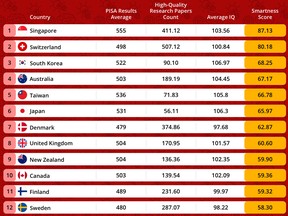
A report on “global intelligence” has placed Canada 10th in a list of 80 countries that were analyzed, eight places ahead of its neighbour the United States, but trailing the U.K., Australia and first-place Singapore.
Sign In or Create an Account
The report was produced by TradingPlatforms, a financial comparison website.
To create its ranking, researchers combined several pieces of information. One was data from the Programme for International Student Assessment (PISA), an international study by the Organisation for Economic Co-operation and Development (OECD) that tests the skills and knowledge of 15-year-old students in various countries.
They also looked at the per capita publication of high-quality scientific publications last year, and the average IQ scores from the International IQ Test, a website that has been active since 2018 and gathered more than 1.2 million scores last year alone.

Get a dash of perspective along with the trending news of the day in a very readable format.
By signing up you consent to receive the above newsletter from Postmedia Network Inc.
A welcome email is on its way. If you don't see it, please check your junk folder.
The next issue of NP Posted will soon be in your inbox.
We encountered an issue signing you up. Please try again
Canada’s PISA scores were relatively high, and it placed 6th in the number of scientific publications and 18th when adjusted for population. Its IQ averaged 102.09, putting it in 11th place in that category among a cluster of countries with scores between 102 and 103.
Combined, these figures gave Canada a “smartness score” of 59.36 and a ranking of 10th place. Singapore topped the list with a score of 87.13, while New Zealand (59.9) and Britain (60.6) narrowly edged out Canada.
The United States was 18th with a score of 53.88 and trailed Canada in all the categories. Although it remains the world leader in scientific papers published, it drops to 23rd place in that category when adjusted for population.
Canada actually scored its worst-ever PISA numbers in 2025, but remained ahead of the OECD average, which has also been dropping.
“The teenagers performed particularly well in science, scoring 510 points, while mathematics and reading scores stood at 485 and 490, respectively,” the study noted. “Canada also scored 525 points in the new computational problem-solving assessment, which measures students’ ability to use digital tools to solve problems.”
It added: “Canada is undoubtedly a scientific powerhouse, with its institutions producing 5,647 high-quality scientific publications in 2025, (but) while this remains a strong result, it falls well below the elite levels produced by Switzerland (507.12), Singapore (411.12) and Denmark (374.86).” Canada’s per-capita publication rate was 139.54.
China was excluded from the ranking, the study noted, in part because the OECD only tests a subset of Chinese provinces and municipalities, “which cannot be reliably compared to whole-country results elsewhere in this dataset.”
Canada has recently made a push to attract researchers from the U.S. and elsewhere, with more than $500 million in government funding behind the move, which brought 64 scientists into the country.
Diliana Hristova, a data analyst behind the study, lauded that move as a smart way to turn the uncertainty surrounding U.S. universities and research funding under the Trump administration into an opportunity. But there is an obvious question hanging over the move: Why is a country with such a strong higher education system having to go abroad for talent in the first place?
She added: “Canada already produces the sixth-highest volume of scientific research among the 80 countries we analyzed, yet it has spent years losing talented researchers in fields such as AI and quantum computing to better-funded labs overseas.
“Recruiting 60-odd scientists will undoubtedly add firepower to Canada’s research base, but it does not solve the problem that created the talent gap in the first place. If Canada wants to compete at the highest level in science, it needs to make staying just as attractive as coming.”
Our website is the place for the latest breaking news, exclusive scoops, longreads and provocative commentary. Please bookmark nationalpost.com and sign up for our daily newsletter, Posted, here.
Join the Conversation
This website uses cookies to personalize your content (including ads), and allows us to analyze our traffic. Read more about cookies here. By continuing to use our site, you agree to our Terms of Use and Privacy Policy.
KioskNews shows a cleaned-up reading view extracted from the publisher’s page — the original always lives on their site, not ours.