How Port Said’s Fishing Community Is Shaping Sustainable Fashion
There are two Fs in Port Said: fishing and fashion. Two industries, two worlds, and countless human lives between them.
At first, they seem to belong to different worlds. The sea and the street, the fishermen who cast their nets into the Mediterranean, and the workers whose hands bring garments, fabrics, and trade to life. And yet, in Port Said, these two worlds have always been closer than they appear.
Two enduring trades that, together, tell the story of a place and the people who call themselves Port Saidians.
Both industries represent the changing treasures of the city. The same climate that is transforming the sea is also unsettling the industries and livelihoods that have long depended upon it. And behind these changes are the lives of the fishermen drawing their lives from the water, and workers whose hands sustain the city’s trade and manufacturing.
Born into a family of fishermen and fashion designers, Moemen Sobh, founder of Visenleer, a social enterprise that turns ocean waste into sustainable textiles, grew up with a Port Saidian soul that looks at both the sea and textiles through one eye.
His family history was written by the sea, as his parents, grandparents, and great-grandparents all lived and worked in Port Said; fishing became so embedded in his sense of self that he describes himself as a fisherman before an engineer or an entrepreneur.
“I call myself a fisherman before calling myself an engineer,” he told Egyptian Streets. “It’s something that is within my identity.”
Even his grandmother, a fashion designer nearing ninety, still works to this day. Her hands are guided by a lifetime steeped in Port Said’s identity as a legendary hub of fashion and global trade.
Living between these worlds, Sobh encountered the effects of climate change as a real crisis that finds its way into conversations at the family dinner table.
Now, through a project that brings together 1,800 local fisherfolk and transforms discarded fish skin into a textile material, he is seeking to bridge two worlds: the fishing communities of Port Said and the global fashion industry.
With support from the Swarovski Foundation’s Creatives for Our Future programme, Visenleer has already successfully upcycled 60,000 fish skins and diverted 20 tonnes of ocean-bound plastic. The brand is set to unveil its first full fashion collection this October.
Living Through Climate Change
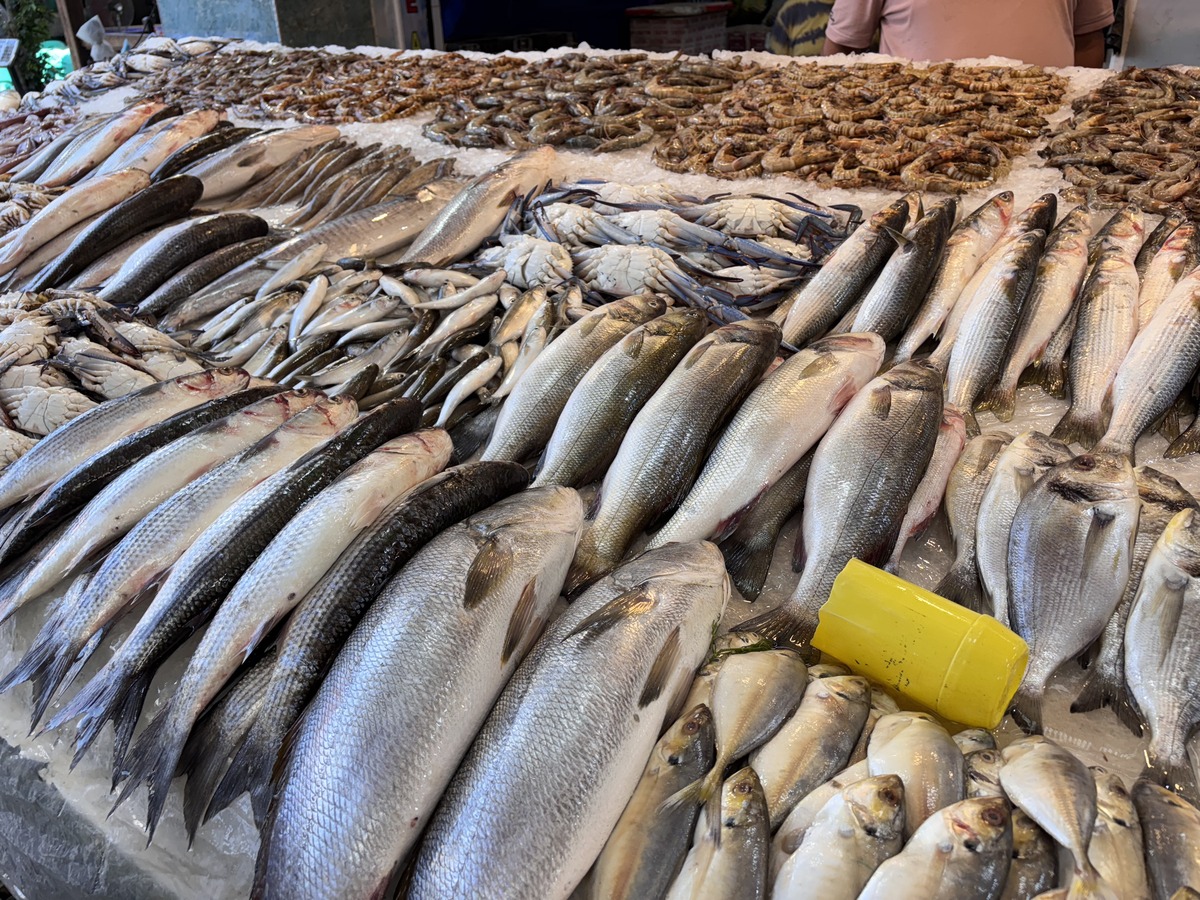
Port Saidians eat their fish with all of their heart, because the sea has never been simply a place beside them; it has always been part of who they are. The fish on their tables carries with it a relationship to the water, to generations of fishermen, and to a city whose life has long followed the waves of the sea.
Sitting uniquely at the crossroads of the Mediterranean Sea and the Suez Canal, Port Said is widely celebrated as one of Egypt’s ultimate culinary capitals for seafood. Because of its geographic convergence of both the saltwater of the Mediterranean Sea and brackish ecosystems of the nearby Lake Manzala, the city boasts an incredible variety of fish.
While the bolti fish (tilapia) is found all over Egypt, the bolti from the Port Said region holds a special reputation. Much of the local tilapia comes from the nutrient-rich, brackish waters of Lake Manzala, giving the fish a distinct, sweet flavor profile compared to purely freshwater farmed varieties.
However, Port Saidians do not only eat the fish; they follow it. They know its movements, its seasons, its disappearance and return, and through it they witness the changing sea around them.
As the climate changes, the fish change too, such as their routes, their abundance, and the conditions in which they live, and these shifts become visible in the everyday lives of the people who depend on them.
For fishermen in Port Said, changes in the sea are increasingly visible in the amount and quality of fish they are able to catch. The fishing environment has become more uncertain, with fishermen describing a dramatic decline in their catches over recent years.
In 2022, Sobh began spending time at the fishing hub and market in Port Said, where he started speaking directly with fishermen about the realities they were facing.
“The only thing that I did was I took my notebook, I took a camera, and an open heart and open ears, and just went there.”
For more than four months, he returned to the fishing market almost every day. The process became less about a single visit or a single conversation, and more about building a relationship with the community and understanding the challenges
“We’ve seen a genuine decline in the output of fishing that we do have. For example, if we were able to catch 100 kilograms back in 2017, right now we’d catch only 20 kilograms. And it’s a drastic change. But we’re also talking about the quality of the fish,” Sobh explains.
Fishermen are also witnessing changes in the species that inhabit the waters around Port Said. Some species that were once familiar and regularly harvested have gradually disappeared, while pressures from intensive fishing further reduce fish populations before they have had the chance to reproduce.
“We’ve seen how at least 12 species, very native species that we used to harvest from Port Said, disappear slowly,” Sobh notes.
“And then the second thing is overfishing. There are a lot of big companies and big fisheries that would usually harvest fish in the very early stages of the fishing cycle, or during the fish cycle itself.”
Overfishing places additional pressure on an already changing marine ecosystem. For small-scale fishermen, who depend directly on these local fish stocks, the consequences are particularly immediate. Fewer fish mean smaller catches, lower incomes, and greater uncertainty about the future of their livelihoods.
Pollution has become another visible threat to the marine environment and to the communities that depend on it. Oil spills and marine pollution can directly damage coastal ecosystems while making fishing areas less productive and less safe.
“We’ve seen in 2022 and 2023 at least three oil spills in Port Said. And one of the things that I remember is when I went that day to the shore in Port Said, I saw kids coming out of the Mediterranean covered in oil. It was a major news alarm for us,” he adds.
The environmental pressures facing fishermen are not caused by climate change alone. They are also intensified by the waste produced by other industries, including fashion and textile manufacturing. In Manzala Lake, one of Egypt’s most important fishing environments, industrial waste has become part of the broader ecological problem.
“In Manzala Lake, we’ve seen that some of these big manufacturers usually dump their waste in the lake,” Sobh says. “A lot of Egyptians, including me, didn’t know that even in Manzala Lake, we have over 600 islands.”
Manzala is home to hundreds of islands and to communities that have lived and worked there for generations. Their knowledge of the lake comes from an intimate relationship with its waters, and visiting these communities allowed Sobh to see the environmental problem from the perspective of the people experiencing it directly.
“There are native communities that live there, that were born there. And working with them, it was quite crazy because you would go through the islands with a very small boat. It’s a fascinating place to be at.”
An investigative report revealed that wastewater from the Bahr al-Baqar drain has historically carried human, agricultural, and industrial pollution into the lake. Fishermen interviewed describe the water becoming dark and fish dying, while industrial wastewater is also described as contributing to major fish kills
For Sobh, witnessing the human consequences of environmental change created an urgency to act sooner and to find a connection between these worlds rather than allowing them to remain separate.
The Potential of Fish Skin
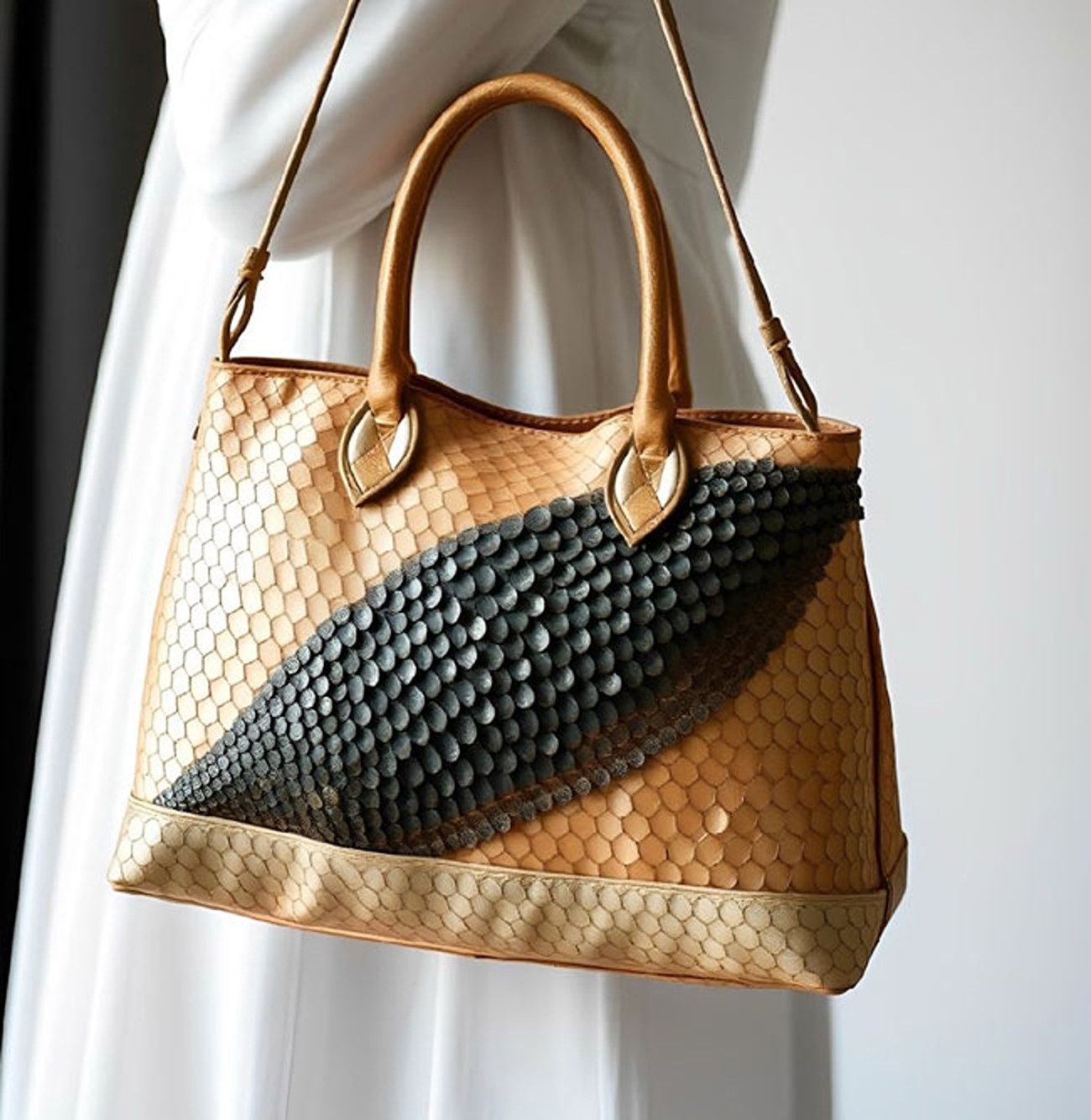
The connection between these two industries emerged through one unexpected material: fish skin.
Every week, the fishing market in Port Said produces tons of discarded material, much of it coming directly from the fish themselves.
“In Port Said, we produce more than 10 tons of fish waste every single week,” Sobh explains. “That includes the guts, the skin, and any kind of biological waste. It’s more than 10 tons of discarded waste that we can absolutely use.”
Rather than seeing this waste as something without value, Sobh began to look at it as a resource. The idea was to reconsider what is thrown away and ask what could be created from it.
“I call fish waste, or waste in general, the gold of the 21st century. It’s something that’s always discarded, but you can also create beautiful things out of it.”
The goal was not simply to reuse fish skin, but to create an alternative to materials that carry their own environmental costs.
The project for Visenleer began to take shape as an alternative approach to textile production, one that draws from biological materials and the forms already found in nature.
“We wanted to create a new alternative for the textile industry that is focused on biomimicry and on the biological life that we have,” Sobh explains.
There was also a practical consideration, such as creating a material that could compete with conventional textiles while reducing reliance on materials such as nylon.
“Instead of buying a nylon sheet, you can buy a fish-skin sheet that really does protect the environment.”
Under the project, trees are also planted using fish waste as a fertilizer. The ambition is to go beyond simply balancing emissions and instead create a process that actively removes more carbon than it produces.
“For every 20 square meters of fish skin that we sell, we plant a tree,” Sobh says. “Even though our process does not produce carbon dioxide, we want to be carbon negative, not even carbon neutral.”
From Waste to Income
What was once thrown away can now return something to the people who caught it. By paying fishermen for the waste that comes from their daily catch, Visenleer has begun to turn something with no economic value into an additional source of income.
“The fishermen now earn more money by giving us the waste. Economically, we really want to create an incentive for them to help us reuse and reproduce the waste into something that is very valuable,” Sobh explains, noting that they make 30 percent more in profits.
Each batch in the system also has a Digital Product Passport that traces its origins, production journey, and social and environmental impact. The idea is that a garment could carry a digital identity that allows consumers to trace its journey, from the materials used to make it, through manufacturing and the supply chain, to the finished product.
The intention is not simply to take the waste away, but to create a reason for fishermen to see it differently, and to understand that what they discard can have another life, and that they can benefit from that life too.
The relationship has grown beyond the exchange of waste; it has also become an exchange of knowledge. The brand began working directly with fishermen, creating educational programmes around the sustainability of the fishing industry, such as knowing when a fish can be caught, when it must be left to grow, and when restraint today can mean abundance tomorrow.
“We would go directly to the fishermen that we already work with and tell them: this is the kind of fish that you’re harvesting right now. But this is the size that you would ideally harvest within that time. This is what you should not harvest,” he says.
Leaving smaller fish in the water gives them the possibility to return larger and in greater numbers the following year. According to Sobh, this has begun to produce visible changes in the catch, both environmentally and economically.
Once the waste reaches the brand, another part of the community enters the process: the fisherwomen, including the wives of the fishermen. The fish skin passes from the boat into another set of hands. The skins are sorted, the unusable material is removed, and what remains becomes the beginning of a new material.
The fisherwomen tan the usable skin at home, which became another point in the journey of the material, traveling from fish to waste to leather, and eventually, toward fashion.
Carrying the Identity of Port Said
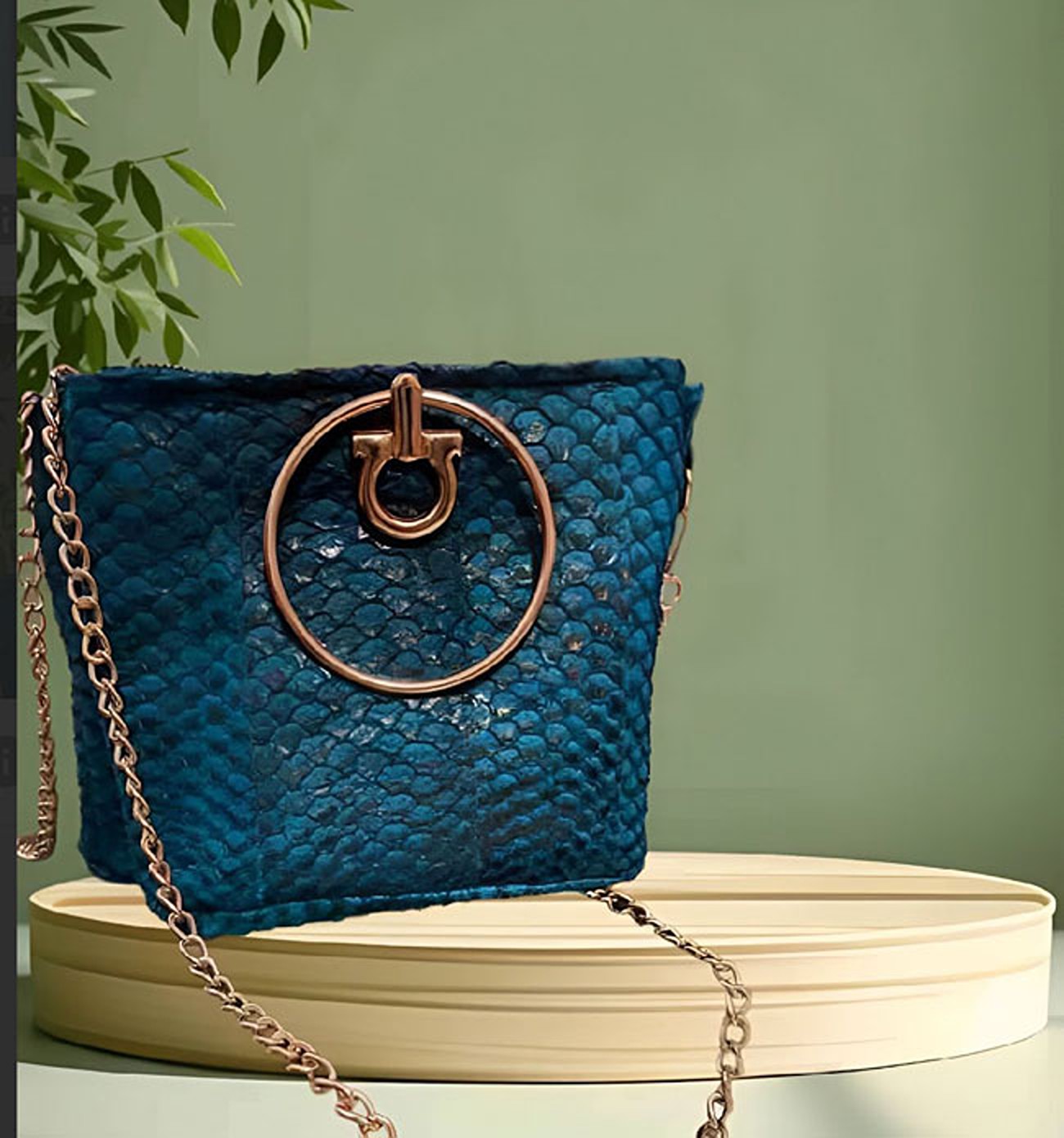
With its next launch in October, Visenleer is creating a collection of bags that carries the identity of Port Said through the fish itself. The designs draw on the texture and form of the fish, allowing the material to retain something of its origin.
His latest creation is a new bag called Arooq (veins), the most recent expression of his ongoing exploration of fish skin as a material.
The name carries a deeply personal history. Arooq is connected to Sobh’s maternal family and, in particular, to his grandfather, the fisherman who first introduced him to the fishing industry and taught him what it meant to belong to Port Said.
“He was the genuine introduction to me to what it means to become, or to be, a Port Saidi,” he says.
The personal connection now finds its way into the design of Arooq. The bag takes inspiration from Samak El Bolti (tilapia), the fish his grandfather was particularly known for, which is a species that becomes, through the material, part of the bag’s identity.
“I’ve learned a lot from him on the culture of Port Said, and I’m genuinely so grateful that he gave me the heritage and culture that would be the reason why I’m here today.”
KioskNews shows a cleaned-up reading view extracted from the publisher’s page — the original always lives on their site, not ours.