Allahabad High Court orders stricter checks after minor girl’s marriage registered in UP
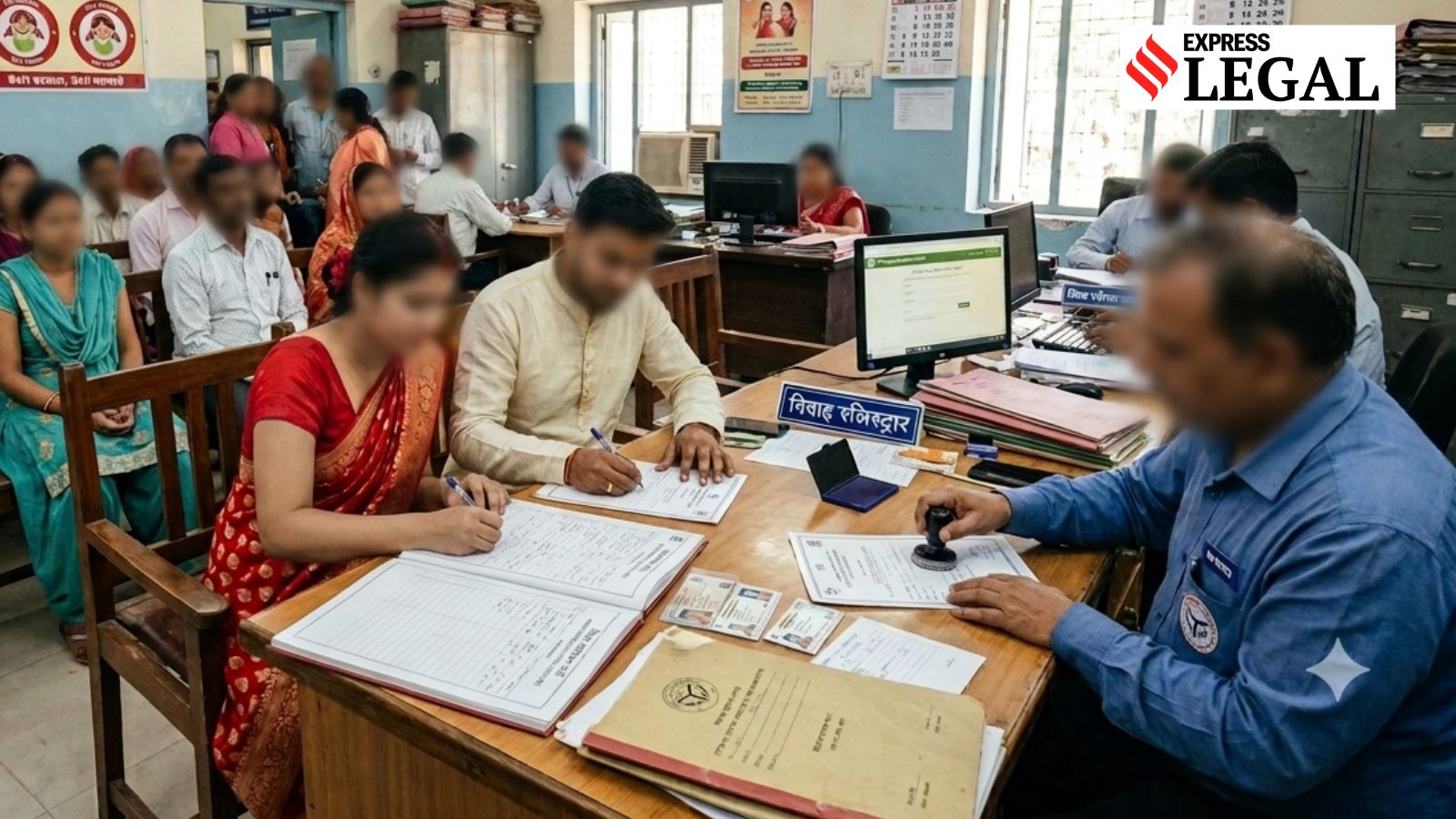
The court found the response of the marriage registration officer concerned unsatisfactory. (Image generated using AI)
Flagging it as a “serious concern”, the Allahabad High Court has ordered marriage registration authorities in Uttar Pradesh to mandatorily verify the age of couples before registering a marriage. The direction came after the court learnt that the Ghaziabad authorities had registered a marriage where the bride was a minor.
Justice Tej Pratap Tiwari, while hearing an appeal of a man in a case under the Protection of Children from Sexual Offences Act (POCSO), expressed serious concern over the registration of marriages involving minors.
“A matter of considerable concern emerges regarding the registration of marriages involving persons below the legally prescribed age. What is more disturbing is that such instances do not appear to be isolated or occasional, but have been noticed in a number of cases,” the court said on September 2.
 Justice Tej Pratap Tiwari pulled up the authorities over the marriage registration of a minor girl.
It noted that if a marriage registration officer registers a marriage of a child without verifying the date of birth, such omission cannot be treated as a mere clerical lapse but is a failure to discharge the responsibility attached to the office and calls for supervisory scrutiny and fixation of responsibility.
The court thus ordered that marriage registration authorities in Uttar Pradesh shall not register any marriage if, on the date of solemnisation, either party was a minor.
It further directed authorities to mandatorily satisfy themselves, based on reliable documentary evidence and prescribed verification, about the age of both parties as on the date of solemnisation. If the documents reveal that either party was below the statutory age, the registration application should not be processed as a routine matter. Instead, the matter must be brought to the notice of the child marriage prohibition officer and the competent district authority for appropriate action.
‘Matter of serious concern’: Court
The prosecution in this case had alleged offences under the Indian Penal Code, the POCSO Act and the SC/ST Act. The counsel for the accused told the court that the girl was an adult and that he had voluntarily married him, with the marriage subsequently registered and a certificate issued.
Story continues below this ad
The State, however, said that the trial court had found her to be a minor and that the marriage certificate could not establish that she was a major because it was allegedly obtained by concealing her age.
The court summoned the officer concerned to explain how the marriage of a minor girl had been registered. The officer said he had taken charge from the previous in-charge officer and had no knowledge of how the marriage had been registered.
Calling the response “a matter of serious concern”, the court noted that departmental instructions expressly require verification of the date of birth of both the bride and groom before registration.
“The inability of the officer or the office, to explain the circumstances in which the marriage of a minor was registered, prima facie reflects a serious failure of supervision, verification and accountability in the discharge of the statutory functions, entrusted to the Marriage Registration Officer,” it said.
Story continues below this ad
The court lamented that there was no evidence to prove any verification of the age of the parties was undertaken before registration of the marriage. It emphasised that the purpose of maintaining marriage registration records is not merely to preserve individual certificates but also to enable the State to ascertain demographic and social trends and to formulate appropriate policies and welfare measures.
“A system which fails to correctly identify child marriages cannot provide the State with a dependable basis for assessing the magnitude of the problem or for devising effective measures for its prevention and eradication,” the court said.
The court thus directed the authorities to follow its instructions and listed the matter for further hearing on October 5.

Ashish Shaji is a Senior Sub-Editor at The Indian Express (Digital), where he specialises in legal journalism. Combining a formal education in law with years of editorial experience, Ashish covers court developments and key cases for the audience. Expertise Ashish is a law graduate (BA LLB) from IME Law College, CCSU. His work at The Indian Express focuses on translating the often-dense proceedings of courts into clear, legal content. He also runs liveblogs from the Supreme Court and various High Courts. Industry Experience: With over 5 years in the field, Ashish has contributed to several niche legal and professional platforms, honing his ability to communicate complex information. His previous experience includes: Lawsikho: Gaining insights into legal education and practical law. Verdictum: Focusing on high-quality legal news and court updates. Enterslice: Working at the intersection of legal, financial, and advisory services. ... Read More
KioskNews shows a cleaned-up reading view extracted from the publisher’s page — the original always lives on their site, not ours.