Netanyahu, Eisenkot Fail To Seal A Deal, Israel Government Deadlock Stays
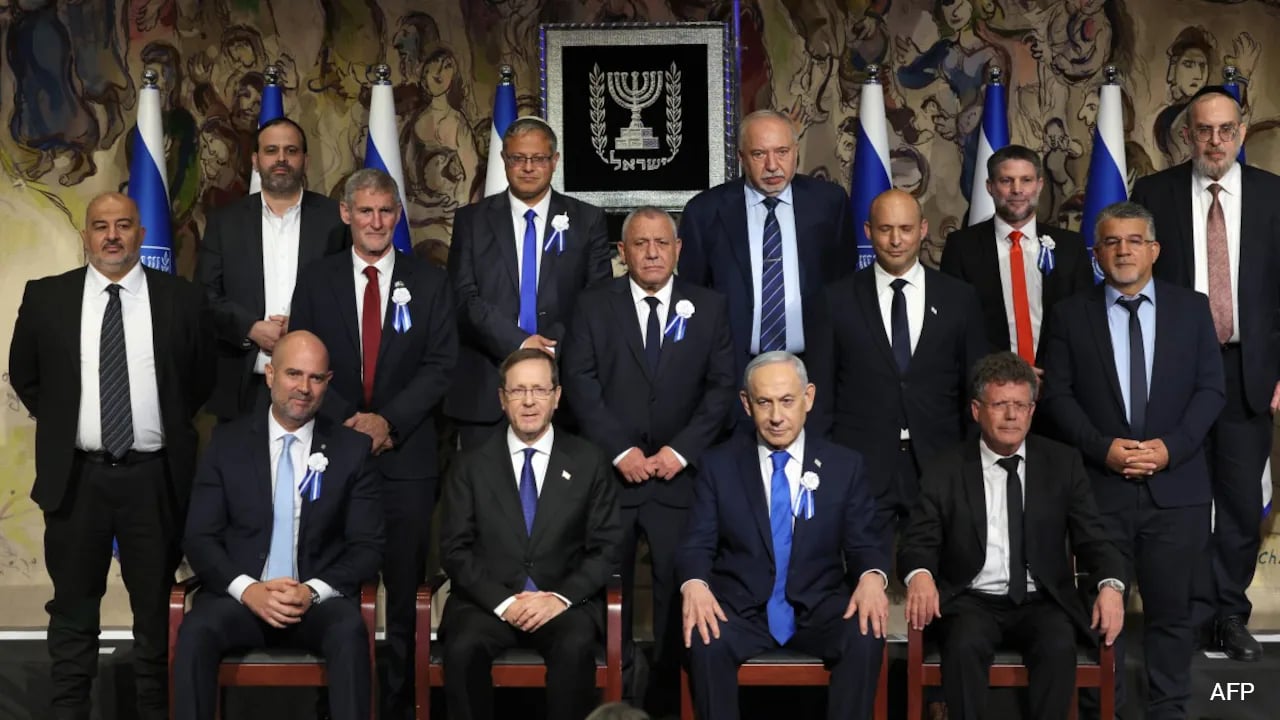
The parties of caretaker Israeli prime minister Benjamin Netanyahu and his rival Gadi Eisenkot concluded a new round of talks on Sunday without reaching an agreement on a possible coalition government, which would require concessions from both sides.
Delegations from Eisenkot's Yashar party and Netanyahu's Likud met for four hours at a hotel in Herzliya, near Tel Aviv, following a first round of discussions last Sunday.
"The latest round of coalition talks... has concluded. The two sides outlined their positions on a range of substantive issues and discussed them in detail," the two parties said in a joint statement.
"A follow-up meeting will be held," they added, without specifying a date or revealing any other details.
A former army chief of staff, Eisenkot has until December 6 to form a government, with the possibility of a 14‑day extension, after October elections failed to give either camp an absolute majority.
His 48-member bloc, which needs 61 lawmakers to reach a majority, remains divided over whether to build a coalition through an alliance with ultra‑Orthodox parties, a rapprochement with Arab parties, or a national unity government with Likud.
Netanyahu is pushing for a national unity government, which could see a rotation of the premiership between the two men, a mechanism already tried in Israel.
Such an arrangement could allow Netanyahu to keep his political protection against the corruption charges he faces, as well as continue to oppose the creation of an independent commission of inquiry into the security failures that preceded the Hamas attack of October 7, 2023.
But that prospect runs up against Eisenkot's refusal to serve in a cabinet led by Netanyahu, against whom he centred his campaign.
His ally Naftali Bennett, a former prime minister, also reiterated on Saturday his refusal to join a coalition with "Netanyahu or his bloc, under any circumstances".
National 'Unity'?
On Saturday, Yashar presented the resumption of talks as "a genuine commitment to forming the broadest possible government", saying that Eisenkot had asked his representatives to explore all options.
But Likud immediately laid down several conditions for its participation in a unity government, a formula backed by Netanyahu.
Among other things, it demands an end to "all personal attacks and incitement to hatred" targeting Netanyahu and his government.
It also called for bringing together "all the parties that support the existence of the State of Israel as the nation‑state of the Jewish people", without the participation of Arab parties.
Netanyahu and his allies regularly target Arab parties, which secured a record 19 seats in the legislature and are opposed to Netanyahu remaining in power.
Likud is also demanding agreement on several major policy positions, notably rejecting the creation of a Palestinian state, maintaining Israeli control over territories in Syria, Lebanon and the Gaza Strip.
It is also pushing for a compromise on conscription of ultra‑Orthodox Jews, a particularly sensitive issue in Israel.
On Friday, Eisenkot warned that he would not allow the talks to drag on, saying he was ready to submit to parliament an "emergency national government".
Although he did not spell out how, his statements suggest a two‑stage plan: the swift formation of a minority government based on the core opposition parties, and then broadening it.
A minority Eisenkot government could receive support from the 19 Arab party lawmakers but Eisenkot's right-wing ally Avigdor Liberman rejects working with them and instead advocates an alliance with ultra-Orthodox Jewish parties.
(Except for the headline, this story has not been edited by NDTV staff and is published from a syndicated feed.)
KioskNews shows a cleaned-up reading view extracted from the publisher’s page — the original always lives on their site, not ours.